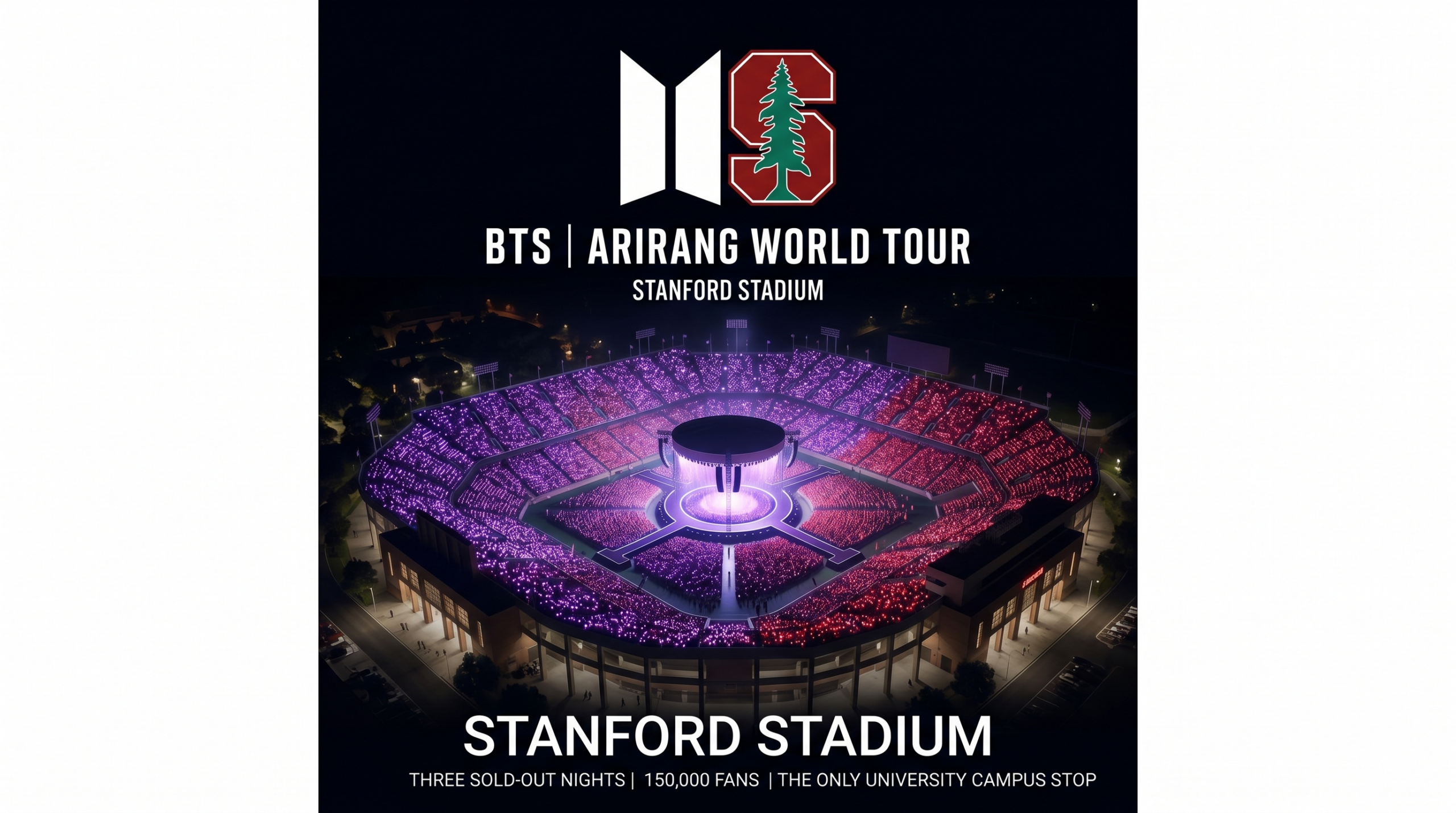
The last time BTS performed as a full group in the Bay Area, it was 2018. Eight years, a global pandemic, and one mandatory military service later, they are back — not at a conventional arena, but at Stanford Stadium, a 50,000-seat university venue that has hosted exactly one other musical act in its history. Three sold-out nights. 150,000 fans. And a university that decided, deliberately, to let this happen on its campus.
This stop is different from every other date on the ARIRANG World Tour. Not because of the numbers — Las Vegas is bigger, and the MetLife Stadium run will draw more total attendees. It’s different because of what it represents: a world-class research university treating a K-pop concert as a legitimate cultural event, worthy of the same institutional seriousness it brings to academic conferences and distinguished lectures.
Why Stanford, Why Now
Stanford Stadium has hosted one musical act before BTS: Coldplay, whose Music of the Spheres World Tour played two sold-out shows there last year. The venue’s director, Jed Nemani, was direct about the university’s approach in a statement to the Stanford Report: “We’re not going to become a stadium venue that’s going to do 100 concerts a year. But when we have very special artists like BTS… the university has decided to say yes.”
Stanford Live and Stanford Athletics co-presented the shows in conjunction with Live Nation — an unusual arrangement that reflects how seriously the institution treated the booking. The university’s vice president for the arts, Deborah Cullinan, framed the moment plainly: “BTS is one of the biggest bands of all time, so being able to say ‘I was here for that’ is pretty special.”
The Stage — 360 Degrees, No Bad Seats
Every stop on the ARIRANG World Tour runs a 360-degree in-the-round stage — a design decision that sets this tour apart from almost every major stadium run in recent memory. There is no true “back” section at Stanford Stadium this weekend. Every seat faces the performance directly, and the circular configuration actually increases total capacity beyond what a traditional end-stage setup would allow in the same venue.
For the 150,000 fans attending across three nights, this means something concrete: the experience is roughly equivalent regardless of where in the stadium you’re sitting. The ARMY section on the far end isn’t watching a distant silhouette — they’re watching the same show as the floor.
The Setlist — What to Expect
Based on earlier North American stops, the ARIRANG setlist runs approximately 23 tracks drawn from across BTS’s career — anchored by the new album but built around the catalog hits that fill stadiums.
K-Pop Comes to Campus — The Stanford Angle
What makes the Stanford stop genuinely unusual isn’t the logistics — it’s the institutional framing. Stanford’s art history department has been teaching K-pop as a legitimate subject of academic inquiry for several years. Associate Professor Marci Kwon, who studies contemporary art and visual culture, traces K-pop’s origins to the 1960s U.S. military bases in Seoul, where Korean performers adapted American music for mixed audiences. She describes the K-pop idol system — which trains performers across music, dance, visuals, and media presence simultaneously — using the German art concept Gesamtkunstwerk: a total work of art.
For Sofia Islas, a Stanford sophomore from Paraguay, the convergence is personal. She discovered BTS at age 11 in 2017 — when the group had almost no Spanish-language media presence — and learned English partly through their music. On Sunday, she’ll walk from her dorm room to the stadium to see them live for the first time. It’s a story that repeats itself in thousands of variations across the three nights: fans for whom BTS was a language, a lifeline, or a first introduction to something beyond their immediate world, now gathered in the institution that studies that world.
The Bigger Picture — Latin America, the New Engine
One data point from the Stanford shows deserves more attention than it’s getting. According to Luminate’s official music consumption data, ARIRANG recorded 739.1 million global streams in its first week — the biggest album of 2026, and the highest since Taylor Swift’s The Life of a Showgirl. The country breakdown is where the story changes: the United States led with 115 million streams. Brazil came second with 78.6 million. Mexico third with 75.9 million. South Korea — the country that invented K-pop — ranked fourth with 58.3 million. Brazil and Mexico combined for 154.5 million streams, outpacing every other market including the US. The region that once had almost no K-pop infrastructure has not just caught up to its origin country. It has lapped it.
HYBE has noticed. The company launched a dedicated Latin American label and debuted Santos Bravos, their first Latin American act, as part of a direct response to this shift. The ARIRANG World Tour’s Mexico City stop — three sold-out nights, an estimated $107 million in economic impact, a presidential welcome — was not an anomaly. It was the leading edge of something structural.
- Tampa, FL3 nights · Raymond James Stadium · April 25, 26, 28
- El Paso, TX2 nights · UTEP Sun Bowl · May 2, 3 · $75M local economic impact
- Mexico City3 nights · Foro Sol · May 7, 9, 10 · ~$107M economic impact
- Stanford, CA3 nights · Stanford Stadium · May 16, 17, 19 · 150,000 attendees
- Las Vegas, NV4 nights · Allegiant Stadium · May 23, 24, 27, 28 · Next stop
What This Stop Actually Means
The ARIRANG World Tour was always going to be historic — a full-group BTS return after military service, the largest tour they’ve ever attempted, 79 shows across 34 regions. The Stanford stop isn’t the biggest date on that tour. It isn’t the most economically impactful. It isn’t even the longest run in any single city.
What it is, is something rarer: a moment where an institution with the cultural authority to confer legitimacy decided that K-pop — and BTS specifically — was worthy of that conferral. Stanford is not a concert venue. It said yes anyway. That matters in ways that go beyond ticket counts and economic impact projections. It is the kind of institutional recognition that K-pop’s trajectory has been building toward for a decade, and it landed, this weekend, in a football stadium a few hundred meters from some of the most influential research happening anywhere on earth.