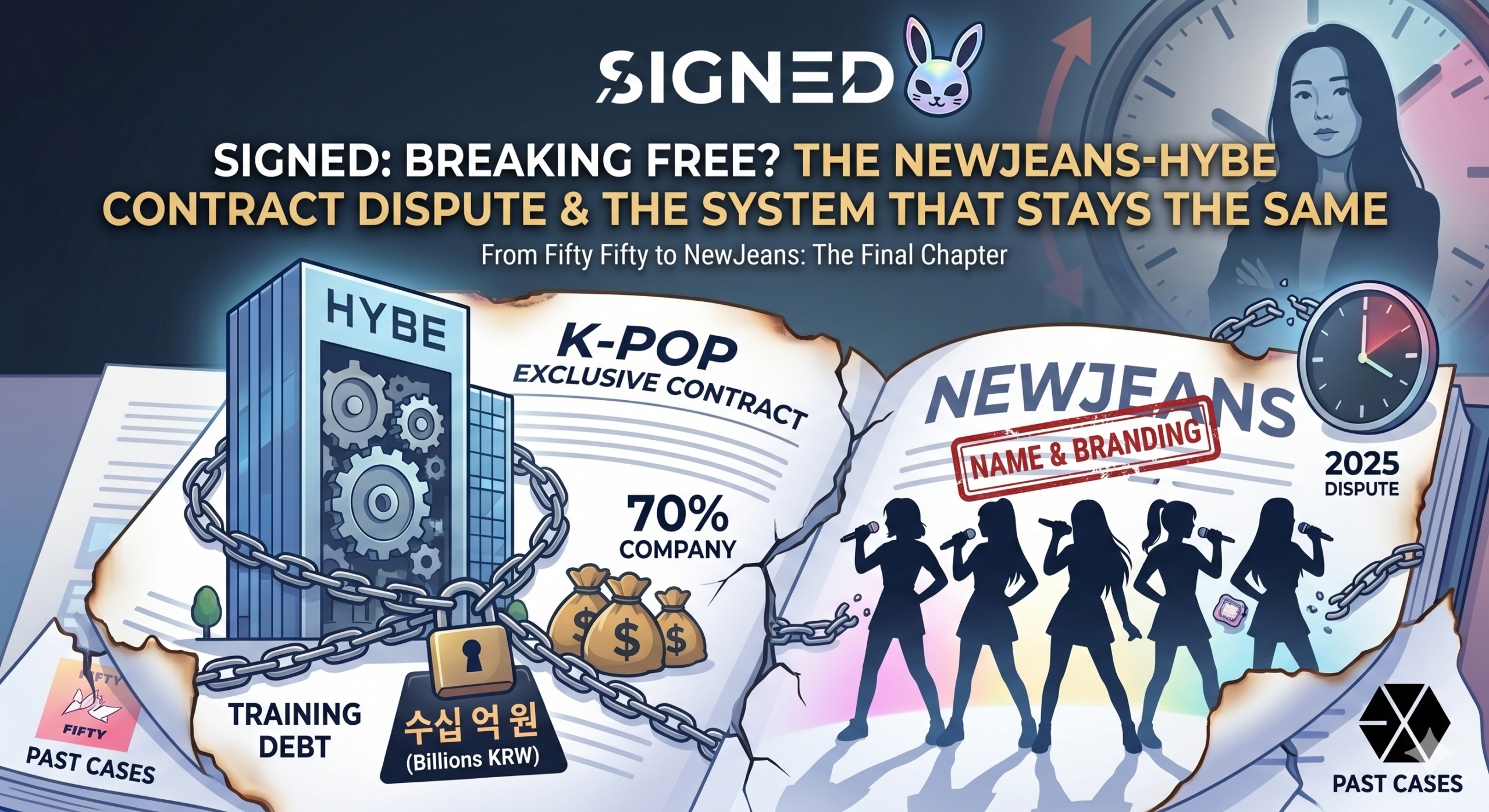
From Fifty Fifty to NewJeans: the new generation of idols fighting back — and what their losses reveal about a system that reforms on paper while holding firm in practice.
On October 15, 2024, a twenty-year-old Vietnamese-Australian singer named Hanni Pham walked into the South Korean National Assembly and testified before the Labour Committee about workplace harassment. She described being deliberately ignored in a hallway by a manager from a rival group within the same company. She described employees criticizing her group on internal workplace platforms. She described a “hostile vibe” that she had initially dismissed as a personal feeling, until she realized it wasn’t. She wiped her tears on live television and said, simply: “I hope trainees don’t suffer these incidents. That’s why I decided to appear.”
It was, by any measure, an extraordinary moment. A K-pop idol testifying before parliament — not about chart manipulation or concert ticket fraud, but about the basic human experience of going to work every day in a building where the people around you have been instructed to pretend you do not exist. The hearing was not supposed to be about contracts. But it was about everything contracts are supposed to protect — and don’t.
Thirteen days later, on October 30, 2025, a Seoul court ruled that NewJeans’ exclusive contracts with ADOR remained valid through 2029. The group had spent a year trying to leave. They had held press conferences, attempted a rebrand as NJZ, filed legal papers, and appealed every ruling. The court rejected all of it. HYBE’s market capitalization jumped $644 million the day the verdict was announced.
The number tells you everything about who the contract was written to protect.
A New Kind of Dispute
The NewJeans case is unlike anything that came before it in K-pop contract history — not because it involves a fight between an artist and a company, but because of the shape of that fight.
In the TVXQ case, the structure was simple: artists vs. agency. In the Lee Seung-gi case, it was: artist vs. agency. In the EXO-CBX dispute of 2023 and 2024, when three members of SM Entertainment’s sub-unit sued over revenue distribution, it was again: artists vs. agency. The contract was the battleground, and the two sides were clearly defined.
NewJeans introduced a third point in the triangle. The dispute was not simply between the group and their label. It was between a creative director who had built the group’s identity, a parent company that controlled the label’s governance, and five artists whose contracts sat at the intersection of a corporate power struggle they had never anticipated and never chose.
The critical legal question the court was asked to answer was narrow: did HYBE’s removal of Min Hee-jin as CEO of ADOR constitute a breach of NewJeans’ exclusive contracts? The court said no. Its reasoning was precise: the contracts bound the group to ADOR as an entity, not to Min as an individual. The removal of a CEO, however consequential to the creative relationship, did not legally void the agreement.
Legally, the ruling was defensible. Humanly, it produced this: five artists, bound to a company through 2029, whose core argument — that the person who created them had been removed against their will, and that the environment that remained was one in which a manager had instructed colleagues to ignore them on a daily basis — was deemed insufficient grounds for exit. The court did not find that the harassment hadn’t happened. It found that it didn’t legally matter enough.
Telling us to return to ADOR and HYBE is like telling the victim of school bullying to return to the same school and endure it.
NewJeans, petition submitted to court — cited by their legal representatives, July 2025For those watching from outside Korea, this was the most clarifying moment of the entire case. The contract, it turned out, did not require the company to be a place the artist could bear to be. It required the artist to be there anyway.
The Case That Came Before
NewJeans was not the first group of its generation to try to break free. In 2023, a four-member girl group called Fifty Fifty — signed to a small agency called Attrakt — filed an injunction seeking to terminate their exclusive contracts after an extraordinary debut that had placed their song “Cupid” on the Billboard Hot 100 and made them briefly the most internationally visible new K-pop act of the year. Their complaint centered on alleged financial mismanagement and the influence of an outside producer, David Amber, who they claimed had encouraged them to leave the label. Attrakt called it tampering. The court eventually found insufficient grounds to terminate the contracts. The group fractured: two members returned, two pursued separate paths. The agency survived. The group, effectively, did not.
The Fifty Fifty case introduced something that the NewJeans dispute would amplify: the role of outside parties in K-pop contract disputes. In both cases, the agency’s most effective legal argument was not about the quality of their management — it was about who had been talking to their artists. Tampering, in K-pop, has become the contractual equivalent of a nuclear option: the accusation that reframes an artist’s desire to leave as the product of manipulation rather than legitimate grievance.
The EXO-CBX case, running concurrently through 2023 and 2024, added another dimension. Three members of SM Entertainment’s long-running boy group sub-unit alleged unfair revenue distribution and filed to terminate their contracts. SM countersued. The case settled, terms undisclosed, in late 2024. What made it notable was not the outcome but the fact that it happened at all: members of one of SM’s flagship units, with over a decade of company history, still felt the need to litigate for their financial rights. The reforms of 2009 and 2017 had not made that fight unnecessary.
What the 2026 Reforms Do — and Don’t — Change
On January 1, 2026, South Korea’s Ministry of Culture, Sports and Tourism implemented revised standard contracts for entertainment trainees. The reforms were real. The supplementary agreement for minor artists now expressly prohibits verbal abuse, coercion, and sexual harassment — not merely physical assault, which had been the previous standard. Agencies must designate protection officers and notify both trainees and their guardians of their appointment. Payment deadlines, previously described only as “within a reasonable period,” now require specific timelines to be written into the contract itself.
These are meaningful changes. They reflect, in particular, the legislative momentum generated by the Lee Seung-gi case in 2022-2023, which exposed how “reasonable period” language had allowed an agency to simply not pay an artist for eighteen years and face no statutory violation until the artist was powerful enough to sue.
But the 2026 reforms have two structural limitations that advocates and critics have been quick to identify.
The first is enforcement. The standard contracts are not mandatory. They are templates recommended by the government, which agencies are encouraged but not legally required to use. The Fair Trade Commission can instruct specific agencies to amend unfair terms — it did exactly this with YG, JYP, SM, and Cube in 2025, targeting ambiguous termination conditions — but the broader enforcement mechanism remains complaint-driven. A trainee who believes their contract violates the standard must file a complaint to trigger an investigation. Filing a complaint means risking the agency relationship, the training investment, and potentially the debut that the trainee has spent years working toward. The system is structurally designed so that those with the least power are least able to use it.
The second limitation is scope. The 2026 revision is entirely silent on foreign trainees — a significant omission in an era when, by some estimates, nearly 30% of HYBE’s trainee roster is non-Korean. A trainee from Thailand, Vietnam, or the United States who signs a contract written entirely in Korean, with no visa provisions, no mandatory translation requirement, and no legal enforceability of the standard contract terms in their home jurisdiction, is protected by nothing except their agency’s goodwill. The contract covers them on paper. The paper is written in a language they may not fully read.
That last row of the scorecard is perhaps the most consequential. At the heart of every K-pop contract dispute — TVXQ in 2009, Lee Seung-gi in 2022, NewJeans in 2024 — is the same structural fact: the artist is classified not as an employee but as an independent contractor. As an independent contractor, they have no right to collective bargaining. They cannot unionize. They cannot leverage the solidarity of fellow artists to negotiate better terms, because there is no legal mechanism by which that solidarity can be exercised.
In South Korea’s National Assembly hearing, a committee chair noted that “new kinds of workers have emerged due to technological advancements, and many of them are not covered by traditional labor laws.” K-pop idols are, in this framing, a new kind of worker. They live where the company tells them to live. They work the hours the company schedules. They are subject to disciplinary provisions that govern their personal appearance, their romantic lives, and their public speech. By every functional definition, they are employees. By legal definition, they are not. And that gap — between functional reality and legal category — is where the contracts do their work.
The Question the Contract Can’t Answer
There is a version of this story that ends with optimism. NewJeans, after everything, began returning to ADOR by the end of 2025. Hanni resumed activities in December. Negotiations with other members proceeded through early 2026. The group that had declared its contracts terminated was, in some form, continuing. The system that had bound them held — and they were, cautiously, back within it.
One reading of that outcome is that the system worked. The contract protected the investment. The courts enforced the agreement. The artists, ultimately, found a path forward within the structure they had signed. ADOR issued a statement expressing its commitment to the members’ “further growth and success.”
Another reading is that it didn’t work at all — that what “worked” was the contract’s capacity to make the alternative so costly that return became the rational choice. The injunction that barred NewJeans from independent activities included a provision requiring each member to pay ₩1 billion — approximately $699,000 — to ADOR for every violation. That is not a deterrent. That is a wall. And when the wall is high enough, coming back through the door is not reconciliation. It is exhaustion.
The deeper question the NewJeans case raised — and that the 2026 reforms did not answer — is whether a contract signed at seventeen or eighteen years old, in the euphoria of debut and the desperation of ambition, can ever be renegotiated on fair terms once the power dynamic has been established. The answer the industry has consistently returned is: only if you become big enough that the company needs you more than you need it. Only if, like BTS, your success restructures the equation entirely. For everyone else, the contract is the ceiling.
What trainees and idols need for true leverage is a union. But those are hard enough to drum up support for among working-class adults. Trying to get trainees who come from increasingly disparate backgrounds to unite and collectively bargain seems like a next to impossible task — and that’s likely how the system is designed to work.
Asian Junkie, analysis of the 2026 standard contract revisions, February 2026That observation is bleak, but it is honest. The K-pop contract system has survived every reform wave of the past fifteen years not by resisting change, but by accommodating just enough of it to reduce political pressure while preserving the structural asymmetry that makes it profitable. The seven-year cap reduced the most egregious excesses. The Lee Seung-gi disclosures created a financial transparency requirement. The 2026 revisions added language about verbal abuse and payment timelines. At each stage, the companies adapted. At each stage, the fundamental relationship — company holds the contract, artist performs within it, exit is prohibitively costly — remained intact.
A Contract Is a Document. The Industry Is a Culture.
In Part 1 of this series, we described the K-pop contract system as a machine: designed to transform raw talent into global performers, at a scale and speed no other industry has matched. That description remains true. The machine works. It works spectacularly. It has produced some of the most commercially successful and artistically compelling popular music of the twenty-first century, and it has done so with a consistency and a volume that Western music industries — with all their advantages of capital and infrastructure — have not come close to matching.
The machine’s productivity is not the question. The question is what it costs the people inside it — and who bears that cost.
The answer, across three parts and fifteen years of contract disputes, is consistent: the cost is borne almost entirely by the artists, particularly the ones who never become famous enough to renegotiate. The trainee who accumulates debt and never debuts. The idol who generates revenue for a mid-tier agency for a decade and receives, like Lee Seung-gi, a statement telling them they are a “minus singer.” The group whose creative director is removed by a parent company and who discovers, in court, that their contract bound them to the entity, not the person — and that the entity can fill the CEO role with whoever it chooses.
The 2026 reforms are a beginning. The payment timeline clarifications, the verbal abuse prohibitions, the protection officer requirements — these are real, and they matter, particularly for the youngest trainees. But a reform that does not make the standard contract mandatory, does not extend protections to foreign trainees, and does not create a legal pathway for collective bargaining has not addressed the architecture of the problem. It has repainted the exterior.
Hanni testified before parliament and said she hoped trainees wouldn’t suffer what she had suffered. She was not speaking about contract clauses. She was speaking about the experience of going to work in a building where you felt systematically invisible, and having no legal recourse because your contract does not require the company to make you feel seen. What she was describing is not a contract problem. It is a culture problem — one that contracts can gesture toward but cannot, on their own, resolve.
The K-pop contract, at its most honest, is a document that says: we will invest in you, and in return, you will belong to us. The industry has spent fifteen years arguing about the terms of that belonging. The artists have spent fifteen years trying to negotiate, litigate, or simply endure their way to something that looks more like dignity. The two positions have not converged. They have, at best, been papered over — one standard contract revision at a time.
End of series
SIGNED: The Hidden World of K-Pop Contracts