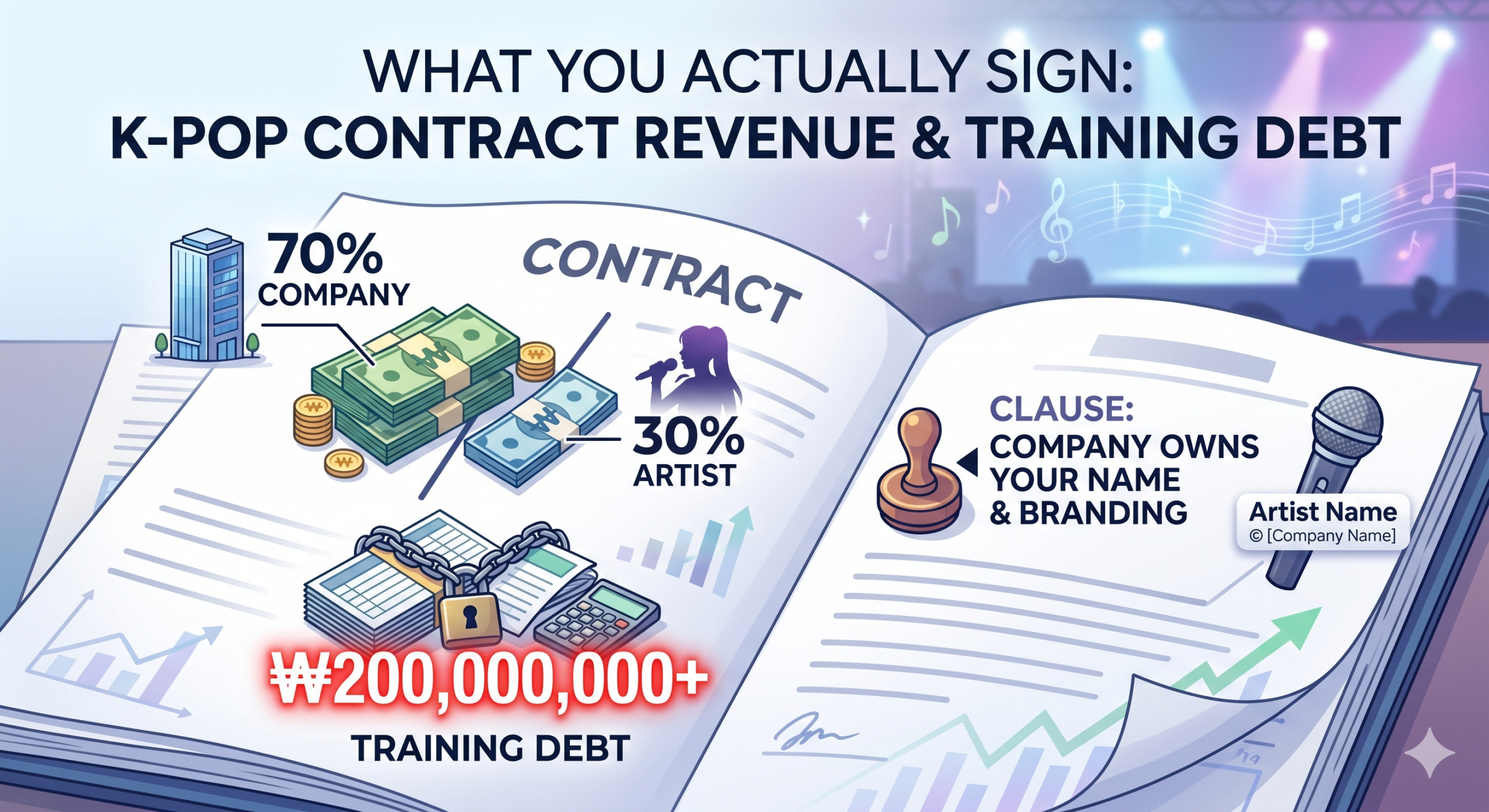
The revenue splits, the training debt, the clause that says the company owns your name. A close read of what K-pop contracts actually contain — and why two idols in the same industry can have completely different financial realities.
In November 2022, a Korean singer named Lee Seung-gi sent a certified letter to his agency of eighteen years — a mid-sized company called Hook Entertainment. He had a simple question: where was his money? Over the course of his career, he had released twenty-seven albums, sung 137 songs, and watched one of his debut tracks — “Because You’re My Girl,” from 2004 — become a classic that even veteran producer PSY cited as among the finest he had ever worked on. PSY had received substantial royalties as the producer. Lee Seung-gi, as the singer, had received nothing. Zero won. For eighteen years.
The response from Hook Entertainment was not an apology. It was a rebuke. Executives told him he was a “minus singer” — a term designed not just to deny payment, but to psychologically condition him into believing his music had no commercial value. A form of gaslighting so effective that Lee Seung-gi spent years genuinely doubting his own worth as an artist, long before he thought to demand a proper accounting. When he finally pressed for documentation, one executive shouted that the accountant tasked with preparing the report “didn’t want to work.”
It took a lawsuit, three years of legal proceedings, and a final court ruling in April 2025 to confirm what the documents had always suggested: Hook Entertainment owed Lee Seung-gi hundreds of millions of won in unpaid music royalties. The agency was ordered to pay. The contract, it turned out, had specified that between 60% and 70% of music sales revenue belonged to Lee Seung-gi. The company had simply chosen not to pay it — and for eighteen years, it had worked.
This is what a K-pop contract can look like in practice: numbers on paper that mean nothing without the power to enforce them.
The Architecture of the Deal
A standard K-pop exclusive management contract is not simply a record deal. It is simultaneously an employment agreement, a management contract, a licensing arrangement, and a personal conduct code. Understanding it requires understanding all four layers at once.
The revenue structure is where most public attention has focused, and where the numbers are most legible. For a rookie group in its first contract cycle, the split between agency and artist is typically 70:30 in the company’s favor — meaning the agency takes seventy cents of every dollar generated before any other deductions. This ratio reflects the agency’s argument that it has made a significant upfront investment in the group’s development and needs to recoup that investment as quickly as possible. As groups become more successful and renegotiate, the splits can shift — sometimes significantly, toward 50:50 or better — but that leverage only exists for groups that have already proven their commercial value.
Album sales and streaming revenue are only part of the picture. Concert revenue, merchandise, endorsements, and individual acting or modeling projects are each governed by separate provisions with different split ratios. Overseas promotions sometimes offer more favorable terms for artists, reflecting the extra burden of international schedules. Endorsements and individual CFs are often negotiated separately and can be more favorable to the idol — but only if the idol is famous enough to attract them independently.
Read on paper, a 70:30 split does not sound catastrophic. But the split applies to revenue after deductions — not revenue itself. Production costs, music video budgets, styling, promotional expenses, and the accumulated cost of the artist’s training period are subtracted before the percentage calculation begins. For a newly debuted group whose first album cost hundreds of millions of won to produce, the artist’s share of “profit” may be mathematically zero for months or years — even while the group performs on television every week.
The Debt That Follows You to Debut
Training debt is the most discussed — and most misunderstood — feature of K-pop contracts. The basic mechanism is this: the money spent on a trainee’s development is classified not as a company investment but as a loan to the trainee. Vocal lessons, dance instruction, language tutoring, dormitory costs, meals, clothing, even some beauty treatments — all of it is recorded in a ledger. When the trainee debuts and begins earning, the debt must be repaid to the agency from their share of revenues before they see any personal income.
The numbers involved are significant. Industry estimates suggest it costs an agency between $1.3 million and $7.5 million to bring a single K-pop group to debut, depending on the scale of the production and the number of trainees involved. Former Momoland member Daisy publicly revealed she had been charged approximately $60,000 for the production costs of the audition show she appeared on — before she had even been selected for the group. In one documented case reported by Korean media, a trainee who spent eight years in the system accumulated a debt of approximately $450,000 without ever debuting at all.
Training debt is real. But it operates very differently depending on which building you’re in.
Industry observation, widely reflected in agency structure reporting, 2024–2025Here is where the picture becomes more complex — and where broad characterizations of the K-pop industry tend to mislead. Among the Big 4 agencies — HYBE, SM Entertainment, JYP Entertainment, and YG Entertainment — the training debt system has been substantially reformed in the past decade. These companies now commonly absorb training costs as a business investment rather than a recoverable loan. A trainee at HYBE or JYP today is unlikely to debut carrying the kind of personal debt burden that defined the system in the 2000s.
At smaller and mid-tier agencies — the vast majority of the industry — the picture is entirely different. Training debt remains a central feature of contracts, enforced with varying degrees of rigor. Hook Entertainment, where Lee Seung-gi spent eighteen years, sits in precisely this middle tier: large enough to manage a significant roster, but without the structural reforms or institutional oversight that characterize the Big 4. It is not a coincidence that the most egregious documented cases of non-payment and financial manipulation have emerged from this stratum of the industry.
This two-tier reality — the Big 4 experience versus the rest of the industry — is the structural divide that most coverage of K-pop contracts fails to draw clearly. The idol who debuts under HYBE and the idol who debuts under a fifty-person agency in Mapo are both operating under “K-pop contracts.” What those contracts actually mean for their daily lives and financial futures is almost incomparably different.
You Don’t Own Your Name
If training debt is the financial trap, intellectual property is the existential one. In the standard K-pop exclusive management contract, the group name is a trademark registered by the agency. The music is copyrighted to the agency. The album artwork, music videos, photographs, and associated brand assets belong to the agency. When an idol leaves their agency, they are often leaving all of this behind — not just the company, but the name, the catalog, and the brand equity that fans associate with them.
The history of K-pop trademark disputes is long and, for those who lost, devastating. H.O.T. disbanded in 2001; when members attempted a reunion concert in 2018, they were legally prevented from using their own group name. Shinhwa spent twelve years in court to reclaim their name from SM Entertainment, finally succeeding in 2015. BEAST rebranded as Highlight for years after Cube Entertainment held the trademark to their original name, only reclaiming “BEAST” in 2024. The Boyz, in a recent agency transition, alleged their former label imposed “unreasonable conditions” before agreeing to transfer trademark rights.
The exception — and it is an instructive one — is BTS. HYBE began not as a corporate giant but as Big Hit Entertainment: a debt-ridden small agency that, by the mid-2010s, was kept alive almost entirely by BTS’s own commercial output. The group’s unprecedented global success did not simply enrich the company — it restructured the power dynamic between artist and agency entirely. BTS members became major shareholders in the company that managed them. The group’s name is HYBE-registered, but the members participate in brand decisions at a level no standard K-pop contract would ever permit.
The lesson is not that the right agency produces fair contracts. It is that success on a historic scale can force a renegotiation of power that no contract clause anticipated. BTS did not escape the system. They became too large for the system to contain. For the thousands of idols who will never reach that scale — which is to say, nearly all of them — the standard terms remain.
The Clauses Nobody Talks About
Beyond the financial architecture, K-pop contracts have historically included provisions governing aspects of an artist’s life that would be unenforceable in most other professional contexts. Dating bans — formal or informal clauses requiring agency approval before any relationship could be made public — have been a feature of the industry since its inception. Two Cube Entertainment artists were dropped from the company specifically for being discovered in romantic relationships. The clause was never written as “you cannot date.” It was written as “you must maintain conduct appropriate to the company’s reputation” — and the interpretation was applied accordingly.
Appearance management provisions have required idols to maintain specific weight ranges, obtain company approval for haircuts or color changes, and in some cases submit to dietary supervision. Working hour clauses — or the absence of them — allowed schedules that industry insiders described as leaving artists with as few as four hours of sleep per night during peak promotional periods. The 2023 amendment to Korea’s Popular Culture and Arts Industry Development Act introduced age-specific working hour limits for minors. The legislation was opposed by major entertainment agencies, who argued it would hamper the industry’s competitiveness.
The penalty clauses deserve particular attention. If an artist wishes to terminate their contract early — for any reason — the standard penalty is typically calculated as a multiple of the agency’s projected losses from the termination. These projections are made by the agency, using the agency’s own financial models. Even post-reform, the power to define “damages” remains largely with the company.
What “Reform” Has and Hasn’t Changed
The reforms of the past fifteen years are real. The seven-year cap, the mandatory financial disclosure requirement introduced in 2023, the 2025 and 2026 updates to standard trainee contracts — these represent genuine legislative effort to rebalance a system that had tilted catastrophically toward agency power.
But the gap between legal text and lived reality remains significant, and it follows a predictable logic: the bigger the company, the more likely the letter and spirit of the law are observed. The smaller the company, the more likely enforcement exists only in theory. A trainee at a forty-person agency in Seoul has limited practical recourse if their company violates their contract — filing a complaint risks blacklisting, retaliation, and the loss of whatever industry relationships the company helped build.
What has changed most is not the contracts themselves but the awareness around them. The idols who debut today know more about what is inside those documents than any generation before them. They know what “minus singer” means. They know to ask for annual financial disclosures. They know that the group name they are building may not be theirs to keep.
Whether knowing changes the outcome is a different question entirely. And it is the question at the center of Part 3.
In 2024, the members of NewJeans stood at a press conference and announced they were terminating their contracts with their agency. They cited mistreatment and breach of contract. One of them had already testified before the National Assembly about workplace harassment. A court subsequently ruled their contracts remained valid. The case was not simply about a group and its label. It was about a creative director, a parent company, and the question of who — in a K-pop contract — actually controls the artist. In Part 3, we go inside that question.
Next in the Series
Part1 – SIGNED : Signed at Thirteen
Part 3 — Breaking Free: NewJeans, HYBE, and the New Battleground of Artist Rights