Nine years of absence. Mandatory military service. A full-group return. BTS’s Mexico City run was not a pop concert. It was the birth of a new form of cultural diplomacy.
By Special Correspondent, Culture & Global Affairs On the ground in Mexico City · May 7–10, 2026By
Sources: Promoter Ocesa (ticket figures) · Mexico City Chamber of Commerce (economic impact est.) · Mexico City government (Zócalo crowd)
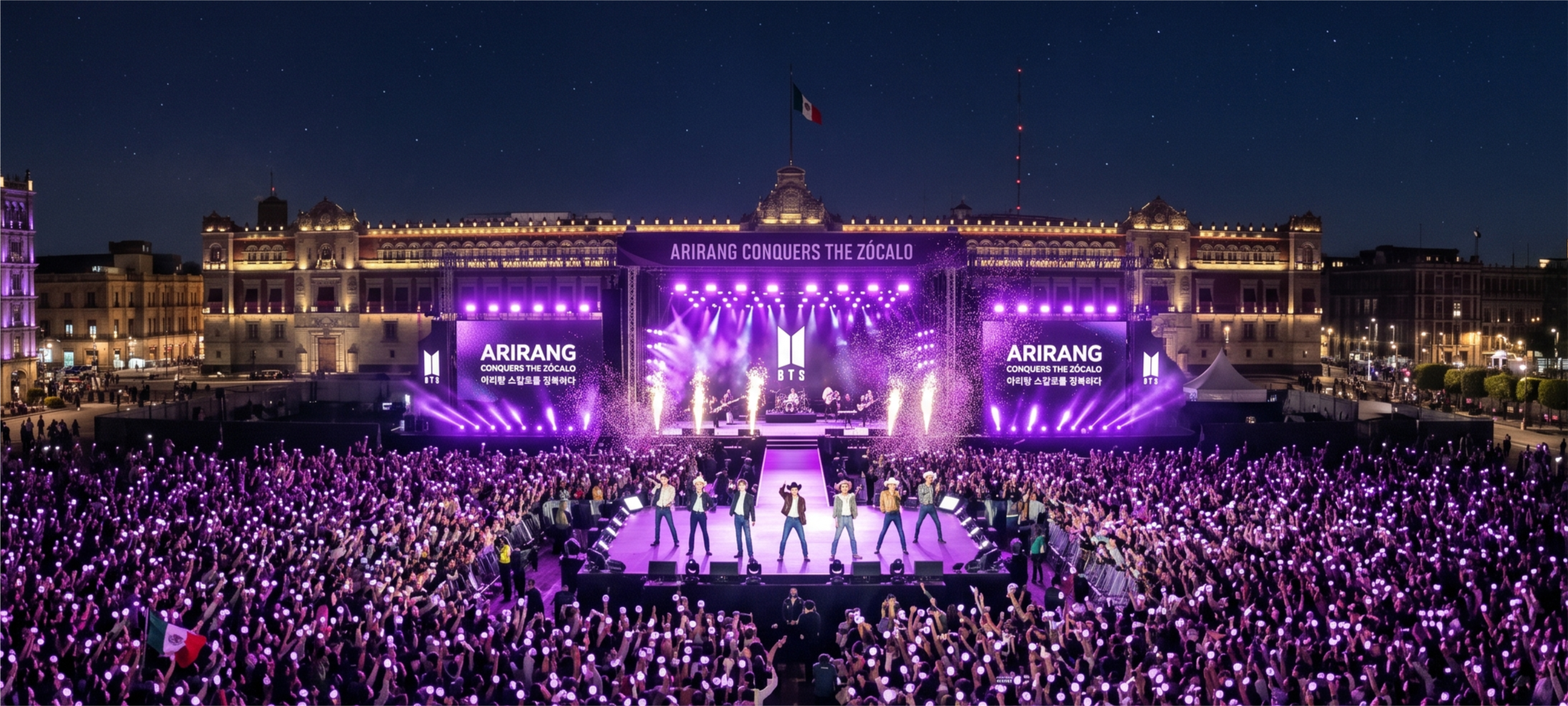
On a blazing May afternoon in Mexico City, the Zócalo — the vast, ancient public square that has witnessed emperors, revolutions, and independence — turned gold and white. Tens of thousands of people stood under an unrelenting sun, eyes fixed on the balcony of the National Palace. Then seven men appeared, standing alongside President Claudia Sheinbaum. RM, Jin, Suga, j-hope, Jimin, V, and Jung Kook. That is: BTS.
What unfolded on May 6, the eve of the first concert, cannot be reduced to a celebrity appearance. The Mexican government had officially designated BTS as Visitantes Distinguidos — Distinguished Visitors — and presented them with a commemorative plaque. President Sheinbaum had personally written to South Korean President Lee Jae-myung requesting additional concert dates after 136,000 tickets sold out in under an hour. And all the while, the group’s album ARIRANG — named after a 600-year-old Korean folk song — sat at No. 1 on the Billboard Hot 100. This is what the new soft power looks like: not treaties, not trade delegations. Seven men in a sold-out stadium, and a head of state asking for more.
“Muchas gracias for having us. We can’t wait for tomorrow’s concert. Let’s have fun together. Te amo. Te quiero.”
— RM · National Palace Balcony · May 6, 2026
Nine Years, One Stage
BTS last performed in Mexico in 2017. In the years since, the world shifted beneath them. A pandemic arrived. The group pivoted to English-language pop and charted globally. Then, in June 2022, they announced a collective pause — each member enlisting in South Korea’s mandatory military service one by one, the last completing his service in June 2025. It was an interruption at the peak of their powers: more analogous to Elvis Presley’s Army draft than to any modern pop hiatus.
When ARIRANG dropped on March 20, 2026, it collected 110 million Spotify streams on day one. The tour sold out North American and European legs within minutes. But the numbers, staggering as they are, miss the more interesting story: the military service itself — a distinctly Korean institutional reality — paradoxically deepened the global fandom’s investment. ARMY didn’t just wait; they organized, they documented, they held vigil. The three-year pause became a kind of shared sacrifice.
On the night of May 7, that community materialized outside the GNP Seguros Stadium. Thousands who couldn’t get tickets gathered on nearby streets, singing along to music they could hear beyond the walls. Their light sticks — the signature purple Army Bomb — blinked in sync with those inside. It was a scene that required no ticket, no seat, no language.
Cowboy Hats, Spanish, and a Folk Song’s Contradiction
The group took the stage on opening night in Ciudad de México T-shirts and cowboy hats. V delivered his message to the crowd in Spanish — read carefully from his phone — confessing that the band had missed Mexico. The 50,000 in attendance erupted. It was a gesture of calibrated warmth, and it worked completely.
The setlist traced BTS’s twelve-year career: new tracks FYA, Body to Body, and IDOL gave way to a victory lap around the stadium, flags in hand, dancers in tow. When surprise slots surfaced Boy In Luv and So What — reaching back to the group’s early, rougher-edged years — sections of the crowd laughed and wept at the same time. The weight of accumulated time, compressed into a single evening.
BTS arrived in Mexico City wearing the most Korean name they have ever given an album — and playing it through the most Western pop grammar they have ever employed. ARIRANG was recorded in Los Angeles with Diplo, Ryan Tedder, and Mike WiLL Made-It. Its roots are a 600-year-old folk melody. Its sonic surface is the glossiest international pop of 2026. This is not a contradiction to be resolved. It is, perhaps, the most honest document BTS has ever made: a record that is simultaneously of everywhere and unmistakably of one place.
RM put it directly in an Apple Music interview: “We are all Koreans and we are proud of where we came from. I think Arirang has lyrics and melodies that are very universal.” On the album opener Body to Body, a pansori-style performance of the traditional melody fades in over a hip-hop foundation, then recedes. The roots are present — but they are not the whole picture. In Mexico City, that ambiguity didn’t trouble the crowd. A Korean folk song became a shared anthem in Spanish. That is the only argument the song needed to make.
When a President Writes to Ask for More Concerts
Mexico is the world’s fifth-largest K-pop streaming market, according to Spotify. Within it, BTS is the most-streamed K-pop artist. These are not incidental facts. They explain why Sheinbaum, after tickets vanished in under an hour, sent a formal letter to the South Korean head of state requesting more shows — and why the Korean government replied that it had forwarded the request to HYBE.
A sitting president, lobbying through diplomatic channels, for a pop group to perform more concerts. The scene strains plausibility until you consider what the Mexico City Chamber of Commerce estimated: the three-night run would generate approximately $107.5 million in economic impact. Hotels, restaurants, transport, local tourism — all reorganized around four days in May. This is soft power measured in hard currency.
At the National Palace, Sheinbaum presented the group with a commemorative plaque recognizing BTS’s influence on Mexican youth and their messages of “respect, empathy, diversity and peace.” Her framing was precise: BTS was not being celebrated as entertainment. They were being recognized as a cultural force. “Music and values unite Mexico and South Korea,” she wrote afterward. What took diplomats decades to build, BTS compressed into three nights.
Between Praise and Fracture
This homecoming was not received without friction. Pitchfork found that the album’s more generic tracks “ring hollow and lack the vim and vigor of the band’s best work.” South Korean music journal IZM argued that the low proportion of Korean-language lyrics throughout the record makes the title ARIRANG feel, in its words, like a MacGuffin — a name that promises cultural depth the music doesn’t consistently deliver.
More pointed still: several international outlets reported — citing unnamed sources within the Korean music industry — that members RM and Suga had pushed during the LA sessions for a higher proportion of Korean-language lyrics, and that concerns about global commercial reach had tempered that push. Whether or not those accounts reflect the full picture, they surfaced with enough consistency to become part of the album’s public narrative.
The tension is real, and it is not BTS’s alone to carry. Every Korean artist who achieves genuine global reach faces a version of the same question: at what point does accessibility become assimilation? The choice of ARIRANG as a title was, regardless of what the music does with it, a declaration of intent. NPR put it simply: “The most resonant thing the group could do in this moment is return, unified and bilingual, with the program more sharply defined.”
The Zócalo does not adjudicate these questions. It simply holds them. On the night of May 7, a Mexican crowd sang along to a band named after a Korean folk song, in a stadium in a city that had waited nine years. The contradictions — between roots and reach, between identity and commerce, between the folk melody and the Los Angeles production suite — dissolved into something harder to categorize than either a triumph or a compromise. Call it, for now, the sound of a world that has grown genuinely smaller.