Before BTS sold out stadiums and BLACKPINK graced the cover of Rolling Stone, there was a contract. Usually signed by a teenager. Almost always written entirely in the company’s favor.
In 2005, a fifteen-year-old from Pennsylvania named Taylor Swift signed her first record deal with a small Nashville label called Big Machine Records. She was talented, ambitious, and, like most teenagers offered a shot at their dream, not in a position to negotiate hard. The label kept the master recordings of everything she made. Fourteen years later, when those masters were sold to a man she described as her bully — without her knowledge, without her consent — she had to rebuild her entire catalog from scratch, song by song, re-recording her own life’s work to reclaim it.
The story shocked the world. It sparked congressional conversations, think-pieces in the New York Times, and a solidarity movement among artists that remade the conversation around musicians’ rights. Swift eventually bought back her masters in 2025, calling it the resolution of her “worst case scenario.”
Now imagine that same story — but the contract is not seven years. It is thirteen. The label does not just own your recordings; it controls where you live, what you eat, who you date, and how many hours you sleep. You signed it at twelve or thirteen years old, long before you had a lawyer who understood what the clauses meant. And when you finally decide to fight back — at the absolute peak of your career, because otherwise no one will care — your agency holds a press conference to call you greedy.
This is not a hypothetical. This is the story of TVXQ, and of the contract system that built K-pop.
The Factory That Made Stars
To understand K-pop contracts, you first need to understand what K-pop actually is — not as a music genre, but as an industrial system. And that system begins with one man and one visit to Japan.
In the early 1990s, Lee Soo-man, a Korean singer-turned-music-executive, traveled to Japan and studied the country’s idol industry up close. What he saw at Johnny & Associates — the agency founded by Johnny Kitagawa that had dominated Japanese pop since the 1960s — was a machine: young boys recruited young, placed in dormitories, trained in singing and dance for years before debuting as polished, camera-ready groups. The company owned everything. The artists owned nothing. And the system worked spectacularly.
Lee came home and built the Korean version. He founded SM Entertainment in 1995, and within a few years he had systematized what would become the K-pop trainee model: scout talent through nationwide auditions, sign trainees as young as twelve or thirteen, house them in company dormitories, train them in singing, dance, languages, and media appearance — and bind them to the company through exclusive contracts that could last a decade or more.
The crucial difference from the Western model was vertical integration. In the United States or the United Kingdom, an artist might have a record label, a separate management company, a booking agent, and a publicist — all distinct entities with competing interests that, imperfect as it is, create some checks on any single party’s power. In K-pop, the agency is all of those things simultaneously. It scouts you, trains you, produces your music, manages your schedule, handles your press, books your concerts, and negotiates your endorsements. The contract governs every dimension of your professional and personal life.
The system worked. H.O.T., SM’s first idol group, debuted in 1996 and became a sensation. JYP Entertainment and YG Entertainment built their own versions. By the 2000s, the model had produced BoA, TVXQ, Super Junior, and the beginnings of what would become a global phenomenon.
Behind the synchronized choreography and immaculate styling, however, the contracts remained what they had always been: long, restrictive, and written almost entirely to protect the company’s investment.
Tokyo Dome, Then a Courthouse
By 2009, TVXQ — five members, debuted in 2003 — were not just K-pop stars. They were a phenomenon. They had conquered Japan, a market that had resisted Korean acts for years, building one of the largest fan communities in Asia. In May 2009, they made history: the first Korean group to perform at Tokyo Dome, selling out two nights.
Six weeks later, three of the five members filed a lawsuit.
Jaejoong, Junsu, and Yoochun — who would later operate as JYJ — submitted an injunction against SM Entertainment on July 31, 2009, seeking to terminate their exclusive contracts. They cited two core complaints: the contract length, and the profit distribution. Their contracts, signed when they were minors, ran for thirteen years. When mandatory military service was factored in — a duty all Korean men must complete — the effective term stretched to fifteen years or more. As one analysis at the time put it, they would have been bound to SM from their 2003 debut through, potentially, 2021: four Olympic Games, and a whole pandemic they couldn’t have imagined, still chained to the same company.
The profit terms were, by any standard, stark. Reports at the time indicated the group received a fraction of their earnings from album sales — with some accounts citing that members saw as little as 2% of physical sales revenue in the contract’s earlier years. Divided five ways, that meant global stars performing at Tokyo Dome were each taking home a share of what amounted to a small fraction of their commercial value.
Thirteen years. When you factor in military service, it’s fifteen. They debuted in 2003. Do the math.
Analysis of the TVXQ contract, circulated in K-pop legal commentary, 2025SM Entertainment’s response was swift and characteristically corporate: this was not about contracts, they said, but about money. Specifically, about a cosmetics company — CreBeau — that the three members had invested in, which SM alleged was a conflict of interest and a violation of their exclusivity terms. The agency held a press conference, called the lawsuit a product of the members’ “greed,” and denied that the contracts were slave contracts at all.
In October 2009, a court granted a partial provisional injunction: the three members could conduct independent activities while the main case proceeded. SM appealed. The legal battle dragged on for three years, ending in a settlement in November 2012, with both sides agreeing to withdraw all claims and not interfere with each other’s activities. The settlement was sealed — and only made public years later when new legislation forced the documents into the open.
What the documents showed, when they finally became available, complicated the narrative on both sides. The court found no “slave contract” in the legal sense — the profit distribution was not, on paper, as catastrophic as the public had assumed, and the parents of the members had agreed to extend the contract length. But the length itself, the working conditions, and the total control the company exerted over every aspect of the members’ lives had been real. And the fact that three men, at the peak of their careers, felt the only way to fight was through a court — that was real too.
What mattered most, however, was not the legal outcome. It was the two words the case put into global circulation.
Two Words the World Learned
노예 계약. Slave contract.
The term was not new in Korea — it had been circulating in entertainment industry circles for years, used to describe agreements that critics felt crossed the line from demanding to exploitative. But the TVXQ lawsuit gave it a face, a story, and a global platform. When Western media picked up the story, it was those two words that led every headline.
The BBC’s reporter Lucy Williamson wrote that some of K-pop’s biggest stars “were built on the back of slave contracts, which tie trainees into long exclusive deals, with not much control and little financial reward.” The Los Angeles Times dispatched correspondents to Seoul to investigate the industry’s labor conditions. Al Jazeera reported on trainee regimes that included strict dietary control, restricted contact with family and friends, and performance schedules that allowed as little as four hours of sleep per night.
But here is what the early Western coverage often missed: the framing of pure exploitation, while emotionally legible, flattened a more complicated reality. The K-pop system is not simply a company extracting value from helpless teenagers. It is a machine that genuinely transforms raw talent into global performers — providing years of world-class training in singing, dance, languages, and performance that most artists in other markets simply do not receive. The companies take enormous financial risks on trainees who may never debut, and they build infrastructure — choreographers, producers, stylists, global marketing — that individual artists could not access on their own.
The question was never whether the system produced results. It clearly did. The question was whether the contract — the legal document that governed who owned what and who owed what — fairly reflected the value that artists created once those results arrived.
In 2009, the answer was clearly no. And the South Korean government agreed.
The Government Steps In (For the First Time)
The fallout from the TVXQ case moved fast. Korea’s Fair Trade Commission launched an investigation into the industry’s contract practices and, by late 2009, established a new rule: exclusive management contracts in the entertainment industry would be capped at seven years.
Seven years sounds reasonable. But the reform was, in practice, narrower than it appeared. The cap applied to the formal contract term — it did not immediately address profit distribution structures, training debt arrangements, or the sweeping personal conduct clauses that gave companies control over idols’ private lives. And crucially, a maximum contract length means little if the power imbalance at the negotiating table remains unchanged.
The seven-year limit did, however, create an unintended cultural phenomenon: the “seven-year curse.” As group after group approached their contract expiration dates, fans began watching anxiously. 2NE1. Sistar. Miss A. Groups that had defined a generation dissolved at the seven-year mark — members choosing not to renew, pursuing solo careers, or simply walking away from systems they had grown too experienced to accept without question.
The TVXQ case had done something the contracts themselves never intended: it had educated a generation of idols about what was inside those documents.
What Taylor Swift and TVXQ Share — And Where They Diverge
It is worth returning, briefly, to Taylor Swift. Because the parallel — and the divergence — is instructive.
Both Swift and the members of TVXQ signed their first major contracts as teenagers, without full comprehension of what they were giving away. Both discovered, years later, that the documents they signed had transferred enormous value — creative, financial, commercial — to companies that retained it long after the relationship had soured. Both fought back, publicly, at significant personal cost.
But the tools available to them were entirely different. Swift could re-record her albums because she retained her voice and her name. She had a separate management structure, independent legal counsel, and crucially, the ability to negotiate a new deal with a competing label that explicitly included master ownership. When her fight became public, she spoke to a media ecosystem that already understood music industry contracts and was ready to be outraged on her behalf.
JYJ fought their case largely in Korean courts, in a country where the industry’s power structures were embedded deeply enough that SM was able to informally discourage broadcasters from featuring the three members during the years their lawsuit was active — a pressure campaign that the court later acknowledged but found insufficient grounds to sanction. They did not re-record. They could not simply move to a competing label, because the exclusivity and non-compete implications of their situation were labyrinthine. And they fought at a time when Western audiences had barely heard of K-pop at all.
The K-pop contract, at its core, was built around a simple premise: we will make you a star, and in exchange, we will own almost everything that stardom produces. For a teenager in Seoul in 2003, with no comparable precedent and no alternative path, that was not an unreasonable trade to accept. The tragedy was not that the deal existed. It was that by the time the artist understood what they had signed, there was almost no way out that did not cost them years of their career.
The 2009 reforms were real. The seven-year cap was real. But reforms on paper do not automatically translate into change in practice — especially when the power asymmetry between a major entertainment company and a twenty-two-year-old who has never worked anywhere else remains as stark as ever.
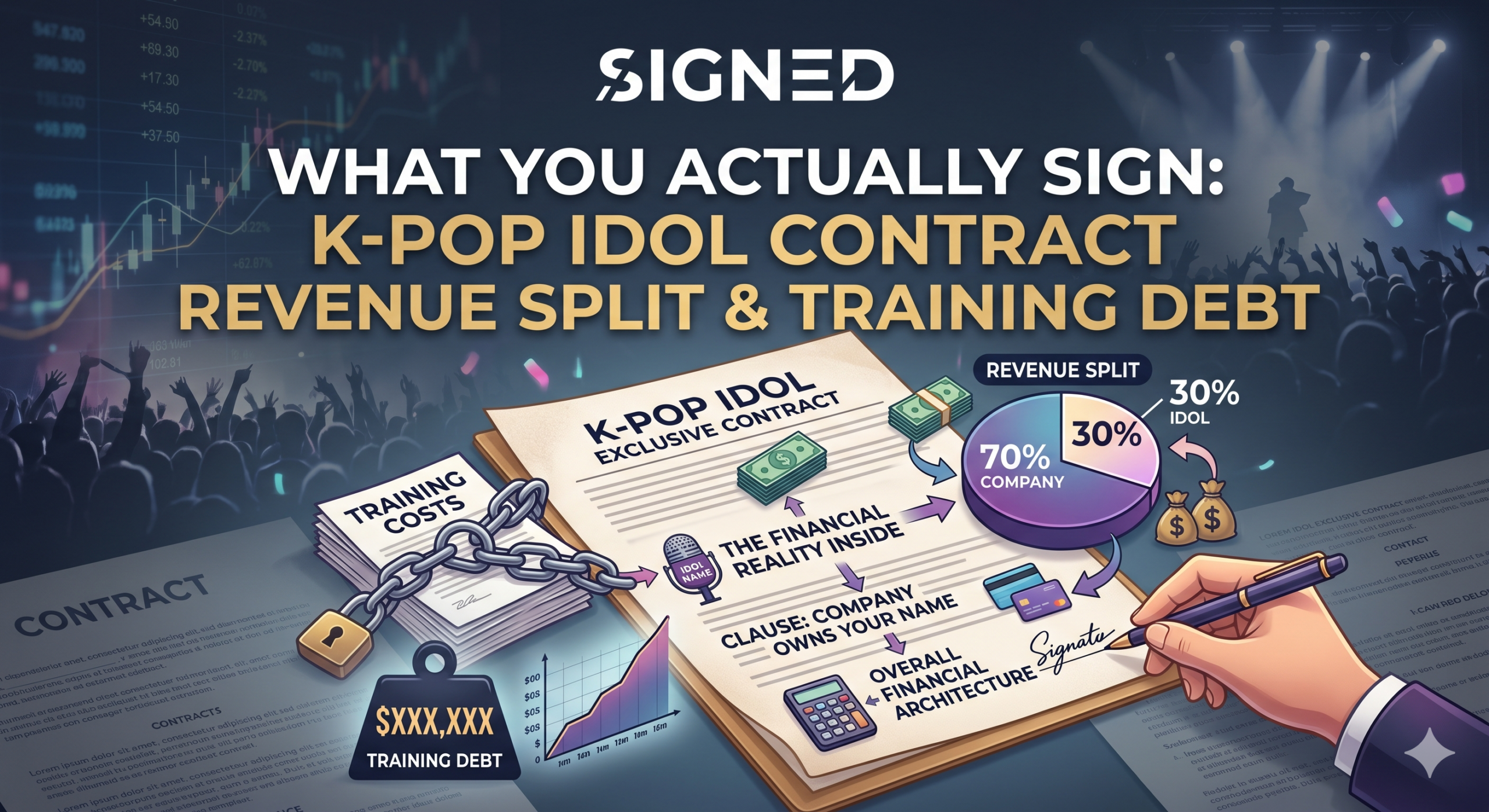
In Part 2, we go inside the actual structure of a K-pop contract: what the clauses say, how the money flows — and why the training debt system means some idols spend years as global stars before they see a meaningful personal profit.
Next in the Series
Part 2 — What You Actually Sign: Inside the Money, the Clauses, and the Debt