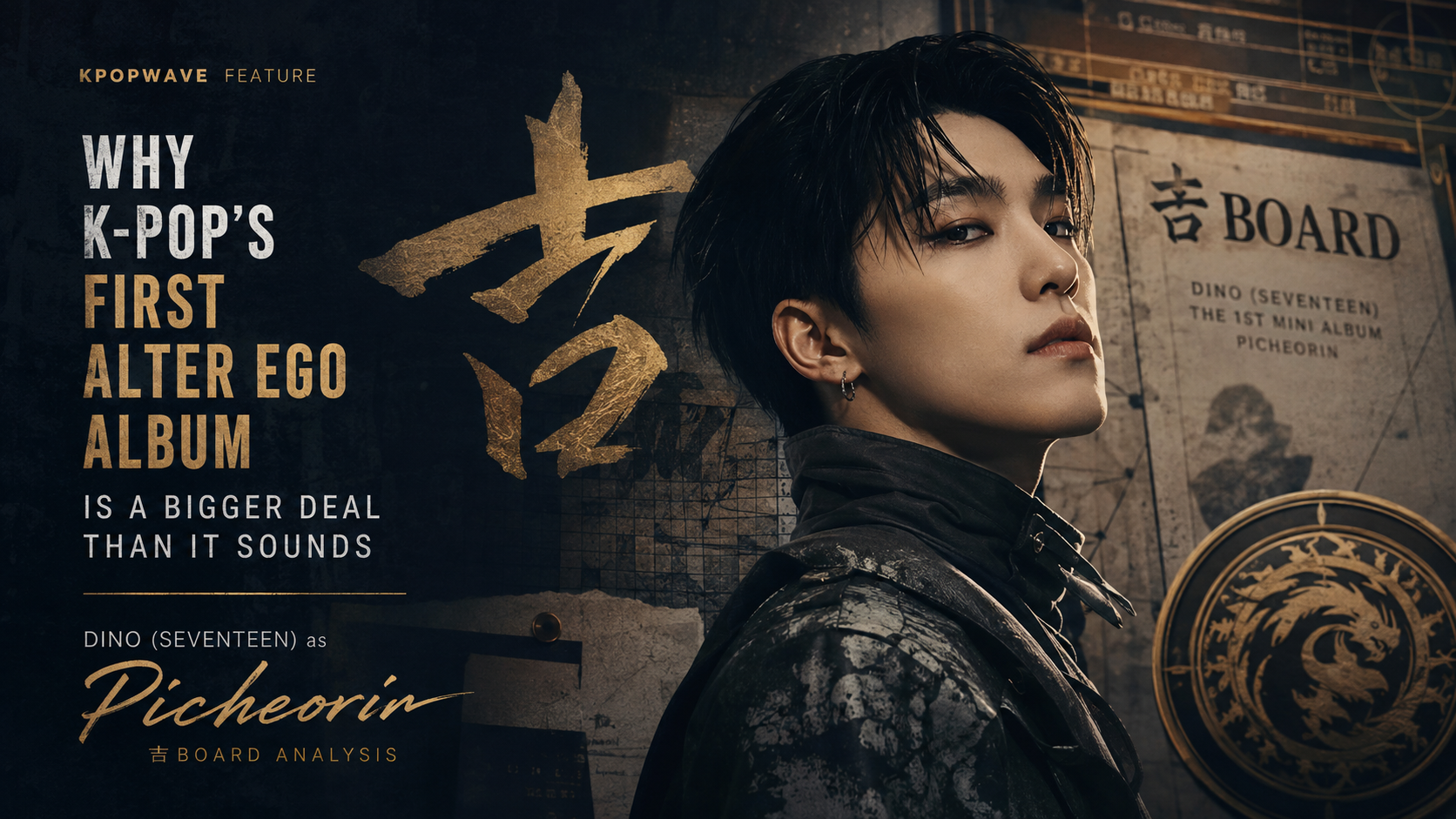
01What Picheorin Actually Is — and Why That Matters
Before anything else, the name. Picheorin (피철인) is derived from the Korean pronunciation of “featuring” — 피처링 (picheoling) — with the last syllable shifted. The name describes what the character does: it features in people’s daily lives, showing up unexpectedly, making things more lively, and then moving on. The character’s Korean subtitle is 흥의 수호자 — “Guardian of Heung,” where heung (흥) is the specific Korean concept of collective joy, the energy that builds in a crowd when music or celebration takes hold of everyone simultaneously.
The character itself predates the album by five years. Picheorin first appeared in a 2021 fan content series called 캐릿랜드, where he was depicted as a meddlesome middle-aged man from a rural village — the kind of person who inserts himself into everyone else’s business with cheerful disregard for whether he was invited. The character was played for laughs, a recurring bit in SEVENTEEN’s fan ecosystem. The audience for Picheorin, from the beginning, was primarily CARATs — SEVENTEEN’s fanbase — who already knew the joke.
The leap from fan-content gag to debut artist is the interesting move. DINO did not simply create a project under a different name. He built a five-year mythology around a character, then gave that character its own mini album, its own tracklist credits, its own music show performances, and its own pop-up store — all while maintaining the stated position that DINO and Picheorin are different entities who should not be conflated.
흥 (heung) is one of Korean culture’s most specific and least translatable emotional concepts. It describes the feeling of joy that rises collectively in a group — the energy that builds when music connects with people in a shared space, the specific pleasure of communal celebration that can’t quite be replicated alone. It is associated with traditional Korean folk culture, with pungmul (농악), with the kind of festive atmosphere that brings strangers into the same emotional state. For Picheorin to be the “Guardian of Heung” is to claim a cultural lineage that runs through Korean folk tradition — a deliberately broad, cross-generational ambition that sits in interesting tension with the idol-industry context in which the album was released.
02What Came Before — And Why It’s Different
The claim that 吉BOARD is K-pop’s first alter ego album is carefully worded in Korean media: 부캐 앨범 — an alter ego album. Not the first alter ego. Not the first different name. Not the first creative persona. The distinction is important, because K-pop has a long and well-documented history of all three of those things. What it hasn’t had before is a full debut — with its own mini album, its own music show promotion, and its own live performances — under a character the artist has built and maintained as separate from themselves.
The Persona Precedents — Artistic Expression Through a Different Name
| Artist / Alter Ego | Nature of the Persona | What It Did |
|---|---|---|
| SUGA (BTS) → Agust D | A rawer, more confrontational musical self — named after Daegu Town (DT) + Suga spelled backwards. Allowed Yoongi to express mental health struggles and underground rap aesthetics that didn’t fit BTS’s group output. | Three solo mixtapes/albums (2016, 2020, 2023). Critically acclaimed. Functioned as artistic expansion of the same person’s identity, not a separate character. |
| G-Dragon (BIGBANG) → Multiple personas | G-Dragon has operated with several aesthetic and conceptual identities across different eras, but never under a separate credited name on an album. | Persona-driven aesthetics within a single credited artist identity. |
| SEVENTEEN Subunit — 부석순 (BooSeokSoon) | A unit name combining the members’ real names (부승관, 이석민, 권순영). Positioned tongue-in-cheek as a self-styled 4th-generation group — not an alter ego but a comedic reframing of themselves. | Full unit album and promotion, but performed as themselves under a constructed group name, not as separate characters. |
| DINO (SEVENTEEN) → Picheorin (피철인) | A fully constructed character with its own name, origin story, visual identity, and cultural mission — built over five years before the album — that DINO insists should be distinguished from himself as an idol. | Full mini album debut, music show promotion, pop-up store, and solo concerts under the character’s name. The credited artist is Picheorin, not DINO. |
The most useful comparison is with Agust D — both because it’s the best-known K-pop persona case internationally, and because the contrast clarifies exactly what Picheorin is doing differently. Agust D is Suga. The name is an anagram of the artist’s own name combined with his hometown. The persona expresses parts of Yoongi that the idol context doesn’t accommodate — rawer, angrier, more self-revealing — but it is understood by everyone involved, including Yoongi himself, as a different mode of the same person. When Agust D raps about mental health struggles, those are Yoongi’s actual mental health struggles. The persona is a lens, not a separate identity.
Picheorin is explicitly not DINO. The character has a different backstory (rural village meddler, not a K-pop idol), a different aesthetic (folk-inflected heung energy, not polished idol presentation), and DINO has publicly asked that the two be kept separate. When Picheorin performs on music shows, the entity performing is understood to be the character — not DINO temporarily adopting a different vibe, but Picheorin doing what Picheorin does. The distinction sounds philosophical until you notice that 吉BOARD’s tracklist credits the artist as 피철인, not 이찬 (DINO’s real name) or 디노. The character, not the idol, released the album.
03Why K-Pop Hasn’t Done This Before
The absence of alter ego albums in K-pop before 2026 isn’t an oversight. It’s a structural consequence of how K-pop’s identity management works. Understanding why Picheorin is new requires understanding why it’s been difficult.
K-Pop Identity Is Managed, Not Just Performed
K-pop groups and their members operate within carefully constructed public identities that are built and maintained by agencies, teams, and the artists themselves over years. The “idol” identity is not just a performance mode — it’s the entire commercial and relational infrastructure through which artists connect with fans, generate revenue, and maintain their position in the industry. Introducing a separate character with a separate identity creates an immediate complication: which identity does the agency’s resources support? Which fans is the output for? How does the character’s commercial performance get attributed and evaluated?
Fan Relationships Are Built on the Idol, Not a Character
The K-pop fan-artist relationship is built on parasocial closeness with specific people. Fans follow DINO — his performances, his personality, his development as an artist. Asking fans to redirect some of that investment toward Picheorin — a character DINO plays — asks them to hold two relationships simultaneously: one with the idol they know, and one with a fictional entity that the idol embodies. Most idol activities, including solo albums, reinforce the primary relationship. An alter ego album introduces a structural ambiguity that the K-pop fanbase model hasn’t had to navigate before.
The Industry Has Been Getting Closer, But Not All the Way There
The trend toward creative self-expression in K-pop — self-produced albums, self-written lyrics, personal solo projects — has been building steadily through the third and fourth generation. 3RACHA, BUMZU, USUM, and other production units have pushed toward more artist-driven output. Solo projects have become increasingly personal rather than agency-directed. But all of these remain expressions of the artist’s own identity, however expanded. Picheorin is the next logical step in that trajectory: not just expressing yourself differently, but constructing a different self to express through.
DINO is 26 years old in 2026 and has been a member of SEVENTEEN since debut in 2015. He has spent over a decade building the DINO identity within a group context. The confidence to step sideways into a separate character — and to insist on the distinction publicly — requires a level of established identity security that is hard to achieve earlier in a career. Picheorin’s feasibility depends on the DINO foundation being solid enough that stepping away from it temporarily doesn’t undermine it. An early-career idol attempting this risks confusing their audience about who they are. DINO attempting it after eleven years as a core SEVENTEEN member carries a different weight: he knows exactly who he is, and that knowledge is what makes it possible to become someone else for an album.
04吉BOARD — What the Album Does
A pun on “Billboard” via the Korean word 길 (gil — road/street) and 吉 (gil — the hanja character for “auspicious/lucky”). The billboard is on the street; the album is a road-board; everything on it is meant to bring good fortune. The wordplay fuses urban music culture with the traditional Korean wish for things to go well.
The album was supported by a pop-up store at HYBE’s Yongsan headquarters (August 7–12), music show promotion beginning with M Countdown on August 6, and a three-night solo concert — 2026 디노X피철인 [吉BOARD SHOW] — at Jamsil Indoor Stadium (August 21–23).
Three producers with deep roots in Korean music history: BUMZU (SEVENTEEN’s primary in-house producer), Hitchhiker (formerly of band Rollercoster, responsible for multiple K-pop hit productions), and 이현도 (Lee Hyun-do of DEUX — the legendary 1990s duo that defined Korean hip-hop and dance music of that era).
The album is not a concept handed to DINO by producers. Every piece of writing on it involved him directly, making Picheorin simultaneously a character DINO inhabits and an album DINO built.
아프지 않은 이별은 없다 (narr. 이문세)
Pre-release / narration by legendary singer Lee Moon-sae
미쳐 미쳐
Pre-release / 6 consecutive days in YouTube Korea daily top 10
놀아보세 (prod. Hitchhiker)
Title Track
짠 (feat. DINO)
Picheorin features DINO — the character credits the idol
정말 (prod. 이현도 of DEUX)
1990s New Jack Swing style / produced by DEUX’s Lee Hyun-do
정으로 사랑으로
City pop / coexistence of romance and loneliness
LIKE IT
본캐 DINO의 진심 — the idol’s own voice, closing the album
Track 04 — “짠 (feat. DINO)” — is the most structurally unusual moment on the album: Picheorin, the character, features DINO, the idol, as a collaborator. The credit line reads: Picheorin feat. DINO. The character invited the idol onto his own track. This is either a playful deconstruction of the separation DINO established, or the most precise illustration of how the separation is meant to work: they are two different entities with different enough identities that one can reasonably feature on the other’s song.
Track 07 — “LIKE IT” — closes the album as the 본캐 (main character) track: explicitly credited as DINO’s own voice and perspective, not Picheorin’s. The album begins with Picheorin, moves through his world for six tracks, and ends with DINO stepping back in to speak directly. The architecture of the album is the architecture of the relationship between the two identities: Picheorin dominates, DINO closes.
05Why DINO — What This Reveals About His Position in SEVENTEEN
DINO is SEVENTEEN’s youngest member — the maknae, in K-pop terminology — and has occupied that position since the group’s 2015 debut. The maknae role carries a specific weight in K-pop group dynamics: youngest members are often associated with freshness, playfulness, and a kind of charmed exemption from the more serious responsibilities that fall to older members. DINO has spent eleven years being the youngest person in a thirteen-member group.
Picheorin is, in some ways, the inversion of everything that implies. The character is explicitly imagined as a meddlesome middle-aged man — someone with the confidence, life experience, and social boldness that comes from having lived long enough to feel comfortable inserting himself into anyone’s situation. DINO playing Picheorin is the maknae inhabiting the oldest-person-in-the-room energy, and doing it through a character separate enough from himself that he doesn’t have to reconcile it with his established group identity.
The choice of heung as Picheorin’s governing concept is also significant for DINO specifically. Among SEVENTEEN’s thirteen members, DINO is perhaps most consistently associated with dance — his performances are technically demanding, precise, and visually striking. Heung, by contrast, is about collective emotional release, communal joy, the feeling that spreads through a crowd when the music takes hold. Picheorin pursues a different relationship to music than DINO does: less about technical mastery, more about moving a room. The character allows DINO to inhabit a musical philosophy that differs from his established identity as a dancer.
The decision to work with 이현도 of DEUX on “정말 (prod. 이현도 of DEUX)” is worth pausing on. DEUX was one of Korea’s defining dance music acts of the 1990s — their sound shaped what Korean hip-hop and dance music looked like before K-pop as a genre had fully formed. Bringing Lee Hyun-do into a 2026 K-pop idol alter ego project is both a cultural citation (the album’s heung concept reaching back into Korean pop history) and a statement about the seriousness of the musical intent. Picheorin is not a novelty project dressed up in fun. It’s a project that called in a figure from Korean music history to contribute to the New Jack Swing track.
06What This Opens — The Alter Ego Album as a New Format
Whether Picheorin succeeds as a precedent depends on factors beyond the album’s quality. It depends on whether the K-pop industry reads 吉BOARD ‘s reception — critical, commercial, and fan-side — as evidence that the format works well enough to replicate. Several conditions would need to hold for alter ego albums to become a recurring feature rather than a one-time curiosity.
The Character Has to Be Built Over Time
Picheorin worked partly because DINO spent five years building the character in fan content before asking anyone to buy an album. The audience for 吉BOARD already knew who Picheorin was. An idol attempting an alter ego album with a character they introduced six months earlier would be asking audiences to invest in someone they don’t know, which is a much harder sell. The format requires patience in a medium that often operates on very compressed timelines.
The Character Has to Have Its Own Coherent Aesthetic
Picheorin’s musical world — heung, traditional Korean folk energy, genres from Korea’s pop history (New Jack Swing, city pop, EDM reinterpretations of 흥 aesthetics) — is distinct enough from DINO’s established identity that the album can’t be mistaken for a regular DINO solo project with a funny name. If the character’s music sounds exactly like what the idol would have released anyway, the alter ego framing becomes a marketing angle rather than a genuine creative distinction.
The Main Identity Has to Be Secure Enough to Sustain the Separation
Alter ego albums require the audience to hold two identities simultaneously — to know that DINO made this album while also believing that Picheorin is performing it. That cognitive flexibility is easier for fans with a strong, established relationship to the primary identity. Artists with a clear, well-established main identity can step sideways into a character without the audience losing track of either. Artists still in the process of establishing who they are cannot easily afford to introduce the complication.
What DINO has demonstrated with Picheorin is that the format is possible — that an idol can build a character over years, give that character its own album, and have the release treated seriously enough to receive full music show promotion, a three-night solo concert, and coverage as a genuine industry first. Whether other artists follow depends on how many have spent years quietly building characters they’ve never yet asked anyone to take seriously as musicians.
— The Question Picheorin Asks K-Pop
K-pop has always been a medium that manages identity with unusual precision. The idol system is built on the careful construction, maintenance, and protection of specific public personas — what an artist is called, how they appear, what they represent. An alter ego album introduces a crack in that system, not destructively but creatively: what if the identity you’ve been managing all along isn’t the only identity you have the right to inhabit?
DINO’s answer, via Picheorin, is that an idol who knows exactly who they are is free to become someone else for an album — as long as they’ve done the work of building that someone else over enough years that the audience can find them credible, and as long as the return address is clear enough that nobody gets lost on the way back.
The final track on 吉BOARD is “LIKE IT” — DINO’s voice, DINO’s words, DINO closing the album as himself. Picheorin ran the show for six tracks. The idol checked in at the end. Both of them made something worth hearing.
That, more than any chart position or sales figure, is what makes 吉BOARD a genuine first: it proved that K-pop’s most identity-managed art form has room for an artist to be two people at once — and to know which one they are when the music stops.