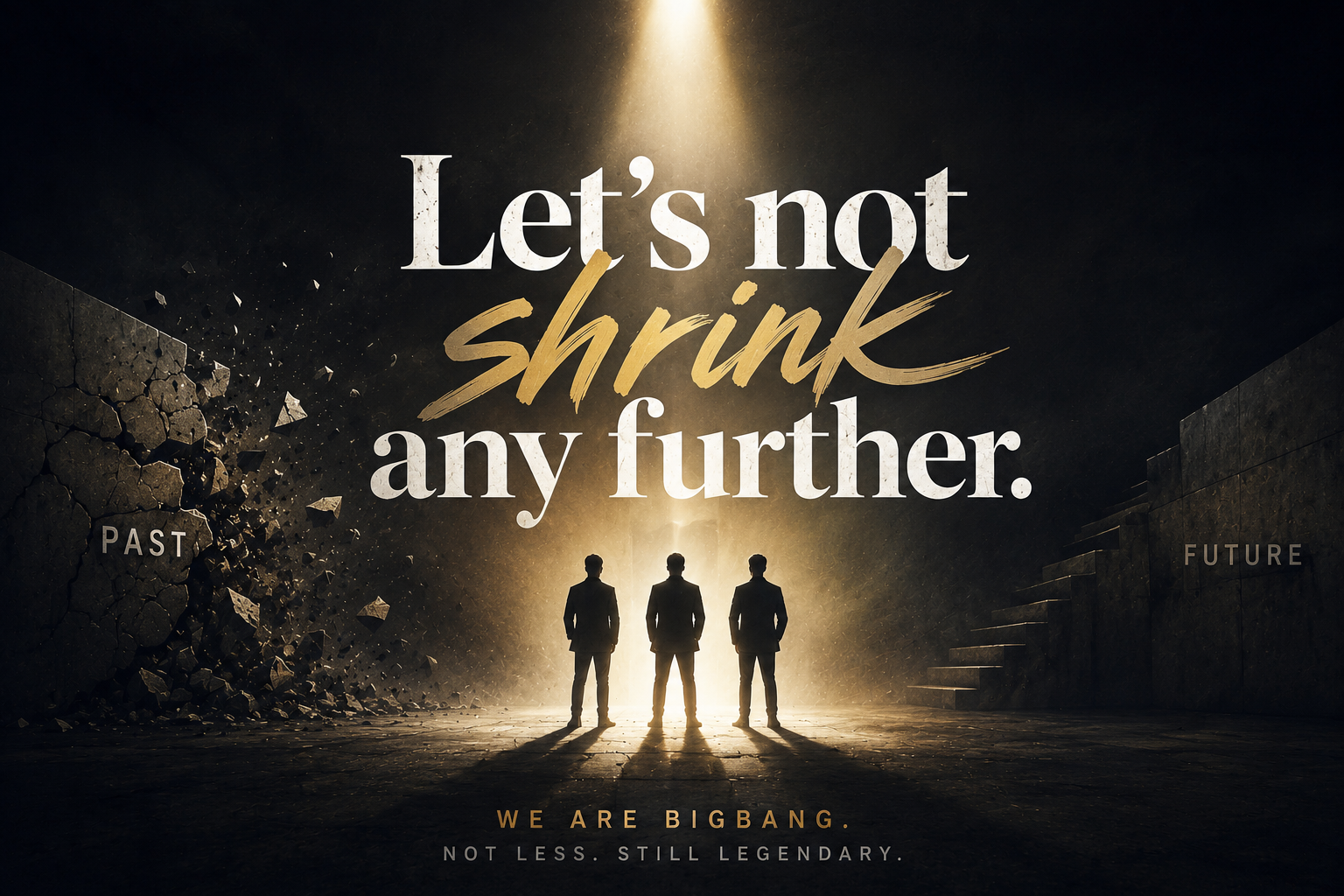
BIGBANG’s first world tour in nine years starts this month — 31 shows, 18 cities, a 20th-anniversary victory lap. It’s also the first tour where the group has stopped pretending it might one day be five again.
BIGBANG’s 2026 World Tour opens August 21 at Goyang Stadium — three nights there, then 31 shows across 18 cities spanning North America, Europe, Oceania, and Asia. It’s the group’s first world tour since 2017, and every headline is treating it, fairly, as a triumphant 20th-anniversary return. What most of that coverage handles gently, or skips entirely, is that the group taking that victory lap is G-Dragon, Taeyang, and Daesung — three of the five men who debuted together in 2006. This is not a reunion tour in the way that word usually gets used. It’s a tour by the group BIGBANG has actually been, on paper, since 2023.
T.O.P and Seungri didn’t leave BIGBANG for the same reason, and it does neither man justice to blur the two stories together. In 2017, T.O.P was found to have used marijuana while serving mandatory duty as an auxiliary police officer, and received a suspended prison sentence. He remained nominally part of the group through his military service and beyond, but his contract with YG Entertainment lapsed in February 2022 and wasn’t renewed. By mid-2023, reporting confirmed what fans had suspected for a while: T.O.P was no longer part of BIGBANG’s active lineup.
Seungri’s exit was categorically more serious. In 2019, he was implicated in the Burning Sun scandal, a nightclub-linked investigation that led to his departure from BIGBANG and full retirement from the entertainment industry. He was later convicted on multiple charges in a military court and served time. Unlike T.O.P, there’s been no public conversation about a path back — not for Seungri as a performer, and certainly not for Seungri as a member of BIGBANG.
What’s struck longtime observers of the group is how differently G-Dragon and Taeyang have treated T.O.P’s departure compared to how these situations often go. Last year, when T.O.P released his own solo album — his first in over a decade — both G-Dragon and Taeyang publicly promoted it on their own social accounts, more than a decade after T.O.P’s exit from the group’s day-to-day activities. Korean press covering the moment described it plainly as loyalty rather than a clean break: the two members who stayed haven’t treated T.O.P as someone they’ve cut ties with, even if he’s no longer part of BIGBANG’s lineup.
T.O.P has spoken about the departure in similarly measured terms. In a 2025 interview tied to his “Squid Game” work, he said, for the first time publicly, that he felt he’d caused real harm to both BIGBANG and YG, and that he chose to leave rather than risk causing the group and the company further damage. He added that watching fans continue to hope for a reunion was, in his words, genuinely painful to witness.
How the Group Talks About Itself Now
The clearest window into how the three remaining members have actually processed this came, unexpectedly, on a variety show last November. Talking with Daesung and Taeyang, G-Dragon turned suddenly serious and told the other two, half as a joke and half not: “Let’s not shrink any further.” Daesung laughed it off — “well, there’s no such thing as a two-leaf clover” — and G-Dragon, still in on the bit, added that a two-leaf clover would look sad anyway, so they might as well just call it a leaf.
It’s a small moment, but it says more than any official statement has. The members aren’t performing grief about the lineup, and they’re not pretending the door is still open, either. They’ve landed somewhere that sounds a lot like acceptance delivered as deadpan humor — the kind of joke a family makes about a loss everyone’s already made peace with, not one still raw enough to need careful language.
Even this year’s press hasn’t been fully consistent about how to describe what’s touring. One Korean outlet’s headline in March asked, almost hopefully, whether BIGBANG was “returning as a complete unit” for its 20th anniversary — a question the tour itself has since answered definitively, and in the negative. YG’s own statement ahead of the tour leaned on continuity rather than completeness, promising a show “worthy of the BIGBANG name,” which is a carefully different claim than promising the full group.
That distinction is worth sitting with. “BIGBANG” is, at this point, doing double duty as both a specific five-person roster from 2006 and a brand carrying two decades of songs, choreography, and cultural weight that three of the original five are choosing to keep operating under. Neither use is dishonest, but they’re not quite the same thing, and the tour marketing is banking on audiences not needing to choose between them — letting the nostalgia of “Fantastic Baby” and “Bang Bang Bang” do the work that a genuinely complete reunion would otherwise have to do.
Twenty years is long enough that a group’s name stops being just a lineup and starts being an era people lived through — which is probably the most honest way to understand what’s touring this August. This isn’t the five men who made “Lies” and “Haru Haru” in the mid-2000s. It’s three of them, carrying two decades of songs that belong to more people than just the ones on stage.
I don’t think that’s a story to mourn. G-Dragon’s joke about the two-leaf clover is, in its own dry way, the healthiest thing anyone connected to this group has said about it in years — an acknowledgment that doesn’t pretend the gap isn’t there, but doesn’t treat it as an open wound either. BIGBANG at three isn’t a diminished version of BIGBANG at five. It’s just what BIGBANG is now, and the tour seems to know that better than most of the headlines announcing it.
— KpopWave Editorial
Reporting cross-verified across Wikipedia (Korean), Insight, Marie Claire Korea, Sports Chosun, Nate News, and Korean entertainment press coverage of BIGBANG’s lineup history and 2026 World Tour announcement (2022–2026). Quoted material is limited and independently confirmed across multiple outlets.