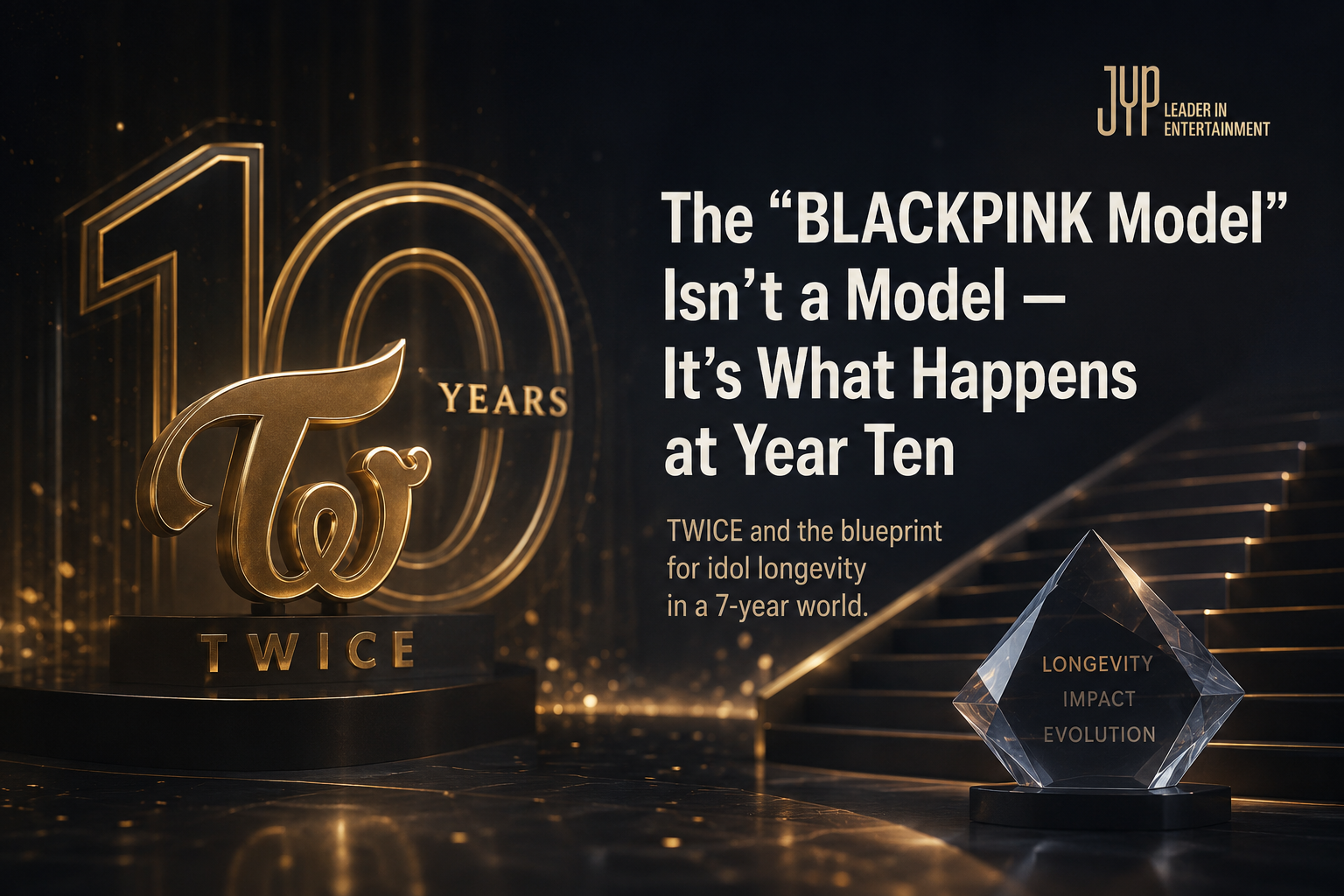
TWICE has entered its second re-contract negotiation with JYP, and the internet has already decided it knows the outcome. The comparison being reached for tells you more about how lazily the industry talks about contracts than about what TWICE is actually facing.
TWICE is twelve years into a career most K-pop groups don’t reach, and JYP Entertainment has confirmed the group is now in a new round of contract negotiations. Almost immediately, reports surfaced linking individual members — Jeongyeon, Tzuyu, Chaeyoung, Jihyo — to outside agencies, and the shorthand explanation arrived just as fast: TWICE is heading toward “the BLACKPINK model,” group promotions through JYP, solo careers scattered across separate companies. It’s a tidy story. It’s also probably the wrong frame, for reasons that have nothing to do with whether the members stay together.
JYP confirmed on June 24 that TWICE is in what it called a “re-contract discussion period,” describing the process as one of careful, mutual conversation between the company and the members, with an update to follow once anything is finalized. That statement, notably, doesn’t confirm a split of any kind — it confirms only that negotiations are underway, which is itself unremarkable for a group nearing the end of a contract cycle.
What’s driven the speculation is more specific: Jeongyeon has been reported in connection with Baro Entertainment, the agency representing her older sister, actress Gong Seung-yeon. Tzuyu has been linked to a Taiwan-based agency her mother is said to have founded. Chaeyoung and Jihyo have also been reported as exploring other agencies for individual activities. None of this has been confirmed as final by JYP or the members themselves — but the pattern of names is specific enough that it’s driving most of the “BLACKPINK model” framing in Korean coverage.
The BLACKPINK arrangement is real and specific: group activities stay with YG Entertainment, while each member has pursued individual ventures through separate companies or independent setups. It’s become the reference point anytime a senior girl group’s contract cycle comes up. But it’s worth being precise about what that arrangement actually required to work, because TWICE isn’t starting from the same place.
It’s also worth noting the framing itself isn’t new. Girls’ Generation has maintained group comebacks for years even as multiple members built careers under different agencies. 2PM has continued group activities under JYP while its members are individually signed elsewhere. Red Velvet has kept its lineup active as a unit even after some members moved their personal contracts. Split structures — group contract in one place, individual contracts scattered — have quietly become the default outcome for K-pop groups that make it past the decade mark, not a special maneuver BLACKPINK invented.
Why Year Ten Forces This
Strip away the BLACKPINK comparison and what’s really happening is closer to biology than strategy: every long-running K-pop group eventually has to solve the same math problem. In year one through five, group promotion is the entire business — comebacks, tours, variety appearances, all coordinated as a single unit because there’s no individual demand yet to manage separately. By year ten, that’s no longer true. Members have built independent acting careers, solo discographies, overseas fanbases, and fashion-house relationships that don’t all move at the same speed or point in the same direction.
- The BLACKPINK case is the version of this problem solved by four members who had already become individually bankable before any split conversation happened — Jennie, Lisa, Jisoo, and Rosé each carried standalone luxury ambassadorships and solo catalogs strong enough to make separate representation an obvious, low-risk move.
- TWICE’s version is messier by comparison, not because the group is weaker, but because its commercial strength has always been more evenly distributed across nine members and expressed collectively — through tours, unit releases, and reality content — rather than through four hyper-individualized global personas. Splitting nine people across potentially five or six different companies is a logistics problem BLACKPINK’s four-way split never had to solve.
That’s the real story sitting underneath the “BLACKPINK model” headlines: not whether TWICE breaks up in some way, but whether a group built on collective identity can be restructured into individual contracts without the coordination cost — scheduling, IP licensing, tour logistics — becoming the story instead of the music.
TWICE isn’t just a legacy act for JYP — reporting describes the group as one of the company’s core intellectual properties, anchoring its global touring, album, and licensing business. That gives JYP real incentive to protect the group unit even if it accepts separate individual contracts for some members, and it’s the likely reason coverage keeps floating a split-contract structure rather than a full-group departure as the working assumption. A company doesn’t let its most bankable global IP walk without a serious fight to keep the group container intact, whatever happens to the individual paperwork underneath it.
The “BLACKPINK model” language flattens something that deserves more precision. BLACKPINK’s split worked because the company was managing four already-separate global brands that happened to also make music together. TWICE is trying to solve the opposite problem — how to formally separate nine intertwined contracts without unraveling a group identity that was never built around four individual megastars in the first place.
I don’t think this negotiation tells us TWICE is ending. I think it tells us K-pop’s contract templates haven’t caught up to what a genuinely decade-plus group actually looks like on the inside — and that “just do what BLACKPINK did” is a headline, not a plan.
— KpopWave Editorial
Reporting cross-verified across Edaily, SSTV (via Daum), Xports News, and Namuwiki, citing JYP Entertainment’s official June 24, 2026 statement and subsequent Korean entertainment press coverage of individual member agency reports (June–July 2026). Contract terms remain unconfirmed as of publication; all agency links are reported, not confirmed by JYP or the members. Quoted material is limited and independently confirmed across multiple outlets.