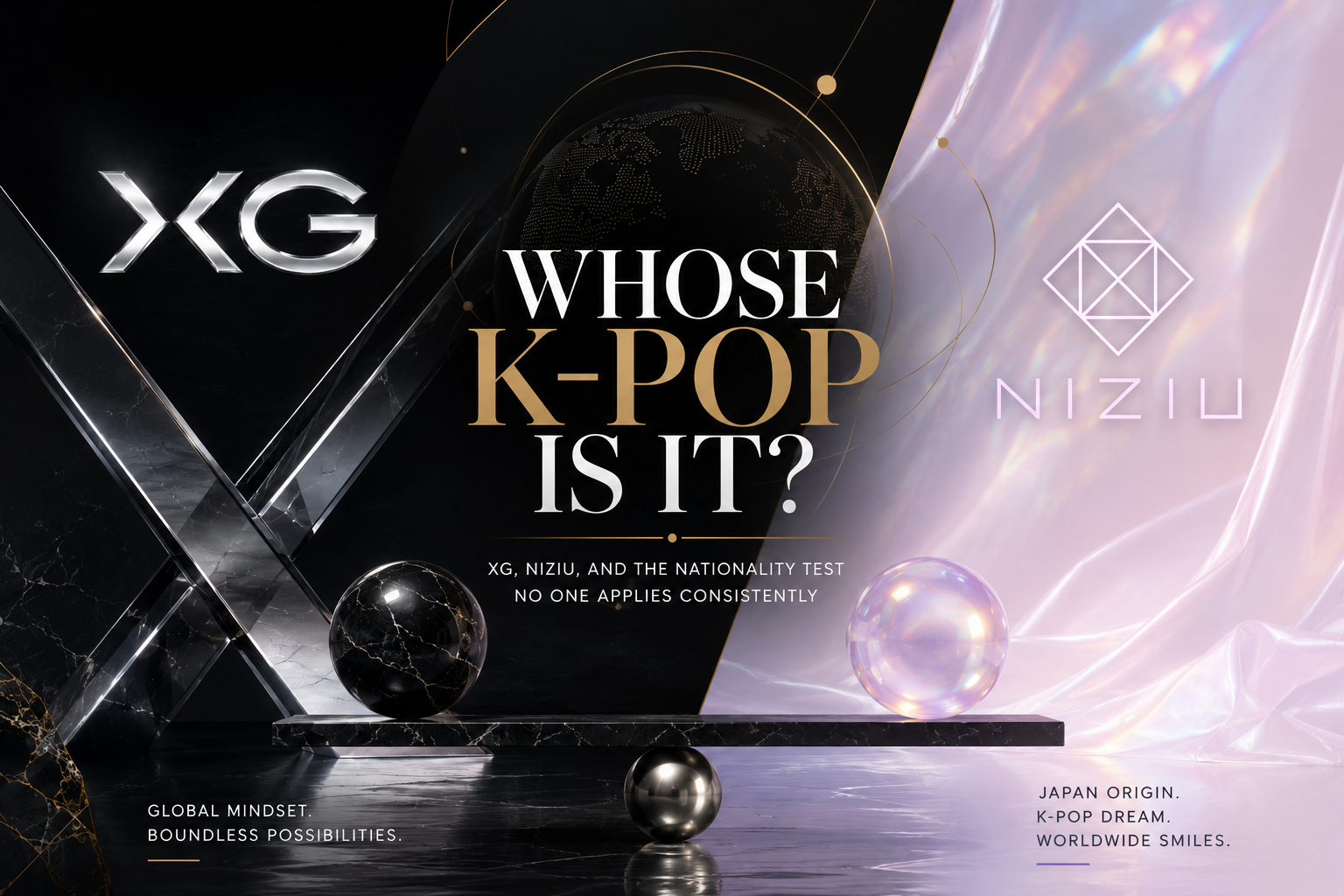
A Japanese company trains a Japanese group in Korea and calls it “not K-pop.” A Korean company trains a Japanese group in Korea and calls it J-pop. The method is identical. Only the label changes — and it changes for business reasons, not cultural ones.
Ask ten fans whether XG is a K-pop group and expect ten different answers, most of them confident. Ask the same question about NiziU and you’ll get the opposite problem — a near-unanimous “no,” despite NiziU being built by one of Korea’s three biggest entertainment companies using the exact training pipeline that produced TWICE and Stray Kids. The two cases mirror each other perfectly, and looked at side by side, they say less about either group and more about how loosely “K-pop” actually gets defined by the industry that owns the term.
What actually makes a group “K-pop” was never really about geography. It’s a production process: modular vocal and dance training, a survival-show or trainee pipeline, choreography built for camera-ready formations, comeback cycles timed to music-show wins. That process was developed and refined inside Korea’s major agencies, but it was never patent-protected — and for the past several years, companies far outside Korea have been licensing it, hiring its choreographers, and running their own talent through versions of it.
That’s exactly what happened with both XG and NiziU. Both groups are composed entirely of Japanese members. Both trained substantially in South Korea. Both are managed day-to-day using systems modeled on Korean idol companies. And yet one calls itself anything but K-pop, while the other is simply filed under J-pop without much debate at all — Oricon and Billboard Japan track NiziU as a domestic act, full stop.
XG debuted in 2022 under XGALX, a label formed by Avex — the Japanese conglomerate that, notably, once distributed BoA’s Japanese releases in the early 2000s. XGALX’s founder, Masato Matsuura, has been unambiguous about how he wants the group understood. Working with Korean producers, he argued, doesn’t make a group Korean any more than a foreign coach makes an American football team foreign. His framing was closer to Hollywood than to Seoul: an international assembly line making a global product.
In practice, the group’s operations tell a more layered story. XG is based in South Korea, promoted on Korean music shows, and coached by Korean choreographers and vocal directors. Its members sing primarily in English — deliberately avoiding both Japanese and Korean, according to people close to the group’s management, so the music doesn’t read as belonging to either national industry. In January 2026, XG further loosened its own self-definition, reinterpreting its name from “Xtraordinary Girls” to “Xtraordinary Genes” — a change the agency tied to the members entering their twenties and to a new album era, arriving about a month after member Cocona publicly came out as transmasculine non-binary. XGALX has consistently described XG as a “global group” rather than a national one, on every axis: genre, gender, and geography alike.
The Mirror Case
NiziU is, on paper, the more Korean of the two groups — formed directly by JYP Entertainment, one of Korea’s original “Big Three,” through Nizi Project, a JYP-produced survival show. Contestants were cut from 26 to 14 in Japan, then relocated to train in South Korea for six months under JYP’s system, the same one used to build TWICE. J.Y. Park himself framed the project as “K-pop 3.0: Globalization by Localization” — a strategy of exporting the production method while dressing the output in the target market’s own genre clothing.
That strategy worked exactly as designed. NiziU’s music, promotional cycle, and chart classification are all built around the Japanese domestic market: Japanese-language singles, Oricon and RIAJ certifications, dome tours in Tokyo and Osaka. Billboard and Oricon list them as a Japanese act. Even fan communities that are fully aware of JYP’s involvement mostly agree NiziU is J-pop that happens to be K-pop-adjacent in method — not a semantic contradiction so much as a demonstration that the company itself never wanted the K-pop label applied here. Calling it K-pop would have undercut the entire localization pitch.
Line the three groups up and the actual sorting variable becomes obvious. It isn’t where training happened — all three trained substantially in Korea. It isn’t the members’ nationality — XG and NiziU are both all-Japanese lineups. It’s some combination of company nationality and target market, applied inconsistently depending on which direction is more useful to sell into.
- XG (Japanese company, global target): disclaims K-pop to avoid being read as a Korean import in Western markets where “K-pop” is a specific, sometimes limiting, brand category.
- NiziU (Korean company, Japanese target): disclaims K-pop to avoid alienating a domestic Japanese audience that, at points over the past decade, has had a complicated relationship with Korean cultural imports.
- IVE (Korean company, Korean target): never has to disclaim anything, because the default assumption already favors it — majority-Korean company, majority-Korean members, primary market at home.
IVE is the control case that makes the other two legible. Rei, the group’s one Japanese member, went through functionally the same recruitment and relocation process as any NiziU or XG member — auditioned in Japan, moved to Korea as a young teenager, trained for years inside a K-pop system. Nobody debates whether IVE is K-pop. The label was never in question, because the group only had to clear one bar — Korean company, Korean majority — instead of the two XG and NiziU are each straining against from opposite directions.
The label carries real weight for the audience caught in the middle of it. Genre classification determines which charts a release competes on, which awards shows a group is eligible for, and which trade press even covers a comeback. A Japanese fan who discovered XG through K-pop content and a Japanese fan who discovered NiziU through J-pop content are, in a meaningful sense, being sorted into different fandom ecosystems by decisions made entirely at the corporate level — not by anything the artists themselves chose or performed differently.
It also shapes a subtler kind of pride and disappointment. Fans who want to claim a group as “theirs” — as evidence that homegrown talent can compete on the biggest stage — are handed inconsistent rules for what counts as home. XG’s insistence on Japanese identity plays well for fans who want a Japan-made success story untethered from Korea’s industry gravity. NiziU’s J-pop framing does something similar in reverse, letting JYP’s Korean fingerprints recede into the background of a story Japanese audiences can hold as their own. Neither framing is dishonest, exactly. Both are optimized.
I don’t think either company is being deceptive, exactly. Matsuura wants XG to compete in a global pop market where “K-pop” can be a ceiling as easily as a launchpad, and J.Y. Park wants NiziU to feel indigenous to a market JYP doesn’t own outright. Both are reasonable commercial instincts.
What I’d push back on is the idea that “K-pop” describes anything fixed at all once you look closely — it’s a label of convenience, assigned or withheld by whoever’s paying for the marketing plan, not a description of where a group trained or who’s standing on stage. IVE proves that a company only has to clear one bar, not two, to have the label applied without question. Japanese fans navigating XG’s global ambiguity and NiziU’s local specificity deserve to know they’re not parsing culture — they’re parsing a spreadsheet.
— KpopWave Editorial
Reporting cross-verified across Wikipedia, Namuwiki, Korea Herald, Billboard, Allkpop, and industry coverage of XGALX/Avex, JYP Entertainment/Sony Music Japan, and Starship Entertainment. Quoted material is limited and independently confirmed across multiple outlets.