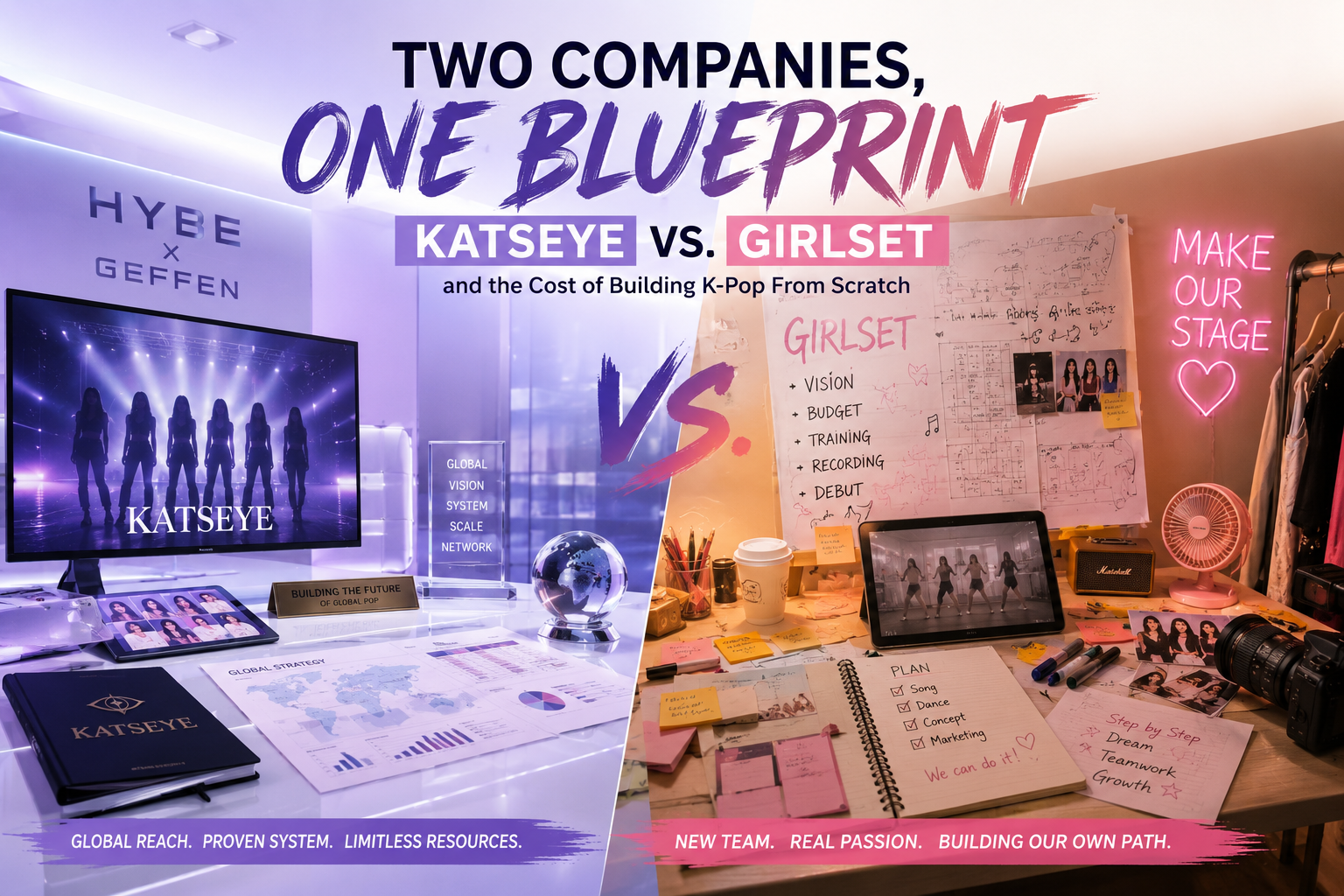
HYBE and JYP ran the same experiment in the same country at the same time. Two years in, the results say less about the girls than about the systems that built them.
In late 2023, two of K-pop’s biggest companies ran a version of the same bet: recruit young women in North America who had never trained as K-pop idols, put them through a filmed competition, and manufacture a global girl group from the winners. HYBE and Universal’s Geffen Records called theirs The Debut: Dream Academy. JYP and Republic Records called theirs A2K. Two and a half years later, KATSEYE is still six members deep into an unresolved hiatus. GIRLSET — the group that started as VCHA — is down to four of its original six, with one departure that came attached to a lawsuit. Same blueprint, same country, same television-industrial method of casting. Very different scars.
Strip away the branding and the two groups are structurally identical proposals. Both companies concluded that the fastest way to build a girl group with real reach in the U.S. market wasn’t to import trainees from Seoul — it was to find young women who were already American, already fluent in the culture, and run them through K-pop’s training system from scratch, in public, as content. The casting process wasn’t a prelude to the show. It was the show.
KATSEYE emerged from Dream Academy with six members: Sophia Laforteza, Lara Raj, Daniela Avanzini, Megan Skiendiel, Yoonchae Jeung, and Manon Bannerman. VCHA emerged from A2K with six of its own: Lexi, Camila, Kendall, Savanna, KG, and Kaylee. Both groups debuted within roughly seven months of each other in early-to-mid 2024. Both were positioned as proof of concept for a specific thesis — that K-pop’s methodology could be exported wholesale and grafted onto non-Korean talent without losing what makes it work.
KATSEYE’s roster has technically never shrunk. Megan Skiendiel took a brief hiatus in late 2024 for a back injury and returned. Manon Bannerman has been on what HxG calls a “temporary hiatus” since February 20, 2026 — a stretch that, as of this writing, has run five months with no return date and no detailed public explanation beyond “health and wellbeing.” The company has had to publicly deny that race was a factor, after fans noted Manon, the group’s only Black member, had engaged with posts about mistreatment of Black women in the industry. KATSEYE has stayed a six-person group on paper for its entire existence. In practice, it has spent roughly a fifth of 2026 performing, and being photographed, as five.
GIRLSET’s attrition has been more literal and less ambiguous. KG left in December 2024, publicly and abruptly, filing a contract-termination suit against JYP and posting a lengthy statement alleging mistreatment by certain staff and describing working and living conditions she said had seriously harmed members’ wellbeing. Kaylee, who had been on hiatus since March 2024 for undisclosed health reasons, followed in July 2025 with a comparatively quiet “mutual agreement” exit. By August 2025, the group had shed a third of its founding lineup and rebranded from VCHA to GIRLSET — a name change the members frame as a fresh start, chosen collectively, rather than a rebrand forced by crisis.
The Language of Damage Control
What separates the two situations isn’t really the severity of what happened — a serious, litigated allegation of mistreatment is categorically different from an unexplained hiatus, and it would be dishonest to flatten that distinction. What’s comparable is the vocabulary each company reaches for once the cracks are visible, and how little either vocabulary actually explains.
HxG’s statements lean on therapeutic language: “health and wellbeing,” “thoughtful conversations,” “the door is always open.” It is warm, procedural, and almost entirely non-specific — designed to signal care without committing to a timeline, a diagnosis, or a cause. JYP’s posture after KG’s allegations was more defensive and legal, structured around the fact of an active lawsuit, which gave the company a genuine reason to say less. But that same legal caution has also applied, less justifiably, to Kaylee’s far more ordinary exit, which was wrapped in nearly identical soft-focus language about mutual agreement and gratitude.
Notably, this isn’t HxG’s first “wellbeing”-framed exit this year. In July, the label’s second act, SAINT SATINE, lost founding member Lexie Levin under strikingly similar phrasing — “different ways of operating,” a mutual and amicable split. Two HxG-branded groups, two departures in one year, two statements that use the language of care to say as little as possible about what actually went wrong.
The more interesting comparison isn’t which company handled its crisis better — it’s what each crisis reveals about the incentive each company is protecting.
- HxG’s incentive is narrative continuity. KATSEYE’s entire value proposition rests on the idea that it is a happy, functional, hand-picked family — the emotional payoff of the Dream Academy narrative. An unresolved, unexplained absence is less damaging to that story than a hard confirmation that something is actually broken. Ambiguity, paradoxically, protects the brand better than clarity would.
- JYP’s incentive is legal exposure. Once KG went public with a lawsuit, every subsequent statement — including ones unrelated to her, like Kaylee’s — had to be written with litigation in mind. The caution isn’t really about protecting the group’s image; it’s about protecting the company from a second version of the same claim.
Both postures are rational for the company issuing them. Neither is designed primarily to inform the public, the fans, or, arguably, the members themselves about what’s actually happening.
The pitch behind both Dream Academy and A2K was that transparency itself would be the innovation — cameras in the room, a docuseries instead of a closed trainee dorm, an audience watching the casting decisions get made in real time. The implicit promise was that a system built and cast in public would be more accountable than the traditional model, not less.
Two and a half years on, that promise is being tested by the thing it was supposed to prevent: opaque, softly worded statements about why members are missing, arriving well after the cameras have stopped rolling. The visibility ended at debut. Everything that has happened to these ten young women since — the hiatuses, the lawsuit, the rebrand, the recasting — has played out through the same terse press-release language every other agency in the industry uses. The reality-show transparency was, it turns out, a first act, not an operating principle.
I don’t think it’s fair to rank these two situations against each other as though one company simply “did it better.” A litigated allegation of mistreatment and an unexplained five-month hiatus are not the same category of event, and treating them as equivalent PR problems would flatten something that shouldn’t be flattened.
But I do think it’s fair to notice that both companies, when pressed, reached for the same toolkit: warm, vague, wellbeing-coded language that asks fans to trust the process without being shown any of it. HYBE and JYP built these groups on the premise that letting cameras into the room made the system more honest. What both companies have demonstrated since is that the honesty only ran one direction — toward the audience, during casting, when it was good for business. Once something goes wrong, both systems default to the same closed door every legacy agency has always used. That’s not a KATSEYE problem or a GIRLSET problem. It’s the model’s actual ceiling.
— KpopWave Editorial
Reporting cross-verified across official HxG/KATSEYE statements (Weverse, X), JYP and JYP America statements, member social media posts, and coverage from Variety, Yahoo Entertainment, E! News, Vanity Fair (via The Tab), People, Teen Vogue, Edaily, Mydaily, and Joongang Economy News (Feb–July 2026 for KATSEYE; Dec 2024–Aug 2025 for VCHA/GIRLSET). Quoted material is limited and independently confirmed across multiple outlets.