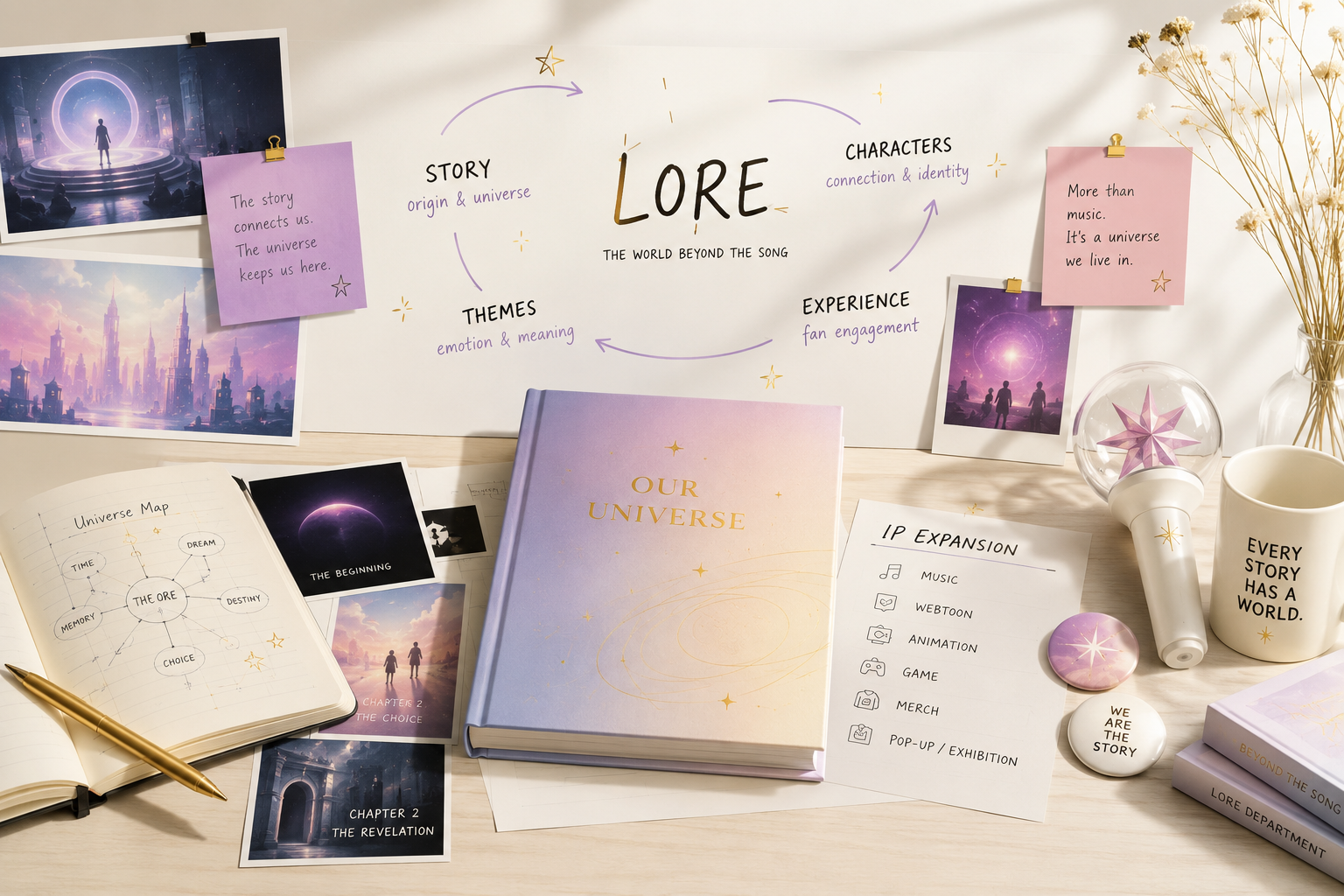
K-pop invented a new kind of fan labor — building fictional universes that only work if enough people believe in them. The question is who that actually serves.
Somewhere on TikTok, there is a video with the caption: “Lore so long even the members don’t know.” It is about ATEEZ. The comment section agrees. The members, for their part, have joked about this themselves — that the fictional universe spanning their discography since 2018 has accumulated sufficient complexity that keeping track of it requires more dedicated effort than most people apply to their actual jobs. The fans who have done that work — who have mapped the timelines, cross-referenced the diary entries, untangled the relationship between Halateez and Halazia and the Black Pirates and the dimension-jumping compass — are genuinely proud of it. They should be. It took hundreds of hours.
The question nobody asks out loud is: proud of what, exactly? And whose interests did all of that work serve?
Chapter One
The Invention of the K-Pop Universe
The BTS Universe — also known as the Bangtan Universe, or BU — did not begin as a strategy. It began as a music video.
“I Need U,” released in April 2015, depicted the seven BTS members in separate vignettes of trauma and collapse: a car accident, a fire, pills on a bathroom floor. The visuals were ambiguous enough to sustain multiple interpretations. Fans began connecting them immediately — building timelines, proposing theories, drawing maps of how the narratives might intersect. Big Hit Entertainment, watching the fan activity, made a decision that would reshape the entire genre: instead of clarifying, they would deepen. They would give the fans more to work with.
What followed over the next several years was the most elaborately constructed fictional apparatus in pop music history. The HYYH: The Notes novel — a physical book sold through the Weverse Shop, containing diary entries from fictional versions of the BTS members — became a bestseller not because fans needed more BTS content, but because it was a key to understanding content they had already seen. The Save Me webtoon adapted the universe for visual narrative. The Omelas reference — drawn from Ursula K. Le Guin’s 1973 short story about a utopia sustained by the suffering of a single child — gave the lore a literary anchor that elevated the interpretation from fan theory to something approaching literary analysis.
KpopWave Editorial
This is the structural innovation that matters. Marvel has a cinematic universe, but you can understand any individual film without having seen the others. The BTS Universe was designed differently — it was designed to reward completionists and to remain deliberately obscure to casual observers. The lore was not supplementary to the music. It was the mechanism by which dedicated fans were distinguished from casual listeners, and by which casual listeners were invited to become dedicated fans.
Every subsequent K-pop worldbuilding project has inherited this architecture, and most of them have made it more elaborate rather than less.
Chapter Two
The Industrial Scale
On January 14, 15, and 16 of 2022 — three consecutive days — HYBE launched three separate fictional universes simultaneously. 7FATES: CHAKHO, linked to BTS, debuted on January 14. Dark Moon: The Blood Altar, linked to ENHYPEN, launched January 15. The Star Seekers, linked to TXT, followed January 16. All three were published through WEBTOON and Wattpad, the two dominant global platforms for web comics and serialized fiction. The coordination was total. The message was unambiguous: HYBE was not dabbling in transmedia storytelling. It was building a studio.
Cumulative views for Dark Moon: The Blood Altar — surpassed in July 2025, three years after debut
Languages Dark Moon was translated into — ranked #1 in Germany for 32 consecutive weeks
Episodes in Dark Moon: The Blood Altar’s original run — plus prequels, sequels, and a spin-off featuring &TEAM
Dark Moon: The Blood Altar — the ENHYPEN-linked vampire romance — became, by a significant margin, the most successful of the three. By February 2023, it had crossed 100 million views. By July 2025, it had doubled that. The series was translated into ten languages and ranked in the top five of WEBTOON’s chart in seven different languages, including German, Spanish, French, and Indonesian. It ranked first in Germany’s Sunday Webtoon chart for 32 consecutive weeks. By the metrics available, it is a genuine hit — not just a K-pop fan service project, but a webtoon that found an audience beyond the existing ENHYPEN fanbase.
What HYBE built around that success is worth mapping carefully, because it demonstrates exactly how the modern K-pop IP strategy works when it is functioning at full capacity.
This is not a side project. This is a media franchise — one that, if you removed the ENHYPEN connection entirely, would be a commercially significant intellectual property in the global webtoon-to-animation pipeline. The anime airing on Crunchyroll, Netflix, and Amazon Prime Video in January 2026 reached an audience with no prior knowledge of or interest in K-pop. Dark Moon arrived in their feeds as an anime. The IP had successfully decoupled from its origin.
That decoupling is the point. SM Entertainment has announced a similar collaboration with Kakao Webtoon — a direct competitive response to HYBE’s WEBTOON partnership. The race to build K-pop fictional universes has become a strategic imperative at the label level, not a creative experiment.
Chapter Three
The Unpaid Theory Department
Here is the thing that does not appear in HYBE’s investor materials: the Dark Moon IP was not built by HYBE alone. It was built by HYBE and, in meaningful structural terms, by approximately two million people who work for free.
The ATEEZ lore community is perhaps the clearest example of what K-pop worldbuilding actually requires from its fans. The ATEEZ universe — which spans from “Pirate King” in 2018 through the Fever series, Halazia, the Golden Hour saga, and beyond — involves parallel timelines, multiple versions of the same characters (Ateez, Halateez, Halazia, the Black Pirates), a mystical object called Sopro whose origin and mechanics have occupied theorists for years, and diary entries distributed across physical album booklets that function as primary source documents requiring cross-referencing and close reading. No single piece of content explains the whole. The whole only becomes visible through accumulated effort.
Primary sources: Physical album diary entries (distributed across multiple album versions — full understanding requires purchasing all versions). Music video visual analysis across 60+ MVs. Short film content. Official social media posts.
Secondary sources: Fan-compiled timelines (the most comprehensive run to 15,000+ words). Cross-referencing tools built by fans to map character relationships across dimensions. YouTube theory videos with cumulative viewership in the tens of millions.
Time investment: No official estimate exists. Fan consensus in online communities is that achieving basic lore literacy takes 20–40 hours of dedicated engagement; comprehensive understanding requires ongoing attention across each comeback cycle.
Required purchases for full access: All album versions (diary entries vary by version), physical albums rather than digital-only purchases, and in some cases limited edition releases. The lore is deliberately inaccessible to those who only stream.
What the fans who do this work produce is, functionally, a continuously updated content marketing operation for ATEEZ and KQ Entertainment. The theory videos drive YouTube views. The Twitter threads drive engagement. The TikTok explainers — “ATEEZ lore explained in two minutes,” which routinely accumulate millions of views — introduce new fans to the group through the lore before they have heard a single song. The lore community is the top of the funnel for ATINY recruitment, and it is staffed entirely by volunteers who pay for the privilege of doing the work.
Media scholar Henry Jenkins coined the term “participatory culture” to describe fan communities that actively shape how media is used and understood. K-pop lore communities are the fullest realization of this model in contemporary music — and they raise the question Jenkins always meant to ask: participation toward what end, and on whose behalf?
Chapter Four
Does the Lore Actually Work?
Three fictional universes launched on three consecutive days in January 2022. They did not produce three equivalent results.
Top-ranked in 7 languages. 32 consecutive weeks at #1 in Germany. Anime on Crunchyroll, Netflix, Amazon Prime Video. Print edition from Yen Press. Active sequel launched November 2025.
Vampire romance is a globally portable genre. The story functions independently of ENHYPEN knowledge. New readers arrived through genre interest and stayed through fandom. The IP escaped its K-pop origin.
BTS’s fanbase guaranteed massive early readership — 7FATES hit records immediately. But long-term engagement did not compound the way Dark Moon’s did. No anime. No sequel announced.
BTS’s story is already the most elaborately developed in K-pop history through the BU. Fans weren’t looking for another fictional universe — they were already managing one. 7FATES ran parallel rather than extending what ARMY actually wanted.
The Star Seekers, the TXT-linked entry in the January 2022 trio, occupied the middle ground — active and beloved within the TXT fandom, but without the crossover reach of Dark Moon or the structural complication of 7FATES. It is genuinely good science-fantasy storytelling. It is also, by the metrics that determine whether HYBE invests in a sequel, the one that has not yet demonstrated that it can travel beyond the existing fanbase.
The pattern across these three cases suggests something the industry has not fully articulated: lore succeeds when the story is portable, and struggles when it is designed exclusively for the converted. Dark Moon works for non-ENHYPEN readers because vampires and werewolves are a genre with its own gravitational pull. The ATEEZ universe works within ATINY because it rewards the specific investment that ATINY is already making — but it is famously impenetrable to newcomers. The TXT lore sits somewhere between, internally coherent and emotionally resonant but requiring context that casual discovery rarely provides.
None of this is a criticism of the quality of the storytelling. It is an observation about the structural challenge of building a fictional universe around artists who are also real people — whose careers, military service, contract renewals, and personal lives all exist in a reality that the lore can never fully absorb. The BTS Universe had to accommodate Jin’s enlistment. The ATEEZ lore had to coexist with a decade of group history that the fictional universe both references and cannot contain. The lore and the life exist simultaneously, and the fan is always managing both.
I want to be careful about the obvious conclusion here, which is that K-pop lore is pure exploitation — companies extracting free interpretive labor from fans who should know better. I don’t think that’s right, and I don’t think most fans who do this work would recognize themselves in that framing.
The fans who build ATEEZ timelines and write Dark Moon theory posts are doing something that is genuinely satisfying on its own terms. The interpretive community that forms around shared lore is a real community — with its own social bonds, creative practices, and accumulated knowledge. The work produces something for the people who do it, not only for the labels that benefit from it. Both things are true simultaneously, and the discomfort of the situation is not resolved by insisting that only one of them matters.
What I find worth naming is the asymmetry. When Dark Moon generates 200 million views, HYBE receives the revenue from the Crunchyroll licensing deal, the Yen Press print edition, the SPAO fashion collaboration, and the Lotte World partnership. The fans who built the theory community that recruited half of those readers receive nothing except the satisfaction of having been right about Sopro’s significance in Chapter 47.
That is not a scandal. It is the ordinary economics of participatory culture, which has always involved enthusiasts creating value for institutions that capture it. Henry Jenkins described this in 2006. The K-pop industry has simply industrialized it, added a photocard, and given it a name with a logo.
The lore department is real. It is staffed entirely by people who volunteered. They are not being deceived — they know exactly what they are doing and why they find it meaningful. The question the industry never answers is whether, having built an entertainment franchise worth hundreds of millions of dollars on the foundation of their interpretive labor, it owes them anything more than a really good Chapter 72. Most fans have already decided the answer is no. I am less certain.