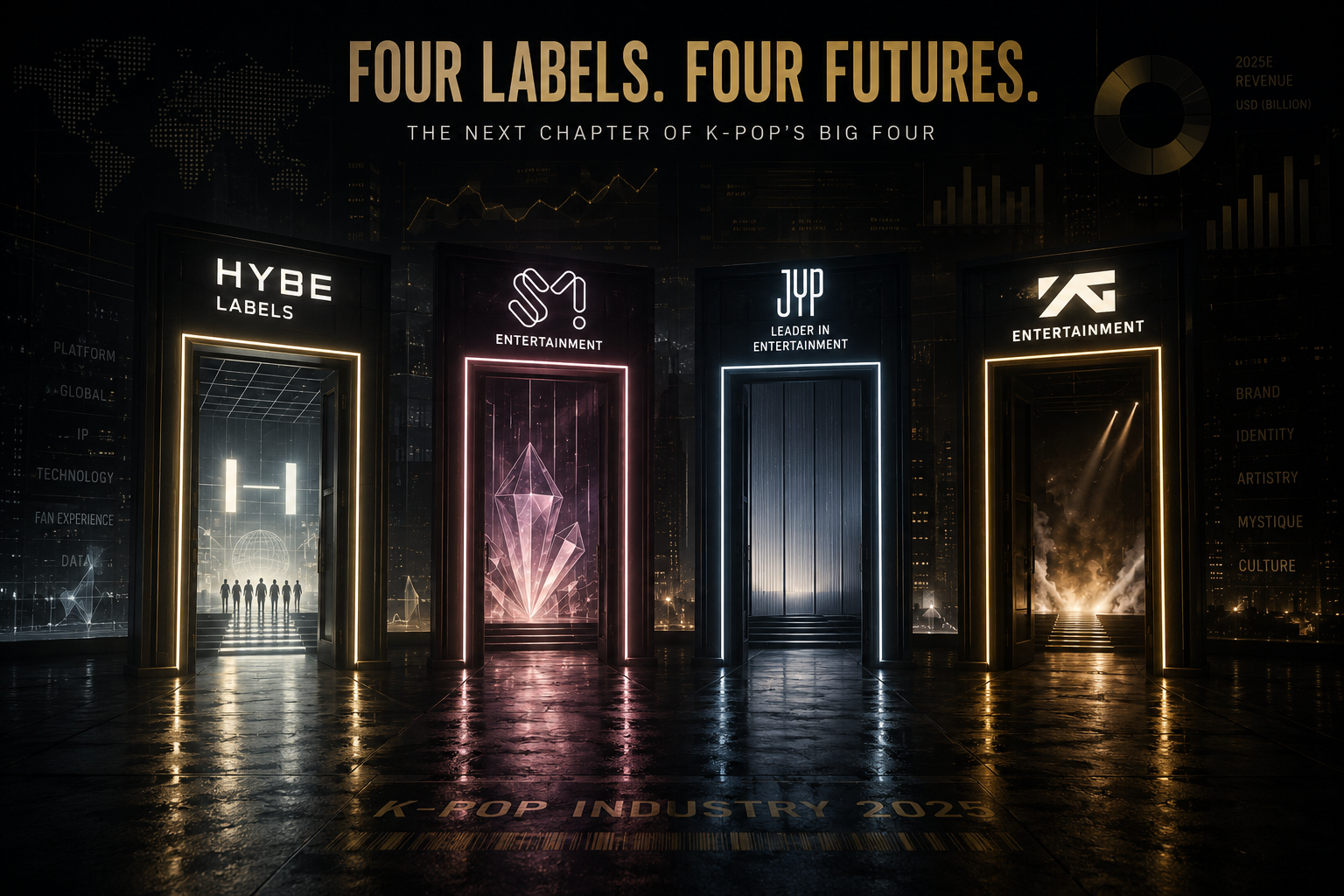
HYBE is building a platform. SM is dismantling its founder. JYP is quietly franchising the world. YG is selling scarcity. None of them are really in the music business anymore.
In 2025, the four major K-pop labels collectively generated roughly $3.7 billion in revenue. That puts them, as a combined entity, in the same conversation as Universal Music Group’s individual divisions — not the comparison most people would have made five years ago, and not one the labels themselves would have made even three years ago. The music was always good. What changed was the business model around it.
Here is what is easy to miss when you look at HYBE, SM Entertainment, JYP Entertainment, and YG Entertainment from the outside: these four companies are no longer competing over the same thing. They share an industry — K-pop — and an origin — Seoul — but they have arrived, through very different routes and very different choices, at four fundamentally different answers to the same question.
The question is not “how do you make money from K-pop?” They all know how to do that. The question is: what business are you actually in? And on that question, none of these companies agrees.
$1.99B
2025 Revenue
Record high. OP margin: 1.9%
$697M
2025 Revenue
Record high. Q4 OP margin: 17.1%
$616M
2025 Revenue
Record high. Highest OP margin of the four
$409M
2025 Revenue
+49.4% YoY. Return to profitability
Label One
The Platform Bet
It wants to be the next Amazon of fan culture. That’s either visionary or the most expensive mistake in K-pop history.
In 2025, HYBE’s concert revenue grew 69% year-over-year, reaching ₩763.9 billion — nearly matching its recorded music revenue for the first time in the company’s history. The company staged 279 concerts across 53 cities, ranking fourth globally on Billboard’s Top Promoters chart, entering what the industry calls the “Big 4” of live entertainment alongside Live Nation, AEG Presents, and CTS Eventim. Meanwhile, its operating profit fell 73%, from ₩184.8 billion to ₩49.9 billion, as the company absorbed roughly ₩200 billion in impairment losses from restructuring its North American operations.
HYBE’s CFO described this as “sacrificing short-term profits to build a better, more sustainable owner-operated system for future long-term growth.” The comparison that keeps appearing in HYBE investor materials and analyst notes is Amazon — a company that also looked chronically unprofitable during its biggest investment years and is now worth $2 trillion.
The comparison is instructive, and not entirely in the way HYBE intends.
Amazon’s profitability came not from selling books or electronics but from AWS — a cloud computing infrastructure business that most observers didn’t even recognize as HYBE’s real product until it was already dominant. HYBE’s equivalent bet is Weverse, its direct-to-fan platform: memberships, digital content, live streaming, merchandise, ticketing, community. In 2025, Weverse turned its first annual profit, averaging 10.9 million monthly active users with total payments up significantly. These are promising numbers. They are not yet AWS numbers.
KpopWave Editorial
HYBE’s multi-label architecture — Big Hit Music, Pledis, Source Music, ADOR, KOZ, and others — gives it something no other K-pop company has: the ability to run multiple artists simultaneously without creative cannibalizing. When BTS enlisted, SEVENTEEN, TXT, ENHYPEN, and LE SSERAFIM collectively sustained the company’s revenue. When BTS returned in 2026 with the “ARIRANG” world tour — 82 stadium shows across 34 cities — the multi-label portfolio was already waiting to amplify rather than replace.
But the multi-label system also produced HYBE’s most visible failure. The 2024 dispute between HYBE and ADOR CEO Min Hee-jin — who created NewJeans and accused HYBE of attempting to clone the group’s aesthetic with ILLIT — exposed something structural: a company that had built creative independence into its subsidiaries did not have a mechanism for managing the conflicts that creative independence inevitably produces. The governance crisis that followed cost HYBE NewJeans, one of its most globally influential acts, and generated months of damaging press coverage that no streaming number could fully offset.
HYBE is not in the music business. It is in the fan relationship infrastructure business — and the evidence that this bet will pay off is still being gathered.
Label Two
The Legacy Bet
Thirty years of cultural technology. One founder forced out. The question is whether what Lee Soo-man built can outlast Lee Soo-man.
SM Entertainment invented the modern K-pop system. This is not hyperbole — it is a verifiable claim. When Lee Soo-man formalized what he called “Cultural Technology” in the mid-1990s, he created the systematic approach to idol training, visual presentation, and fan engagement infrastructure that every other K-pop company subsequently adopted, adapted, or reacted against. H.O.T., TVXQ, Girls’ Generation, EXO, Red Velvet, NCT, aespa — the lineage is unbroken and the influence on the entire genre is total.
In February 2023, SM’s board of directors removed Lee Soo-man from operational control. The company had announced “SM 3.0” — a structural overhaul that replaced the single-producer model with a multi-production center system, dividing SM’s artists across six semi-independent creative units, each with its own decision-making authority. It was presented as an evolution. It was also, unmistakably, a bet that the thing Lee Soo-man had built was more valuable than Lee Soo-man himself.
Before: All SM artists produced under a single creative vision — Lee Soo-man’s. One aesthetic grammar. One man’s judgment on every significant creative call for thirty years.
After: Six “production centers,” each managing separate artist rosters with independent creative and business authority. A new music publishing subsidiary. A virtual artist division (Naevis). Explicit US market expansion targets including a US-trained debut act.
The goal: ₩1.8 trillion ($1.4B) in annual revenue by 2025, with ₩500 billion in operating profit. The result: ₩1 trillion in revenue — a record, but roughly half the operating profit target. The architecture is in place. The scale is not yet there.
SM’s 2025 financials were the best in the company’s history: record annual revenue crossing ₩1 trillion for the first time, with Q4 operating margin hitting 17.1% — the strongest quarter ever. The multi-production center system is functioning. Concert and merchandise revenue grew more than 50%. RIIZE, the first group debuted under the new structure, established a dedicated global fanbase in its first two years. aespa continues to be one of the most globally visible K-pop acts, performing as the first K-pop girl group featured in Dubai’s Imagine Show.
And yet SM’s strategic position remains genuinely uncertain in a way its financial performance doesn’t fully reveal. The SM 3.0 system is producing revenue. It has not yet produced an act at the scale of what Lee Soo-man’s system produced at its peak — the global coherence of EXO, the sustained commercial dominance of Girls’ Generation, the cultural reach of TVXQ. Whether that kind of output requires a single unifying creative vision, or whether it can emerge from a committee of production centers, is a question that SM’s next five years will answer.
SM is not in the music business. It is in the business of proving that the machine is greater than the person who built it.
Label Three
The Franchise Bet
JYP rarely wins the news cycle. It consistently wins the balance sheet. There’s a reason for that.
JYP Entertainment does not make headlines the way HYBE makes headlines. Its governance crises are less dramatic. Its strategic announcements are less sweeping. Its founder, Park Jin-young, has been gradually stepping back from operational management for years without producing a single viral controversy in the process. JYP is, by the standards of the K-pop industry, boring to write about.
Its financials are not boring. In Q2 2025, JYP reported operating profit growth of 466% year-over-year, with a net profit increase of 2,734%. For the full year 2025, the company recorded roughly ₩822 billion in revenue — a record — with an operating margin consistently running higher than any of the other three major labels. In an industry that celebrates raw scale, JYP is the company most efficiently converting revenue into profit.
The explanation is a philosophy JYP calls “Globalization by Localization” — and it is, structurally, a franchise model. Rather than exporting Korean acts to every market and hoping the content crosses cultural barriers, JYP builds local acts using the K-pop training system as the production infrastructure. NiziU for Japan. VCHA for the United States. NEXZ as a Japan-Korea hybrid. CIIU targeting China. Each group is a localized deployment of the same underlying system — auditions, trainee development, K-pop production grammar — calibrated for a specific market’s audience.
Korea → Japan: NiziU debuted 2020. Pre-debut single “Make You Happy” topped Oricon digital chart. Appeared on NHK Kōhaku Uta Gassen months after debut. Became a full domestic Japanese act built on K-pop infrastructure.
Korea → US: VCHA (formerly Girls on Top), debuted 2024 via JYP x Republic Records joint venture. First JYP group with US members trained in Korea’s system for the Western market.
Outside Korea, beyond Japan: Revenue from regions outside Korea, Japan, and China hit 41% of total JYP revenue in Q2 2025 — up from 31% the previous year and only 13% five years prior. The diversification is measurable and accelerating.
JYP’s flagship acts — TWICE, Stray Kids, DAY6 — are simultaneously funding this expansion and proving its model. Stray Kids completed what JYP described as the “largest K-pop world tour ever” in 2025, 54 shows across 34 regions including the first and largest K-pop records at 13 stadiums across North America, Europe, and Latin America. TWICE headlined Lollapalooza Chicago, becoming the first K-pop girl group to do so. These are not just commercial milestones. They are proof-of-concept demonstrations that K-pop acts trained in the JYP system can sustain stadium-scale touring in Western markets — which makes the case for every localized group JYP is building elsewhere.
JYP is not in the music business. It is in the business of exporting a production system — and collecting a franchise fee from every market it enters.
Label Four
The Luxury Bet
The smallest revenue. The most recognizable brand. YG has decided that scarcity is a strategy.
YG Entertainment generates the least revenue of the Big Four. It also controls the brand with arguably the highest per-act commercial density in the industry. BLACKPINK’s Born Pink world tour — which concluded in 2023 — was the highest-grossing tour ever by a female group in history at the time of its conclusion. The group’s individual members have since maintained simultaneous positions as brand ambassadors for Chanel, Valentino, Bvlgari, Saint Laurent, and Tiffany & Co., among others. These are not K-pop endorsement deals. They are luxury goods partnerships — a category of brand relationship that had, before BLACKPINK, been almost entirely inaccessible to Asian pop acts.
YG’s philosophy has a name in the industry: “quality over quantity.” In practice, this means fewer acts, longer development timelines, and release schedules that move at a pace other labels would consider dangerously slow. BLACKPINK went over a year between full album releases at multiple points in their career. BABYMONSTER debuted in 2024 and has moved on a deliberately staged rollout. Big Bang, returning in 2026 following a years-long hiatus, is being repositioned as a heritage act rather than an active promotions machine. YG does not drop. YG arrives.
KpopWave Editorial
YG’s 2025 financials reflect the risk this strategy carries. Revenue of ₩545.4 billion — up 49.4% year-over-year — is impressive growth, but it represents the smallest absolute revenue among the Big Four, at roughly 21% of HYBE’s total. The company’s operating profit of ₩71.3 billion marks a return to profitability after several difficult years, driven by BLACKPINK’s renewed activity, BABYMONSTER’s Japan market breakthrough, and Treasure’s Asia touring. These are real recoveries. They are also entirely dependent on acts that YG did not deliberately sequence, but rather scrambled to activate after the Burning Sun scandal of 2019 and the subsequent departure of several flagship acts disrupted the label’s planned release cadence.
The luxury strategy is real and it works — when the flagship acts are active. The structural vulnerability is that “quality over quantity” produces very few acts, and very few acts means very little resilience when any single one goes offline. YG’s counter-argument is that luxury brands also depend on flagship lines, and that the answer is not to dilute the portfolio but to develop the next generation of flagships. BABYMONSTER’s record-setting pace in the Japanese market — the fastest K-pop girl group to reach a certain audience size there — is the evidence YG is currently offering.
YG is not in the music business. It is in the luxury goods business, and its artists are the products around which scarcity, desire, and premium pricing are carefully engineered.
The Question
The Music Is Not the Battlefield
Four different answers to one question neither of them has said out loud.
Fan Platform Infrastructure
IP Production System
Global Franchise Model
Luxury Brand Architecture
The reason this matters beyond corporate strategy analysis is what it implies about where the music industry is going — not just K-pop, but all of it.
Generative AI is already producing music at scale. In 2025, AI-generated tracks routinely crossed streaming thresholds that would have represented breakout success for human artists five years earlier. The cost of producing a competent piece of recorded music is collapsing toward zero. Every major streaming platform is now making decisions about how to handle the volume. The music itself — the song, the recording, the track — is becoming abundant in a way it has never been before in the industry’s history.
When something becomes abundant, the value migrates. It moves to whatever remains scarce. And looking at the four bets these companies are making, each of them represents a different theory about where that scarcity will live.
HYBE is betting it lives in the relationship — the direct, sustained, emotionally charged connection between a fan and an artist, mediated by a platform that the label controls end-to-end. SM is betting it lives in the system — the accumulated production knowledge that allows the creation of globally coherent IP at a level of quality that random generation cannot replicate. JYP is betting it lives in the methodology — the training, the coordination, the cultural grammar of K-pop as a deployable technology that works in any market. YG is betting it lives in the brand — the specific aura of premium scarcity that luxury has always sold, and that no algorithm can manufacture because it depends on human cultural consensus about what is rare and therefore valuable.
I find myself returning to the same observation every time I work through this material: none of these companies is competing over songs anymore. Songs are the entry point. Songs are how you get someone to care. But songs are not where any of these four labels is making its strategic bet about the next decade.
Of the four bets, I think JYP’s is the most immediately durable — the franchise model generates consistent margin, doesn’t depend on any single act, and is demonstrably exportable. JYP rarely wins the news cycle. It consistently wins the balance sheet. That combination is underrated.
I think HYBE’s bet is the most important — if Weverse becomes what HYBE needs it to become, it restructures the entire economics of K-pop fandom in ways that the other three labels would then have to respond to. But “if” is doing a lot of work in that sentence, and HYBE’s 1.9% operating margin in a record revenue year is a reminder of how much the bet is currently costing.
I think SM’s bet is the most uncertain. The multi-production center system is an attempt to institutionalize genius — to replace one person’s irreplaceable creative vision with a committee’s collective process — and history has not been kind to that kind of attempt in any creative industry. SM may prove history wrong. It has done so before.
And YG’s bet — the luxury bet, the scarcity bet — is the one I find myself thinking about most in the context of AI-generated music, because it is the bet that most directly acknowledges what the others only imply: that when music becomes abundant, the thing that retains value is not the song. It is the meaning attached to the person who made it.
Four labels. Four theories about where value will exist after music becomes cheap. The question isn’t which strategy is correct. The question is which company will be proven right first — and whether the rest will have enough time to follow.