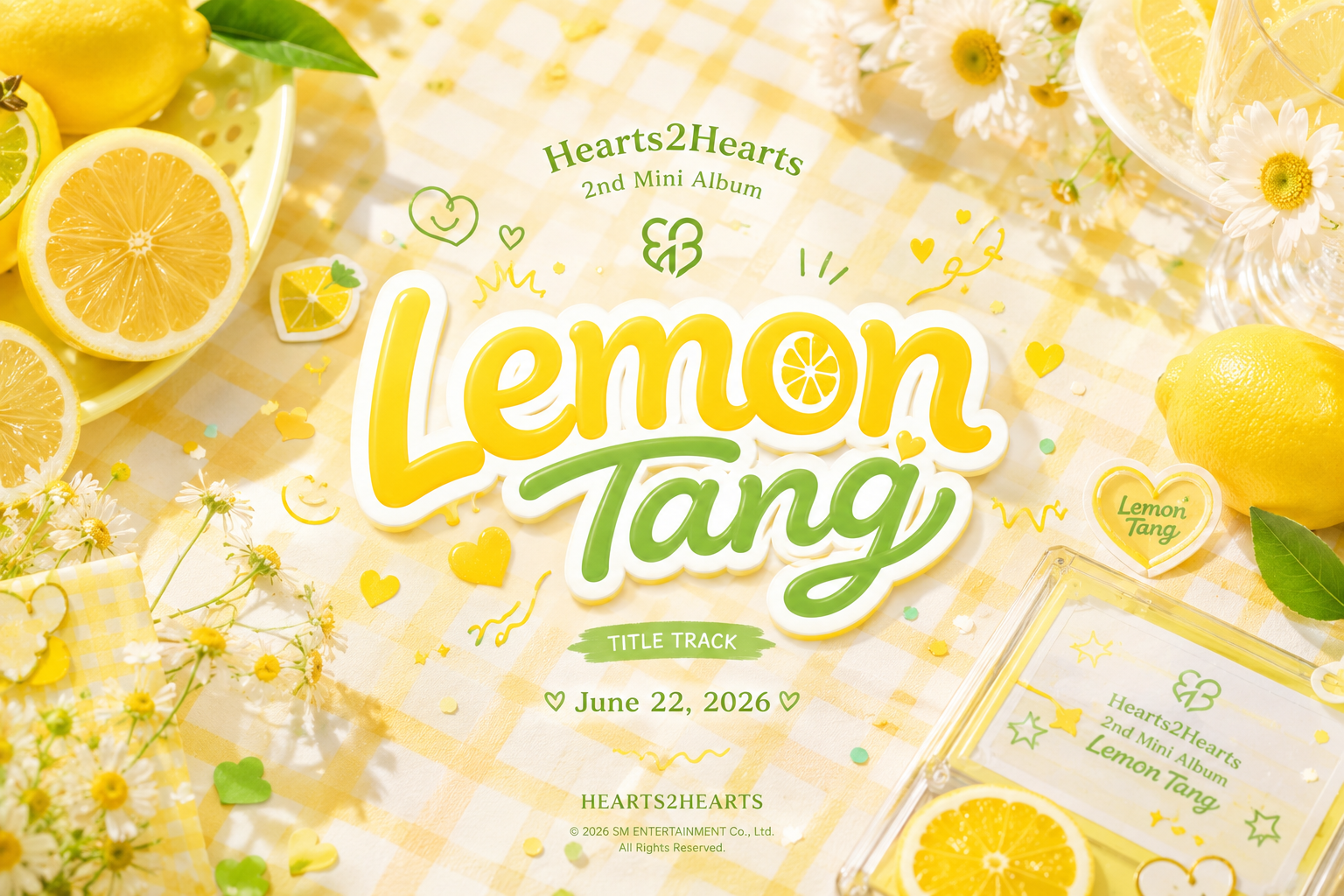
01The Title — Why Tang, Not Just Lemon
A lemon by itself is a familiar shorthand in pop lyricism: sourness, difficulty, the sharp thing that makes you flinch. “Lemon Tang” doesn’t stop at the lemon. The word “tang” — a sharp, pungent flavor or smell, often used for the specific punch of mixed citrus or fruit drinks — describes what happens when that sourness is no longer isolated. Tang is not the absence of sour. It’s sour transformed by combination into something with character, brightness, and bite that’s enjoyable rather than just sharp.
“Lemon Tang” arrived in a season where its own label-mates released a citrus-themed comeback first: aespa’s “LEMONADE” landed in May, just weeks earlier. Group leader Jiwoo addressed the overlap directly, noting she’d spoken with aespa’s Karina about the coincidence and that the two songs land in very different places — “LEMONADE” leaning into cool, electric sourness, “Lemon Tang” leaning into how things turn sweet once you’re with someone else. The shared fruit, in other words, is doing two different jobs for two different songs.
02Key Lyrics — Korean, Romanization & English Translation
The song moves between Korean verses and a heavily English-language chorus — a common structure in 4th- and 5th-generation K-pop dance tracks, where the chorus is built to travel internationally and the verses carry the specific texture of the relationship being described. Below are four passages worth close reading.
The Opening — Heat and a Dare
| Korean | 한 눈 깜짝 감게 해 그 시고 짜릿한 Icy icy 네 맘 터트리고 싶어 |
| Romanization | Han nun kkamjjak gamge hae Geu sigo jjarithan Icy icy ne mam teoteurigo sipeo |
| English | It makes me blink one eye in a flinch / That sour, electric feeling / Icy, icy — I want to make your heart burst |
The opening image is a physical reflex: 눈 깜짝 (nun kkamjjak — a quick blink, a flinch) is the involuntary reaction to something sharp hitting your senses — exactly what happens when you bite straight into citrus. The song doesn’t ease into attraction; it starts with the body’s instinctive, slightly painful response to something intense. 짜릿하다 (jjarithada) describes a thrilling, electric sensation — often used for the specific tingle of excitement or nervous anticipation. Pairing it with 시다 (sour) fuses the physical sensation of citrus directly with the physical sensation of attraction. They are described as the same feeling.
The Pose — Playing It Cool
| Korean | 넌 쿨한 척 혼자가 좋대 Like Unbothered |
| Romanization | Neon kulhan cheok honjaga joatae Like Unbothered |
| English | You act cool, saying you prefer being alone / Like Unbothered |
쿨한 척 (kulhan cheok) — pretending to be cool — uses 척, the same performance-marking suffix that appears throughout K-pop lyricism to flag a pose rather than a genuine state. The other person claims independence, claims they prefer solitude, and the English “Like Unbothered” lands the claim in the specific register of online detachment — the performed nonchalance of someone determined to look like nothing affects them. The narrator doesn’t believe the performance, and the rest of the song is built on that disbelief.
The Chorus — The Central Claim
| English | Lemon ta-ta-tang / I know you hate it / But like, 날 섞는다면? / Can’t deny us |
| Korean phrase | 날 섞는다면? |
| Romanization | Nal seokneundamyeon? |
| English | What if you mix me in? |
The verb at the center of the chorus is 섞다 (seokda) — to mix, to blend, to combine. It’s a deliberately unglamorous word for a love song: not “love me,” not “choose me,” but mix me in, the way you’d combine an ingredient into something larger. The conditional form 섞는다면 (seokneundamyeon — “if you were to mix [me] in”) frames the whole offer as a hypothetical the other person hasn’t agreed to yet — which is exactly the tension the chorus needs. “I know you hate it” acknowledges the other person’s stated resistance to being anyone’s ingredient, anyone’s mixed drink, anyone’s anything. The song’s answer isn’t to argue them out of that resistance. It’s to suggest that mixing might prove the resistance wrong on its own terms.
The Bridge — Already Closer
| Korean | 좀 더 가까워졌지 몇 센티미터쯤 다 마신 유리잔 어색한 얼음처럼 |
| Romanization | Jom deo gakkawojyeotji Myeot senchimiteo jjeum Da masin yurijan Eosaekhan eoreumcheoreom |
| English | We got a little closer / By maybe a few centimeters / Like the awkward ice / Left in an empty glass |
This is the song’s most specific and visually precise image. 몇 센티미터쯤 (a few centimeters or so) measures emotional progress in the smallest possible unit — not a leap, not a transformation, just a slight physical closing of distance. The simile that follows is unusually concrete for a dance-pop chorus: ice sitting alone at the bottom of a glass after the drink is gone, no longer doing the job it was meant for, slightly out of place — 어색하다 (eosaekhada) meaning awkward or ill-at-ease. The metaphor extends the citrus-drink concept of the whole song into its most melancholic corner: even within a song about sweetness from combination, there’s a beat that acknowledges the slightly stranded feeling of being the leftover thing in the glass, waiting to see if anyone notices.
03Hearts2Hearts — A Year and a Half Into the Sprint
Name reflects an intent to connect deeply with fans worldwide through music filled with emotion and heartfelt stories — moving forward together as one larger “us.”
SM’s first new girl group launch in five years, following aespa. Debuted with single album “The Chase.”
Eight members, ranging in nationality across Korean and Indonesian backgrounds. Several were cast through direct social media scouting rather than traditional open auditions.
A release nearly every few months since debut — an unusually fast promotional cadence even by K-pop’s standards, with each release building chart momentum on the last.
“RUDE!” became a genuine global moment for the group, anchored by a viral, scene-stealing segment from member Stella — described by members as the release that made the first half of 2026 feel, in their words, like “a lot, but a good kind of a lot.”
Major rookie-category wins within their first year, positioning them among the most closely watched debuts of the current K-pop cycle.
At a press event ahead of the release, members described wanting the full shape of their year to be defined by the pairing of these two songs — “RUDE!” carrying the first half, “Lemon Tang” carrying the second. That framing matters: it positions “Lemon Tang” not as a leftover or a lesser follow-up, but as the second half of a deliberate full-year statement, with the group’s own description of themselves shifting from “RUDE!”‘s sharper, more confrontational energy toward something the members call more “free and sparkling” — sourness with the edges softened by company.
04Lemon Tang — The Album and Its Six Tracks
Tracks on the EP
Physical album versions
Mini album since debut
Lemon Tang
Title Track
RUDE!
Included from Feb. 2026 single
4 additional tracks
Full listing pending wider release detail
The mini album was filmed partly in Okinawa for its music video and visual content, reinforcing the “full summer energy” framing that both the group and Korean press used to describe the release. The physical edition shipped in fourteen versions — including themed “Lemon Sun” and “Lemon Beach” editions, a limited summer kit, individual member sticker versions, and a keyring format — an unusually wide rollout that signals SM’s continued confidence in the group’s collecting fanbase a year and a half after debut.
Member descriptions of the title track converge on a specific word: refreshing. A-na noted that the song “gives off this cool, feel-good energy,” contrasting it with the group’s own earlier summer single “STYLE.” Yuha described an immediate, instinctive reaction on first hearing it: summer arrived the moment the song started. That immediacy — the sense of a song doing its seasonal work without requiring explanation — is consistent with how “Lemon Tang” is built: short title, repeated stutter (“ta-ta-tang”), and a hook engineered to need no translation to land.
To mark the release, Hearts2Hearts held their first-ever pop-up store at The Hyundai Seoul’s B1 Event Plaza from June 23 to July 1 — a retail and fan-experience activation that, for a group still inside its second year, signals a label investing in physical-world presence well beyond streaming and chart performance alone.
05The Songwriting — A Crowded Writers’ Room, a Simple Idea
“Lemon Tang” carries an unusually large credited writing and production team — eight credited lyricists and nearly twenty credited composers and arrangers, spanning Korean hitmakers like KENZIE and international writers and producers across multiple territories. This kind of large, internationally distributed credit list is now standard for SM Entertainment’s biggest pop singles, and it reflects a production model built for maximum chart and streaming reach rather than a single songwriter’s singular vision.
A Deliberately Simple Premise, Executed Precisely
What’s notable about “Lemon Tang” against that backdrop is how disciplined the central metaphor stays despite the size of the writing room. Every verse and chorus line traces back to the same idea: something sharp and difficult on its own becomes appealing through combination. The song doesn’t introduce competing metaphors or drift from the citrus-and-mixing concept once established. For a track built by a large committee of writers across several countries, that consistency is itself a craft choice — a sign the concept was locked early and protected through the writing process.
English as the Engine of the Hook
The chorus leans more heavily on English than the verses do — “I know you hate it,” “Can’t deny us,” the repeated “Lemon ta-ta-tang” itself — which is consistent with how the song is built to travel. The Korean verses carry the specific, textured images (the ice in the empty glass, the centimeters of closed distance, the performed coolness), while the English chorus carries the portable, easily chanted hook. This is the same bilingual division of labor seen across much of contemporary K-pop: Korean for interior texture, English for the part the whole room sings back.
| Technique | Example | Effect |
|---|---|---|
| Physical reflex as opening image | 눈 깜짝 감게 해 (makes you flinch) | Attraction described as an involuntary bodily response, same register as biting into citrus |
| 섞다 (to mix) as the central verb | 날 섞는다면? (what if you mix me in?) | Reframes romantic interest as combination rather than possession or pursuit |
| Performance-marking suffix 척 | 쿨한 척 (pretending to be cool) | Flags the other person’s detachment as a pose, setting up the song’s disbelief in it |
| Concrete, small-scale image for emotional progress | 몇 센티미터쯤 (a few centimeters or so) | Keeps the closeness modest and specific rather than abstract or grand |
| Bilingual division of labor | English chorus / Korean verse imagery | English carries the portable hook; Korean carries the textured, specific detail |
06Key Vocabulary — Words Worth Knowing
| Korean | Romanization | Meaning & Notes |
|---|---|---|
| 짜릿하다 | jjarithada | To feel a thrilling, electric tingle — used for the sharp jolt of excitement or anticipation, paired here with sourness to fuse taste and attraction |
| 쿨한 척 | kulhan cheok | Pretending/acting cool — 척 marks any verb as a performance rather than a genuine state |
| 섞다 | seokda | To mix, to blend, to combine — the song’s central verb; reframes romantic interest as the act of combining rather than capturing |
| 어색하다 | eosaekhada | Awkward, ill-at-ease — used here for ice sitting alone in an empty glass, no longer serving its purpose |
| 녹아들다 | nogadeulda | To melt in / to dissolve into — describes something gently merging into its surroundings rather than disappearing abruptly |
| 다 이기다 | da igida | To win out completely / to overcome everything — used in the chorus to claim the pairing’s appeal overrides any resistance |
Most K-pop love songs reach for verbs of capture, possession, or arrival — catching someone’s heart, taking someone away, falling into someone. “Lemon Tang” reaches instead for 섞다, to mix. It’s a kitchen verb, a chemistry verb, ordinarily applied to drinks, batters, and solutions rather than people. Applying it to a relationship reframes the entire emotional proposition: the goal isn’t to win the other person or change them, but to combine with them — to let two separately sharp things become, together, something with a flavor neither one had alone. The conditional structure 섞는다면 (if [you/we] were to mix) keeps that combination hypothetical through most of the song, which is exactly why the title’s confident “tang” lands as aspiration as much as description — the drink the chorus is describing hasn’t fully been made yet.
— Why “Lemon Tang” Works as a Summer Single
“Lemon Tang” doesn’t try to disguise its own simplicity, and that’s precisely its strength. The premise is small enough to grasp in one listen — sour alone, sweet together — and specific enough in its details (the centimeters, the leftover ice, the performed coolness) to feel like an actual moment rather than a generic chorus concept stretched over four minutes.
For a group a year and a half into a famously fast SM rollout schedule, arriving at a song built around the idea of letting your sharper edges become someone else’s favorite thing about you is a fitting mid-career statement. “RUDE!” proved Hearts2Hearts could be sharp and confrontational and still win. “Lemon Tang” is the other half of that same fruit: proof that the same sourness, mixed with the right thing, doesn’t need to be softened to be loved. It just needs the right combination.
날 섞는다면? What if you mix me in? The chorus never quite answers its own question — and a song built on citrus knows better than to pretend the answer was ever in doubt.