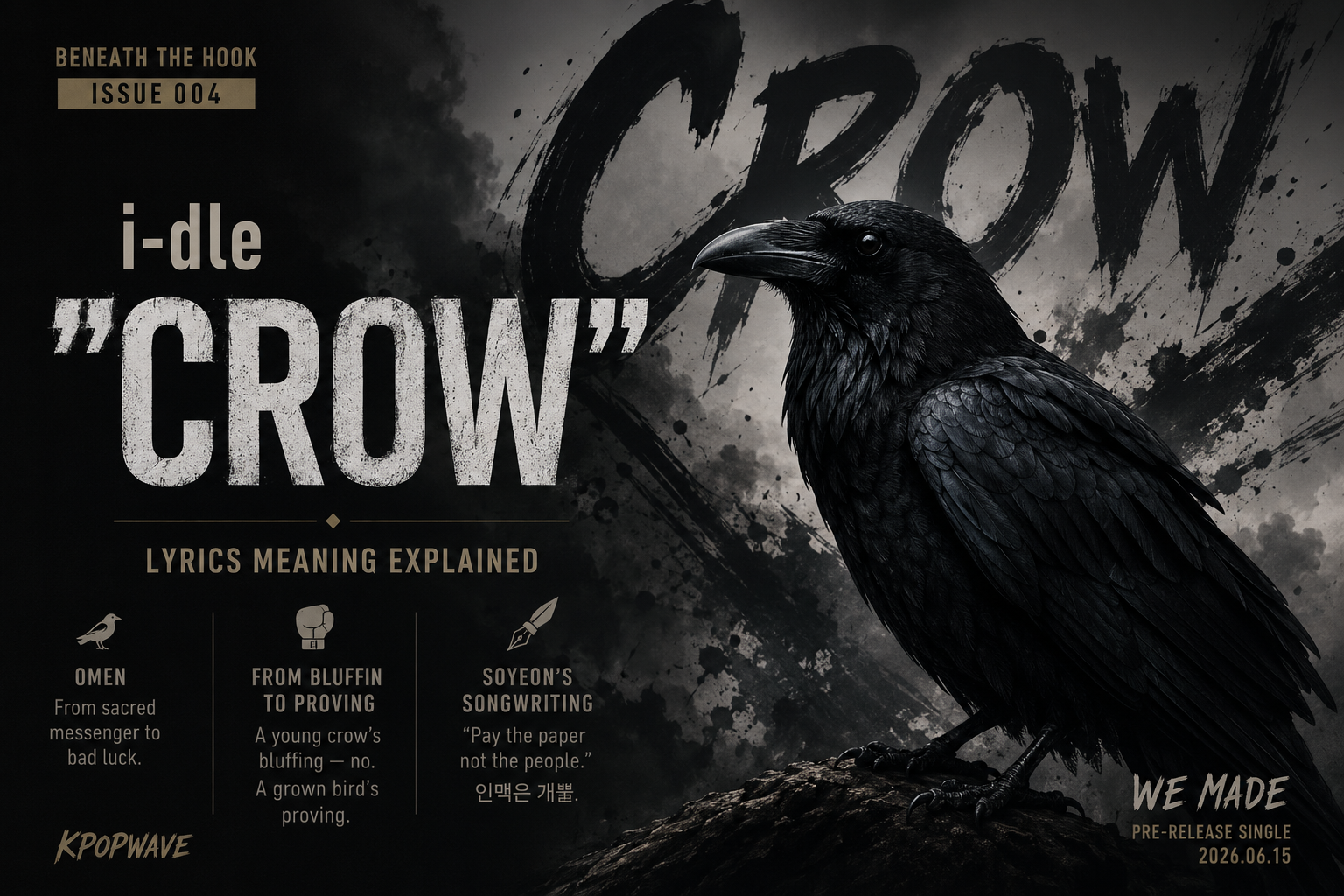
Beneath the Hook — Issue 004
Crows have been called bad luck for centuries — in Korea, in the West, everywhere a black bird circles something dying. i-dle’s “Crow” doesn’t dispute the reputation. It takes the job.
“Crow,” released June 15, 2026 as the pre-release single from i-dle’s 9th mini album We made, is written entirely by Soyeon, composed and arranged by Mortal (KOR) and Jumal of SMGS. The song reclaims the crow — a bird treated as an unlucky omen across both Korean and Western tradition — not by rejecting the label but by fully inhabiting it. Eight years after debut, five members in, freshly renamed from (G)I-DLE to i-dle, the group writes its most direct identity statement yet: if the world insists on calling you a bad omen, become the best omen there is.
Since i-dle’s
May 2018 debut
Mini album,
We made
Group renamed
(G)I-DLE → i-dle
01A Bird With Two Histories
Before “Crow” can be read as a K-pop lyric, it has to be read as an argument about a bird — and the bird has a more complicated history than the song’s gothic, black-and-red music video might suggest.
In most of the world, the crow carries a single reputation: death, misfortune, an omen of something going wrong. European folklore treats it this way. Shakespeare uses it this way. Korean folk belief, in its more recent form, treats it the same way — the cry of a crow near a house is a bad sign, an unwelcome visitor foretold.
But that wasn’t always true. Korean tradition once held the opposite. The crow was considered a sacred bird, a messenger capable of prophecy — the legend of King Jicheung in the Samguk Yusa describes a crow leading the king to a hidden message that saved his life, the origin of a ritual still referenced in Korean folklore today. Older still is the symbol of Samjogo, the three-legged crow believed to live inside the sun — a sacred emblem of Goguryeo, one of Korea’s ancient kingdoms. The crow’s fall from grace to omen of misfortune is a relatively recent turn, layered on top of centuries where it meant the opposite: divine knowledge, the bird that sees what others can’t.
“Crow” doesn’t explain any of this history. It doesn’t need to. But it operates exactly inside that ambiguity — a bird that is simultaneously cursed and prophetic, unlucky and all-seeing. The song’s most quoted line makes the ambivalence the entire point:
Crow
| EN | Come on omen do what you do best We are born in the nest of the Crow |
“Omen” is not a flattering word to claim. An omen isn’t a person — it’s a sign, a symptom, a thing that precedes disaster. To call yourself one is to accept that other people will look at you and read misfortune. The song’s answer isn’t to argue against that reading. It’s to professionalize it. Do what you do best. If the omen is the job, be the best omen there is.
02Bluffing, Then Proving
The song’s opening lines set up a contrast that frames everything after it:
Crow
| EN | 어린 까마귀의 Bluffin No 어른이 된 새의 Proving |
| ROM | eorin kkamagwi-ui Bluffin No eoreuni doen sae-ui Proving |
| EN | A young crow’s bluffing — no A bird grown up — proving |
Bluffing is what you do when you don’t yet have the substance to back up the claim — when the performance has to compensate for the absence of proof. Proving is what happens after the substance arrives, when you no longer need the performance to convince anyone, including yourself.
The line works as pure songwriting. It also works as a precise description of where i-dle is, eight years into a career that began under intense scrutiny — Soyeon’s pre-debut trainee history, the group’s early framing as Cube Entertainment’s high-risk bet, the years of proving a producer-idol could write and compose credibly rather than perform a marketing angle. In May 2025, on the group’s seventh anniversary, they formally dropped the parenthetical and the gender marker, rebranding from (G)I-DLE to i-dle. The bluffing era — if it ever was one — is over by the group’s own framing. “Crow” arrives just over a year later, fronted entirely by the same songwriter who has carried the group’s discography from the start, making the proving explicit.
“Bluffing is what you do when you don’t yet have the substance to back up the claim. Proving is what happens after the substance arrives — when you no longer need the performance to convince anyone, including yourself.”
03Misfortune as Method
The verse that follows treats bad luck less as a misfortune to survive and more as a system to interpret correctly:
Crow
| EN | 저 불운은 본디 행운의 주인을 가려내려는 시험인 듯이 피가 말라도 마치 고고한 척 향이 좋은 돈은 No doubt |
| EN | That misfortune feels like a test meant to sort out who deserves the luck Even running dry, I act unbothered Money that smells right — no doubt |
This is a specific kind of resilience narrative, and it’s worth being precise about what it isn’t. It isn’t “everything happens for a reason” in the soft, consoling sense. It’s closer to a filtering mechanism: misfortune doesn’t build character, it sorts who already has the character to survive it. The bad luck isn’t redemptive. It’s diagnostic. It tells you who was always going to make it and who wasn’t.
That’s a colder, more competitive read than most K-pop resilience anthems offer — and it tracks with what comes next:
형기 내내 쓸개를 핥아
I can’t forget it
부모덕 없이 큰 몸뚱어리
수는 떠나보내려는 수법
This idiom draws from a classical Chinese story (臥薪嘗膽) about a defeated king who kept a bitter gallbladder near him and tasted it daily to remember his humiliation and fuel his eventual revenge. In Korean usage, it means enduring degradation deliberately, as fuel rather than as something to forget. The lyric’s “I can’t forget it” directly echoes the idiom’s original function — the bitterness is kept on purpose.
04Pay the Paper, Not the People
The second pre-chorus pivots from survival to economics, and the language sharpens into something closer to a business philosophy than a lyric:
Crow
| EN | Pay the paper not the people 늘 갈고닦고 배워 엔딩엔 인맥은 개뿔 공짜로는 Never ever |
| EN | Pay the paper, not the people always sharpening, always learning in the end, connections are worth nothing never, ever for free |
Pay the paper not the people — written entirely in English, the line lands as a slogan rather than a confession, deliberately blunt. The Korean that follows clarifies the stakes: 인맥은 개뿔, roughly “connections are worth absolutely nothing” — a phrase with real bite, dismissing nepotism and networking as currency that doesn’t actually pay out. What matters is the paper trail. The receipts. The work that left an actual, verifiable record.
This is a notably specific complaint for a K-pop lyric to make, and it tracks with a discography Soyeon has spent years building a reputation around: songwriting and production credits, not delegated authorship. In an industry where idol songwriting credits are sometimes treated skeptically by audiences, “pay the paper” reads as a direct rebuttal — judge the output, not the org chart.
“인맥은 개뿔” dismisses nepotism and networking as currency that doesn’t actually pay out. What matters is the paper trail — the work that left an actual, verifiable record.
The verse closes on a line that functions as the song’s clearest statement of artistic philosophy:
Crow
| EN | 본질에 대한 탐욕은 멈추는 순간 도태되어 관심 밖을 맴돌다 헛된 걸 가꿔 |
| EN | Greed for the essence — the moment you stop, you fall behind circling outside relevance, tending to nothing |
“본질에 대한 탐욕” — greed for the essence, for the substance, for the thing itself rather than its appearance — is presented as the only acceptable form of ambition. Stop pursuing the actual craft, even for a moment, and the result isn’t rest. It’s irrelevance. There’s no neutral gear in this worldview. You’re either sharpening or falling behind.
05The Crown and the Hunger
The chorus’s second half introduces the song’s central tension — a wanting that doesn’t resolve even when it’s satisfied:
Crow
| EN | We want the boss, we still want more We want the crown, born as the hungry Crow |
“We want the boss” — the top position — “we still want more”: the satisfaction of arrival doesn’t end the wanting. The crown is the explicit symbol of achieved status, and the crow wears it while remaining, definitionally, hungry. There’s no version of this lyric where arrival produces contentment. The hunger is structural, not circumstantial — it’s not waiting to be solved by success. It’s the thing that makes the pursuit of success possible in the first place.
This connects directly to the line Soyeon has publicly named as her own favorite in the song, from later in the second verse:
배우고 배워 그 끝은 성공 아닌 포기까지
“Learning and learning — the end of that road isn’t success. It’s the point where I give up.”
In interviews around the release, Soyeon explained the line as describing a mindset rather than a fear: learning isn’t a means toward success that stops once success arrives. It continues until the person learning decides to stop — and that decision, not external achievement, is the only real endpoint. Success is incidental to the process. The only true ending is voluntary withdrawal, and as long as you haven’t withdrawn, you’re still in it.
Read against “we still want more,” the two lines form a closed loop: the hunger doesn’t end at the crown, and the learning doesn’t end at success. Both processes only terminate by choice, not by achievement. That’s either an exhausting way to live or the only way to keep getting better, depending on which day you ask.
06Spilled Water, Broken Order
The bridge shifts the song’s voice from declaration to something closer to reflection — a rare moment of looking backward rather than forward:
Crow
| EN | Yeah baby once we were too deep in our own haze Lost in the fog we made, forgetting our way 우린 다시 물을 엎질러 맞춘 질서를 어질렀고 우린 우릴 앞질러 날아가려고 더 위로 |
| EN | Once we were too deep in our own haze lost in fog we made ourselves, forgetting the way We spilled the water again scattered the order we’d carefully arranged We tried to outrun ourselves trying to fly even higher |
This is the song’s only real admission of error. 물을 엎질러 — spilled the water — and 질서를 어질렀고 — scattered the order — describe a self-inflicted disorder, not an external misfortune. The fog wasn’t sent by bad luck. The group made it themselves. This matters because it complicates the otherwise clean narrative of misfortune-as-test: not every setback in this song’s universe comes from outside. Some of it is the cost of trying to fly faster than the body can manage.
The bridge resolves into one of the song’s hardest lines:
Crow
| EN | We’re locked in for real, so what you wanna do Out the flock, underdog으로 랭커도 TKO No stardom no money 우린 벨트를 목표로 배우고 배워 그 끝은 성공 아닌 포기까지 |
| EN | We’re locked in for real, so what you wanna do Out of the flock, an underdog who TKOs even the ranked No stardom, no money our target was the belt Learning and learning — the end of that road isn’t success, it’s giving up |
“Out the flock, underdog” positions the group outside its own species’ expected hierarchy — not the favored bird, not the lucky one, the one that wasn’t supposed to win. A boxing metaphor follows immediately: TKO, belt, ranked opponents. The crow isn’t just surviving in this image. It’s fighting up a weight class.
07Key Vocabulary
| 쓸개를 핥다 | to lick one’s gallbladder | An idiom for enduring humiliation deliberately, as fuel for later success — rooted in a classical story about a defeated king who kept his bitterness close on purpose rather than letting it fade. |
| 인맥은 개뿔 | connections are nothing | 개뿔 is a blunt, dismissive intensifier — closer to “absolutely nothing” or “yeah, right” than a neutral negative. The bluntness is the point. |
| 본질 | essence / the thing itself | Used here in contrast to appearance or image — the substance behind the performance, the part of the work that can’t be faked. |
| 맴돌다 | to circle / hover without landing | Describes motion without progress — orbiting relevance without ever entering it. The opposite of “본질” pursuit. |
| 엎질러 | spilled (irreversibly) | Korean idiom culture treats spilled water as a classic image of irreversible mistakes — “엎질러진 물” (spilled water) cannot be put back in the bowl. |
08The Road to “Crow”
What I find most interesting about “Crow” is how little interest it has in being liked.
Most K-pop resilience narratives soften the edges somewhere — a bridge that opens up into vulnerability, a final chorus that resolves the tension into triumph, some gesture toward the listener that says we made it, and so can you. “Crow” doesn’t really do that. Even its one moment of self-reflection — the spilled water, the scattered order — reads less like an apology and more like a tactical debrief. What went wrong, noted, moving on.
That coldness is, I think, the actual statement. A group eight years into a career that began with skepticism about whether an idol could really write her own songs doesn’t owe anyone softness. Pay the paper not the people isn’t a slogan designed for sympathy. It’s a ledger entry.
And yet — the crow, historically, wasn’t always the villain of the story. It used to be the bird that saw what others couldn’t, the messenger of the sun. Maybe the reclamation in this song isn’t inventing a new meaning for the crow. Maybe it’s just remembering an old one that got buried under a few centuries of bad press.
Either way: the omen showed up to do its job. It’s doing it well.