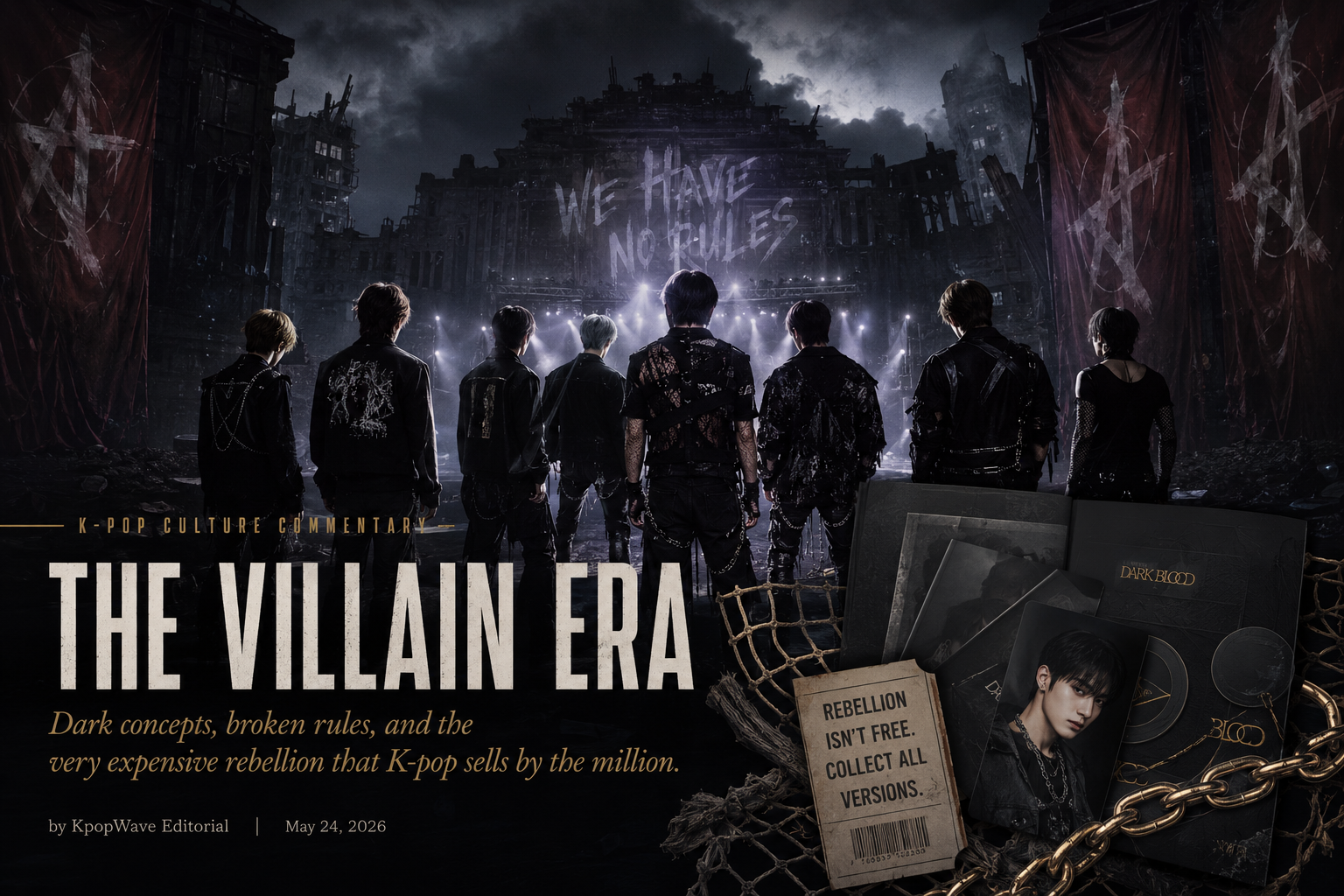
Dark concepts, broken rules, and the very expensive rebellion that K-pop sells by the million.
Stray Kids’ “MIROH” — released in 2019, still one of the most-streamed K-pop tracks of the decade — contains the line: “우린 규칙 따윈 없어.” We have no rules. It is delivered in perfect unison, by eight people, on a count of eight, in an arena, with synchronized lighting. The choreography has been performed identically in over two hundred shows across four continents. The rebellion is extremely well-rehearsed.
Nobody seems to mind. That’s the interesting part.
Somewhere between 2018 and now, the K-pop boy group concept calcified around a single aesthetic: the Villain Origin Story. Dark. Fractured. Misunderstood. Fighting back against a system that has wronged them, usually in a dystopian setting, with excellent hair. The groups doing this are not fringe acts. They are the genre’s biggest names — Stray Kids, ATEEZ, TXT, ENHYPEN, MONSTA X, even BTS in certain chapters. The villain era is not a niche. It is the mainstream.
The question worth asking is not whether it’s real. Of course it isn’t, entirely. The question is why this particular fantasy — the outsider, the rebel, the one who refuses — is what millions of fans in 2026 most want to buy.
Chapter One
From the Classroom to the Apocalypse
K-pop has always sold rebellion. But it used to sell a different kind.
BTS debuted in 2013 with “No More Dream” — a hip-hop track about Korean teenagers suffocating under the weight of the SKY university pipeline. The song told fans to follow their own dreams rather than fall prey to society’s expectations, and directly addressed how South Korean youth culture revolves around the country’s emphasis on education, with most students attending special after-school classes from as young as kindergarten with the aim of attending the prestigious SKY universities. Their follow-up single “N.O” was even more specific: “Who are the ones that made us into studying machines?” The enemy had a name. It was the education system. The parents. The exam schedule. The gap between what you were told to want and what you actually felt.
B.A.P. was doing the same thing, angrier. So was Block B. The second-generation rebellion had an address. You could look it up.
Then something shifted. Compare the targets:
“Who made us study machines?” The Korean education system. Specific, named, furious.
Social inequality. The gap between the powerful and the powerless. Here, on Earth, right now.
The establishment. Authority. Adults who didn’t listen. The world as it actually exists.
Strictland. A fictional authoritarian dystopia. The enemy is a concept. A regime with no name.
Inner darkness. A corrupted self. The threat is internal, metaphysical, operating in a Chaos Chapter.
Vampires. Literally. The villain is a mythology, a genre, a world you have to build a theory board to understand.
The rebellion migrated from the real world to the fictional one. From the classroom to the apocalypse. From “our parents are wrong” to “we exist in a dystopian multiverse and must reclaim our authentic selves from the forces of institutional control (exact nature TBD, lore available in the physical photobook).”
This is not a criticism. It is an observation about what changed — and what that change tells us about who is listening.
Chapter Two
The Very Expensive Rebellion
Let’s talk about the merch.
ENHYPEN’s 2023 mini-album is called DARK BLOOD. It comes in three versions: FULL, HALF, and NEW. Each version contains different photocards. There are seven member-specific versions on top of that. The photobook is described by one retailer as arriving “emotionally expensive.” The overall aesthetic — sleek, moody, and polished in the exact way that makes it instantly shelf-worthy and very hard to buy just one version — is not accidental. It is the product of considerable design investment.
~$18
~$18
~$12
~$18 × N
~$5–15 extra
$80–150+
The chain accessories are sold separately. The ripped fishnet photobook insert is not included in the standard version. The black-on-black embossed packaging is a limited print.
None of this is cheap. None of it is supposed to be. The rebellion aesthetic — the darkness, the chaos, the we-live-outside-your-rules energy — has been converted, with remarkable efficiency, into a luxury goods framework. ENHYPEN’s physical album ecosystem has grown significantly more complex — not just in volume, but in structural variation: multiple versions per release (Standard, INCEPTIO, ARCANUM, Engene, Fugitives, and others), regional editions, and layered bundling. The number of SKUs in a single comeback rivals a mid-size fashion brand’s seasonal drop.
KpopWave Editorial
To be fair: this is not new to K-pop. Multiple versions and photocard randomization have existed since at least the mid-2010s. What is new is the seamless integration of the dark concept aesthetic into the collectible logic. The chaos is branded. The darkness has a SKU. The villain’s photocard costs an extra $12 if you want the platform-exclusive version, and it’s worth noting that the platform-exclusive version is slightly cooler than the standard one.
You cannot fault the execution. The genius — and it is a kind of genius — is that the anti-establishment fantasy and the consumption cycle exist in the same breath, and neither one cancels the other out. Fans buy the rebellion. Fans know they are buying the rebellion. Nobody is deceived. The transaction is transparent and willing and enormous.
Chapter Three
Why We Buy It — The Safest Revolution
Here is the part that actually matters.
The primary consumers of 4th-generation K-pop are people between roughly 15 and 25. They grew up during a pandemic that closed their schools and their social lives simultaneously. They are entering a labor market that, in 2024, offered UK graduates just under 17,000 entry-level positions for 1.2 million applicants — and that was before AI began automating the entry-level tasks that remained. In South Korea specifically, the youth employment rate for ages 15-29 dropped to 44.3% by November 2025, marking a 19-month consecutive decline. Nearly two-thirds of Gen Z globally consider corruption to be a “very serious” problem — a generational gap more pronounced than on almost any other issue.
This is a generation that has every structural reason to be angry at systems, institutions, and the rules designed to protect the people already inside them. The rebellion, in other words, is not invented. The emotion is real. The circumstances are real.
What K-pop’s villain era offers is a way to feel that anger without having to do anything with it. The dystopia is fictional, which means it can be fully immersive without being dangerous. The rebellion is choreographed, which means it is safe. The enemy is abstract — “Strictland,” “the system,” “inner darkness” — which means it can mean anything to anyone without requiring a specific political commitment. You can feel the whole thing and then put on your school uniform and go to class.
The generation consuming 4th-gen dark concepts is also the most structurally controlled generation in recent memory: pandemic lockdowns, intense academic competition, algorithmic social media, economic precarity. They live inside more systems than any previous generation of K-pop fans.
The fantasy they purchase is almost precisely the inverse: breaking free, reclaiming the self, refusing the system. Not in a protest. Not in a petition. In a fancam, at 3am, with a glow stick and a membership kit.
This is not escapism in the pejorative sense. It is a pressure valve — and it works exactly because it costs nothing except money, and offers everything except actual change.
There’s also the lore. The elaborate fictional universes — ATEEZ’s Strictland timeline, TXT’s Chaos Chapter, ENHYPEN’s vampire mythology — are not just marketing. They are participation structures. Understanding the lore requires investment: reading, theorizing, discussing, rewatching. The fandom becomes a community organized around interpretive labor. You’re not just consuming a product. You’re collaborating on a narrative.
For a generation that often feels like passive recipients of a world designed by other people, being the person who figured out what happened in the ATEEZ Universe A-to-Z transition is genuinely satisfying. It is a form of mastery in a landscape where mastery is otherwise hard to come by.
I’ll tell you what I think will not happen: this concept will not end because the music gets tired of it. The music has been excellent. “Fireworks,” “MIROH,” “0X1=LOVESONG” — these are genuinely good songs that earn their darkness. The aesthetic has been sustained because the artists making it are skilled, not because the audience is undemanding.
What might end it — or evolve it — is if the underlying conditions change. If a generation of fans finds actual structural routes to the things the villain era promises symbolically: agency, resistance, belonging, a world that can be understood and influenced. When BTS pivoted from “No More Dream” to “Love Yourself” to “Butter,” they were tracking a real emotional arc. Not abandoning rebellion — redefining what it was fighting for.
The 4th generation hasn’t had that pivot yet. The darkness has remained remarkably consistent across seven years and dozens of groups. That’s either a sign of extraordinary aesthetic coherence, or a sign that the underlying conditions have not meaningfully improved for the people who listen to this music.
I suspect it is both. And I suspect the next evolution will arrive when something in the world shifts enough that the fandom starts to want a different kind of story — one where the villain wins, perhaps, or one where it turns out there was no villain at all. Until then, the rehearsed rebellion continues. The lights are synchronized. The count is eight. Everyone knows the words.