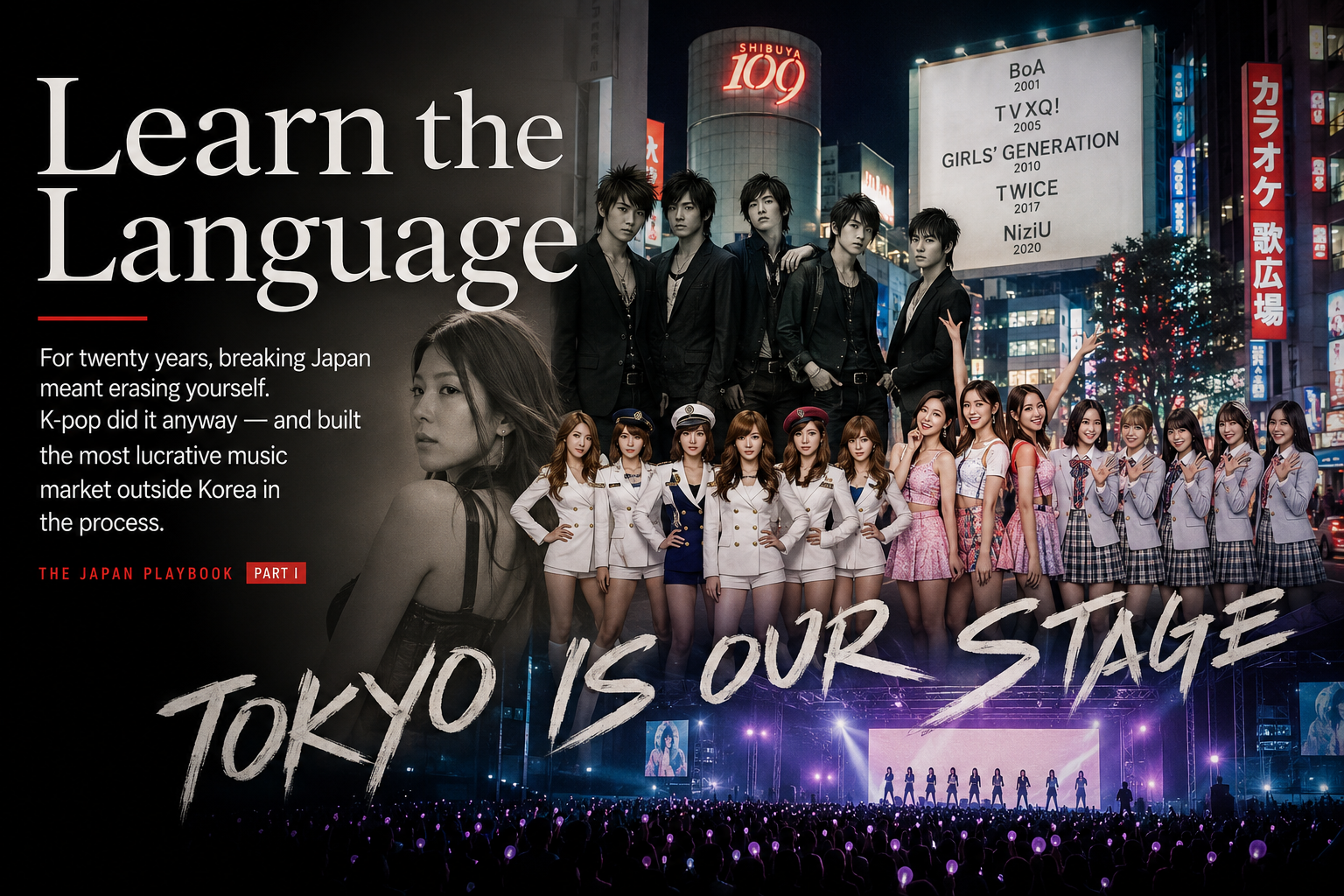
For twenty years, breaking Japan meant erasing yourself. K-pop did it anyway — and built the most lucrative music market outside Korea in the process.
In 2001, a fifteen-year-old from Seoul quit school and moved to Japan. She had been training for three years — vocals, dance, English, Japanese. Her label had spent roughly three million dollars preparing her for a market that had no particular interest in being entered. Her name was BoA, and what she did next rewrote the rules for every Korean artist who came after her.
What she did was simple, and it was brutal: she became Japanese. Not in any legal or ethnic sense — but in every sense the Japanese music market required. She spoke the language without an accent. She released her music in Japanese, written by Japanese collaborators, distributed through a Japanese label. She hosted a radio program on the Japan FM Network for six consecutive years. She performed on the end-of-year television broadcasts that define the cultural calendar. When her debut Japanese album, Listen to My Heart, topped the Oricon chart in March 2002 — the first Korean artist ever to do so — it did not read in Japan as a foreign act breaking through. It read as a Japanese pop star who happened to have been born in Seoul.
That was the first Japan playbook. And for almost twenty years, it was the only one.
Chapter One
The Barrier and the Blueprint
To understand why BoA’s success required the effort it did, you have to understand what the Japanese music market was — and what it thought of itself.
Japan is the second-largest music market in the world. In 2022, recorded and digital music sales totaled roughly 307 billion yen, or approximately 2.4 billion US dollars. It is a market with its own fully developed idol infrastructure, its own chart ecosystem, and a profound historical suspicion of the word “Korean.” South Korean cultural content was formally banned in Japan from the end of World War II until 1998 — a full fifty-three years during which the Japanese music industry had no structural reason to accommodate its neighbor’s artists. When BoA arrived, those fifty-three years of separation were barely three years in the past.
SM Entertainment’s founder Lee Soo-man understood that entering Japan meant not challenging any of this. He had secured a partnership with Avex Trax, the Japanese dance music label behind Ayumi Hamasaki, and he used it as a blueprint: don’t arrive as Korean. Arrive as something Japan can already understand.
Training investment: Approximately $3 million USD in preparation costs for BoA’s Japanese debut — vocal training, Japanese language immersion, choreography development, Japanese market research.
Language requirement: Near-native Japanese fluency. BoA began language study at age 11. By debut she could host live radio programs, conduct press interviews, and perform without an interpreter.
Label structure: Full partnership with Avex Trax (Japan). All Japanese releases cleared through the Japanese label system, with Japanese songwriting collaborators on Japanese-language tracks.
Timeline: Three years of preparation before first Japanese single. One year of Japanese market activity before first album. No Korean-language output during this period.
It worked. Listen to My Heart sold over 930,000 copies in Japan and became the first Korean album to receive million certification from the Recording Industry Association of Japan. BoA is the only foreign artist in Oricon history to have three albums sell more than one million copies in Japan. She became, in every functional sense, a Japanese pop star who happened to be from Korea — and the industry barely had to acknowledge the distinction.
TVXQ followed the same blueprint, but took longer to execute it. They debuted in Japan in 2005 as five members. Their first two years were commercially modest. They played smaller venues, released singles into a market that wasn’t paying close attention. They too had learned Japanese. They too had rerecorded their catalog in the language. They too operated through a Japanese label structure, under the name Tohoshinki — a Japanese reading of their Chinese stage name — that deliberately de-emphasized their Korean origin.
By 2009, the patience had paid off at a scale that almost no one had predicted.
Tickets sold on TVXQ’s 2009 Secret Code Japan tour — their Tokyo Dome finale was the first by a Korean act
Gross revenue from TVXQ’s 2018 Begin Again Tour in Japan — the highest-grossing tour ever by a foreign act in Japan at that time
Tickets sold on Begin Again — TVXQ’s final tour record, set 13 years after their Japanese debut
The TVXQ story is the clearest illustration of what the first playbook actually demanded. It was not a strategy for fast market entry. It was a strategy for permanent residency. By the time Tohoshinki became the first foreign act to headline Japan’s Nissan Stadium in 2013, they were not perceived in Japan as a visiting Korean group. The NamuWiki entry on their Japanese activities puts it directly: they were understood as something closer to a J-pop act composed of Korean members who had grown in Japan over many years. The Korean origin had not disappeared. It had simply become background information.
Observed by IIAS researcher, mid-2010s Japanese fan interviews
Girls’ Generation arrived at the tail end of this era with a slightly accelerated version of the same approach. They debuted in Japan in September 2010 with a Japanese-language recording of “Genie” — their Korean hit re-recorded, re-lyricized in Japanese by a Japanese writer, released through Universal Music Japan’s Nayutawave imprint. “Gee” followed six weeks later. Their first Japanese studio album, released in June 2011, became the highest-selling album by a Korean girl group in Japan to that point. They were the second Korean act, after BoA, and the first Korean group, to earn million certification from the RIAJ.
The pattern was now clear enough to call a system: Korean origin, Japanese execution, Japanese infrastructure, Japanese language. Arrive fluent. Operate locally. Don’t remind anyone where you came from.
Chapter Two
When the Ground Shifted
The system was not invincible.
In 2012, the territorial dispute over the Liancourt Rocks — a small cluster of islets between Japan and South Korea, claimed by both, known in Korea as Dokdo and in Japan as Takeshima — escalated into a public confrontation between the two governments. Korean President Lee Myung-bak made an unannounced visit to the islands in August 2012. The Japanese government recalled its ambassador. Anti-Korean demonstrations surged in Japanese cities. The online movement against Korean cultural influence in Japan, known as Ken-Kanryū, which had been simmering since a xenophobic manga of the same name sold 360,000 copies in 2005, found a fresh wave of mainstream attention.
NHK, Japan’s national broadcaster, quietly reduced the volume of Korean content in its programming. The prime-time television slots that had been available to Korean acts contracted. The Hallyu boom of the early 2010s — which had seen Korean dramas and variety content flood Japanese cable networks alongside the music — cooled visibly.
K-pop did not collapse in Japan. TVXQ continued to sell out domes. But the ceiling became visible in a way it had not been before. The strategy that required Korean artists to become functionally Japanese in order to operate in Japan had a structural vulnerability: it required Japan to want them there. When Japanese political sentiment turned against Korean cultural presence, there was no insulation — because the whole architecture of the first playbook had been built on assimilation rather than identity.
This was the moment the industry should have been asking a different question. It took a third-generation girl group and a pandemic to force the answer.
Chapter Three
The Third Way
TWICE debuted in 2015 with nine members: four Korean, one Taiwanese, and three Japanese — Momo, Sana, and Mina. JYP Entertainment had not recruited Japanese members as a localization tactic in the old sense. They were not there to translate the group for the Japanese market, or to give it a native-speaker anchor for Japanese-language promotions. They were there as themselves, in a Korean group, operating in Korean, who happened to speak Japanese because they were Japanese.
This sounds like a small distinction. It was not. The presence of Momo, Sana, and Mina in TWICE meant that Japanese audiences encountered a group in which the foreign and the familiar existed simultaneously — not through erasure of origin, but through actual coexistence. TWICE did not become Japanese. TWICE contained Japanese people. The difference in how that registered with Japanese fans was significant.
TWICE’s Japanese unit MISAMO — Momo, Sana, Mina operating as a sub-unit — represented the logical endpoint of this middle strategy: a K-pop group, trained and produced in the Korean system, releasing music as Japanese artists, without any pretense that the Korean framework behind them had been hidden. The K-pop system was not being concealed. It was being offered as a feature.
JYP Entertainment named their philosophy explicitly: “Globalization by Localization.” The first stage was exporting Korean content. The second was including foreign members in Korean groups. The third — which produced NiziU in 2020 — was exporting the K-pop training and production system itself, applying it to a group composed entirely of Japanese members, for the Japanese market, under a Japanese label, with no Korean members at all.
NiziU’s pre-debut single “Make You Happy” topped the Oricon digital chart and reached 100 million video streams within fifteen weeks — the fastest female artist to achieve that on the Japanese Hot 100. They appeared on NHK’s New Year broadcast, the Kōhaku Uta Gassen, months after debut. They were, by every metric, a Japanese pop group. They were also, structurally, a K-pop group. The two things were no longer in contradiction.
Generation 1 (2000s–early 2010s): Korean artists learn Japanese, release Japanese albums, operate through Japanese labels. Assimilation as market entry. BoA, TVXQ, Girls’ Generation.
Generation 2 (mid-2010s): Korean groups include Japanese members; Japanese sub-units operate domestically. Hybridity as bridge. TWICE / MISAMO, IZ*ONE.
Generation 3 (2019–present): K-pop system exported wholesale. Japanese groups trained by Korean companies, for Japanese market, without Korean members. K-pop as infrastructure. NiziU, JO1, &TEAM.
By the time the pandemic arrived in 2020, Japan’s relationship with K-pop had been transformed by exactly this sequence. The market was no longer encountering Korean pop music as a foreign import to be assimilated or resisted. It had been encountering the K-pop system — its training methodology, its visual language, its fandom structures, its album formats — for over a decade. K-pop was not a genre arriving in Japan. K-pop was, in some functional sense, a Japanese genre too.
Which created a condition that would only fully reveal itself when the next generation of Korean acts arrived — and decided, for the first time, not to bother learning the language at all.
I find something quietly astonishing about BoA’s story that tends to get lost in the facts. She was thirteen when she was signed. She was fifteen when she quit school. She spent three years becoming fluent in Japanese before she was allowed to release an album — in a language that was not her own, for a market that had spent fifty-three years legally refusing to acknowledge that her country’s culture existed.
And she did it. She topped the Oricon. She sold a million albums. She held a radio program for six years. She is, by almost any measure, the most successful Korean artist in Japan’s history on a per-capita effort basis. The amount of individual transformation that success required is staggering.
What I keep returning to is the asymmetry. Japan did not change to accommodate BoA. BoA changed to accommodate Japan. The market was right, and she was the variable. That was the deal, and she accepted it, and it worked, and every Korean artist who followed her into that market for the next fifteen years accepted the same deal.
The question I find myself asking — and which Part II will try to answer — is not whether that deal was worth it. Obviously it was, commercially. The question is what it revealed about who held the power in that transaction. And what changed when, finally, the Korean side stopped agreeing to the terms.