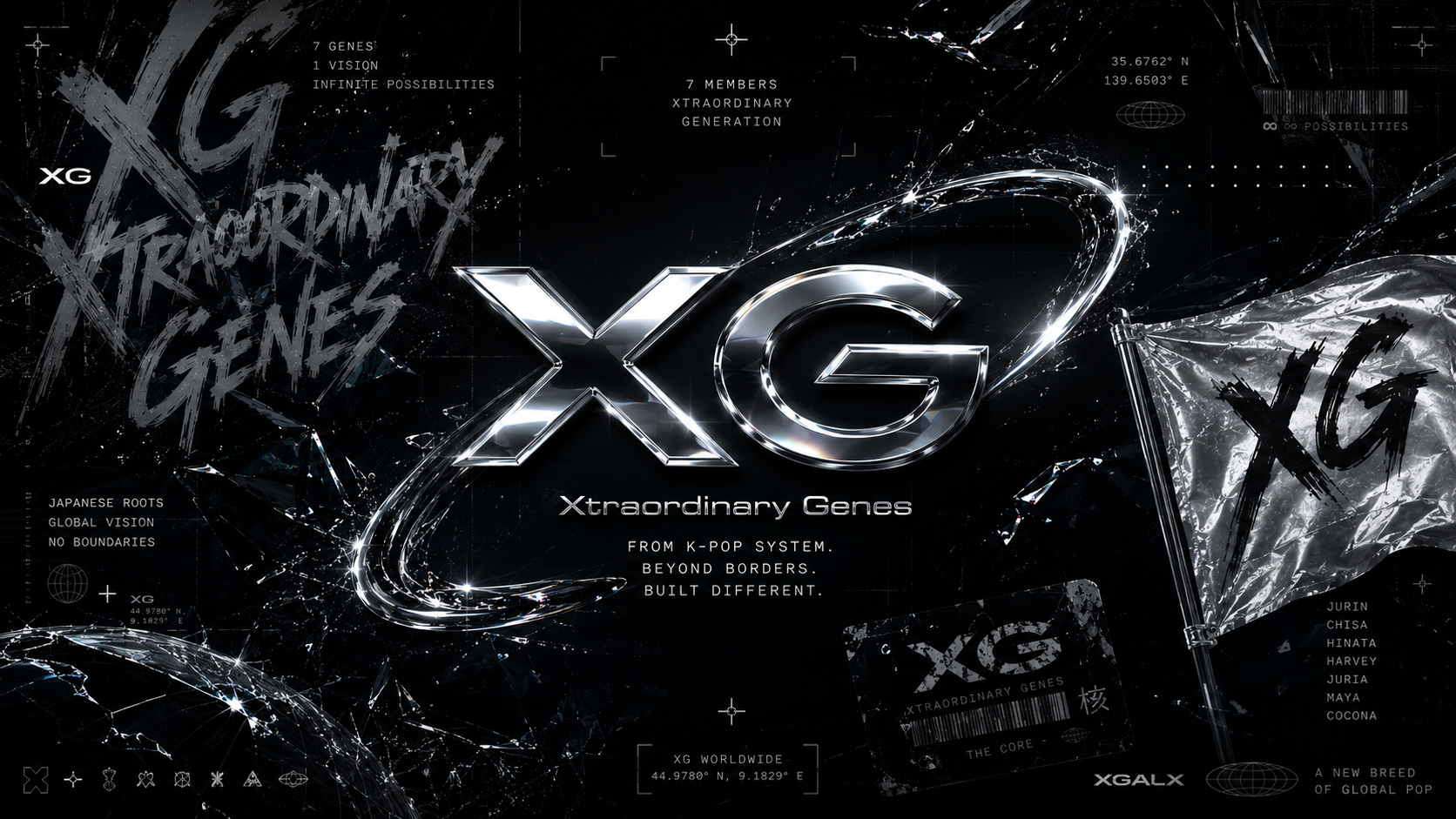
When XG stepped onto the stage at London’s Wembley Stadium for Capital FM’s Summertime Ball on June 6, 2026, they became the first Japanese group in history to perform at the venue. In front of 80,000 people, the moment represented more than another milestone for an Asian girl group. It signaled something larger: a shift in how global pop music is produced, marketed, and understood.
7
Japanese Members
100%
English-Language Title Tracks
Billboard
200 Debut Album
Global
Audience Across Markets
For more than a decade, the international music industry has used “K-pop” as a convenient label for Asian acts emerging from South Korea’s entertainment system. The term came to describe not only a place of origin, but also a specific package of training, performance, visual presentation, and fan engagement.
But what happens when those methods no longer belong exclusively to Korea? That question sits at the center of XG’s rise.
The group’s members are Japanese. Their songs are almost entirely in English. Their audience stretches across North America, Europe, Southeast Asia, and Latin America. Yet nearly every aspect of their development — from performance discipline to visual direction and promotional strategy — was shaped by the Korean idol system.
XG’s significance is not that they rejected K-pop. It is that they extracted its methods from its geography.
Section I
From Genre to Methodology
For years, industry observers treated K-pop as both a musical genre and a national identity. In reality, K-pop’s greatest export may never have been its music. It may have been its production model.
The Korean idol system created one of the most sophisticated artist-development infrastructures in modern entertainment: intensive trainee programs, synchronized performance training, coordinated visual branding, constant digital engagement, and global fan-community building.
As K-pop expanded internationally, entertainment companies increasingly attempted to localize that model. Projects such as KATSEYE, VCHA, and NiziU sought to bring the Korean system into specific domestic markets. Their strategies differed, but the objective was largely the same: use K-pop methods to create local stars.
XG represents a different possibility. Rather than adapting the Korean system to a single market, they largely avoided anchoring themselves to any national identity at all.
The group’s first full-length album, The Core – 核, reached the Billboard 200 in early 2026 and received broad support across Spotify’s global playlist ecosystem. Their project is neither fully Korean, nor traditionally Japanese, nor explicitly American. Instead, it exists in a deliberately global space.
In that sense, XG may be one of the clearest examples yet of what happens when K-pop evolves from a nationality into a methodology.
Section II
The Stateless Pop Group
The most radical thing about XG is not that they are Japanese. It is that nationality rarely functions as the centerpiece of their brand.
Historically, Asian pop exports have been closely tied to national identity. J-pop was Japanese. K-pop was Korean. Mandopop was Chinese-language pop music. XG challenges that framework.
Members
7 Japanese artists
System
Korean idol infrastructure
Language
Overwhelmingly English
The result is a group that feels unusually detached from traditional cultural borders. That does not mean identity disappears. Rather, identity becomes layered and fluid. For younger listeners who move seamlessly between TikTok, Spotify, YouTube, and global fandom communities, nationality often matters less than participation.
The Core Idea
They are not selling a country.
They are selling a system.
Section III
Respect Beyond the Idol Bubble
The challenge for any idol-based act entering Western markets is credibility. Technical excellence alone rarely guarantees acceptance within hip-hop or R&B spaces, where authenticity remains a central value.
This is where XG’s trajectory becomes particularly interesting. Long before major television appearances and festival stages, the group gained attention through performance content such as Galz Xypher, which circulated widely among hip-hop commentators and reaction channels. The response was notable because it emerged from communities that traditionally exist outside the idol ecosystem.
The discussions surrounding cultural appropriation and Black musical influence have not disappeared. Nor should they. Those conversations remain an important part of evaluating how global pop music borrows, transforms, and commercializes cultural forms.
Yet XG has managed to earn recognition from many listeners who might otherwise dismiss idol music entirely. Tracks such as SHOOTING STAR and LEFT RIGHT became breakthrough tracks that introduced the group to listeners well beyond the traditional idol audience, demonstrating a level of genre fluency that resonated with many R&B and hip-hop listeners.
Their success suggests that technical proficiency, artistic commitment, and genre literacy can sometimes open doors that marketing alone cannot.
Section IV
The Blueprint After K-Pop
XG’s growing visibility — from Coachella and American television appearances to Wembley Stadium — matters for reasons beyond the group’s individual achievements. The larger question is what their success represents.
For decades, cultural exports were expected to carry clear national labels. Global audiences consumed American pop, British rock, Korean pop, or Japanese pop. That framework is beginning to blur.
The next generation of global artists may be assembled from multiple systems at once: Korean training, Japanese talent, American songwriting, European production, and worldwide fandom.
Whether XG’s model proves scalable remains an open question. Building a stateless global brand may be easier for a single breakthrough act than for an entire generation of artists.
Still, the experiment matters.
If this future arrives, XG may ultimately be remembered less as an exceptionally successful girl group and more as an early prototype. Their greatest contribution may not be proving that Japanese artists can succeed globally. It may be proving that K-pop itself was never limited to Korea.
Final Thought
What made K-pop powerful was not geography.
It was infrastructure.
And once that infrastructure became exportable, the “K” stopped functioning as a border and started functioning as a blueprint.
XG did not erase K-pop. They demonstrated what happens when its methods become bigger than the place that created them.