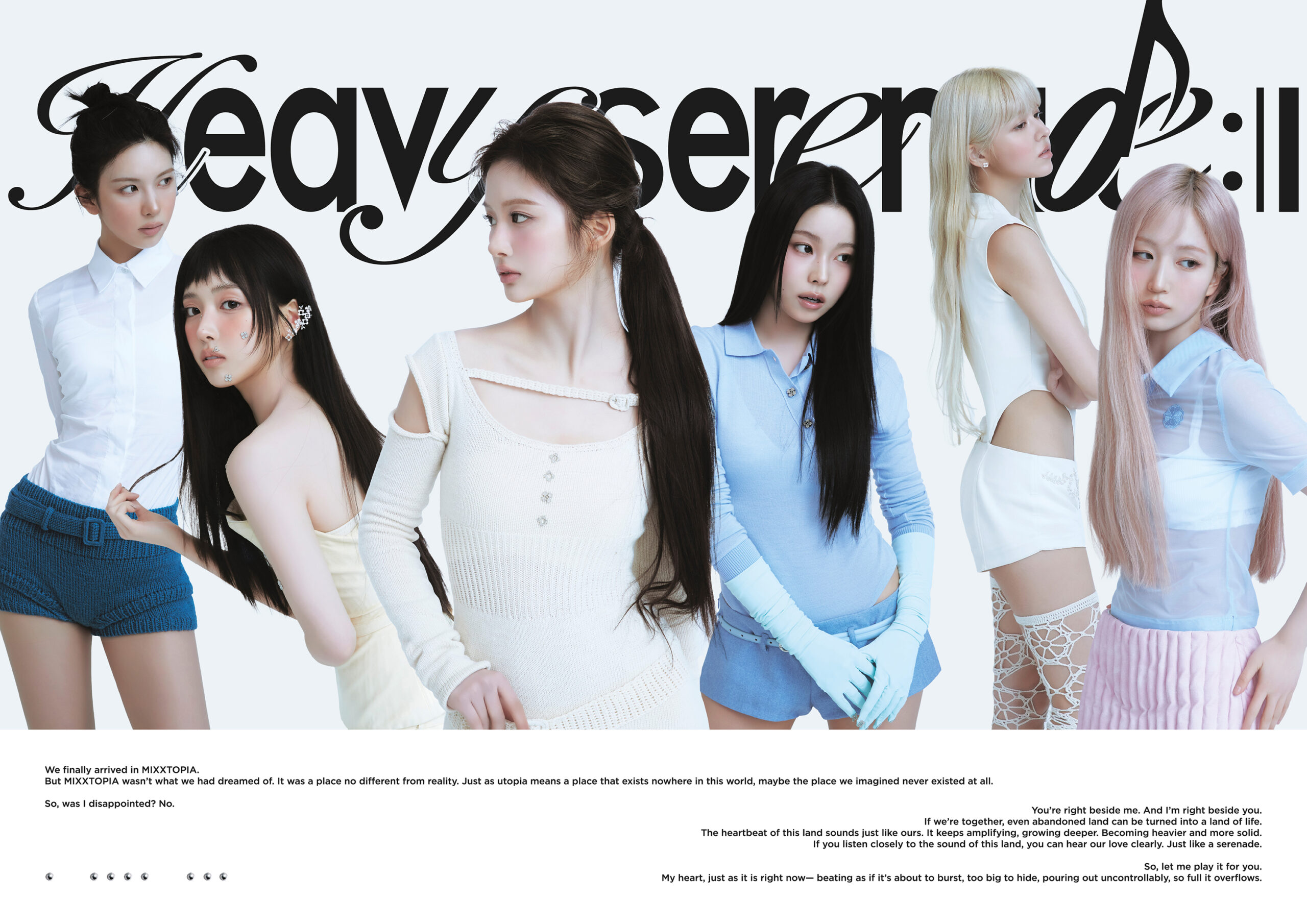
01The Title — Two Words That Contradict Each Other on Purpose
| Title | Heavy Serenade |
| Heavy | Weight, intensity, pressure, overwhelm — something that is too much to hold lightly |
| Serenade | A love song performed beneath a window — traditionally gentle, romantic, tender, quiet |
| Together | A love that is too large to be whispered — a serenade that has become a weight |
A serenade is supposed to be delicate — a soft voice beneath a window at night, asking to be let in. “Heavy Serenade” refuses that delicacy. The modifier “heavy” does not describe the serenade’s volume or its drama; it describes the feeling underneath it. The love being sung about has grown past the point where it can be held gently. It has become something structural, something that presses down.
The title contradiction — heavy + serenade — is also a perfect description of how the song is built musically. It opens with a gentle, floating quality (the serenade) and builds through trance and acid bass lines into a rock-driven, explosive climax (the heavy). The title is not just a description of a feeling. It is a musical map of the song’s structure. NMIXX has always embedded their sonic identity into their titles — “Heavy Serenade” is the most precise example yet.
02Key Lyrics — Korean, Romanization & English Translation
The song moves between English hooks and Korean verses with careful intention. The English passages carry the declaration — the public, outward statement of love. The Korean passages carry the texture of the feeling — the private interior of what it is like to be in it. Below are the five passages that reward closest reading.
The Opening — Where the Song Begins
| Korean | 어린 맘속 헤매던 cosmos 터진 눈물 잃어버린 color |
| Romanization | Eorin mamsok hemaedeon cosmos Teojin nunmul ilheobeolin color |
| English | The cosmos wandering inside a young heart Burst tears, the color that was lost |
헤매던 (hemaedeon) means “wandering” or “lost” — specifically the kind of wandering that is not purposeful but directionless, searching without a destination. Placing this word inside 어린 맘속 (inside a young heart) establishes that the narrator’s starting point is confusion and lostness, not confidence. cosmos here functions both as the flower (a delicate, wild bloom that grows without being cultivated) and as the universe itself — wide, uncontained, overwhelming for a young heart to hold.
The second line is one of the most emotionally precise in the song. 터진 눈물 (teojin nunmul) — burst tears — uses the verb 터지다 (teojida: to burst, to explode, to pop open), which implies tears that couldn’t be held back any longer, not tears that were chosen. And 잃어버린 color — the color that was lost — places those burst tears in the context of something that used to exist and no longer does. The narrator begins the song having already lost something.
The Bouquet Line
| Korean | 날 깨뜨려서 만들래 단 하나뿐인 bouquet |
| Romanization | Nal kkaetteureoseo mandeullae Dan hanabbunin bouquet |
| English | Break me open to make me The one and only bouquet |
깨뜨리다 (kkaetteorida) means to break, to shatter, to crack open — it is a more violent and deliberate verb than simply “breaking.” The narrator is not being worn down gradually; they are being cracked open specifically. And the purpose of being broken is to be made into something: 단 하나뿐인 bouquet — the one and only bouquet. There is only one such arrangement in existence, and the breaking is what creates it.
This is the song’s most compressed emotional image. A bouquet is made by gathering separate things and binding them together — the breaking and the becoming are the same act. The line does not treat being broken as damage. It treats it as transformation: the precondition for becoming irreplaceable.
The phrase 단 하나뿐인 is a Korean intensifier construction that English struggles to replicate directly. 단 (dan) means “only” or “just.” 하나뿐인 (hanaббunin) means “there is only one.” Together, 단 하나뿐인 layers both words onto each other for maximum exclusivity: not just one, not just the only one, but emphatically, undeniably, the singular one. The English translation “one and only” approaches it, but loses the specific Korean emphasis the construction carries.
The Galaxy Invitation
| Korean | 은하수 아래서 take my hands 시들지 않을 꿈에 널 데려가고 있잖아 |
| Romanization | Eunhasu araeseo take my hands Sideulji aneur kkume neol deryeogago itjanha |
| English | Under the Milky Way, take my hands I’m taking you to a dream that will never wither |
은하수 (eunhasu) is the Korean word for the Milky Way — literally “silver river.” Positioning the invitation under the silver river places the moment at a specific scale: not indoors, not intimate, but cosmic. The two people are small beneath something enormous.
The second line carries the song’s most important promise: 시들지 않을 꿈 — a dream that will not wither. 시들다 (sideulda) means to wilt, to fade, to wither — it is the verb used for flowers dying. Using it here, in negative form, creates a direct response to the opening verse’s lost color and burst tears: what was once withering will not wither here. The invitation is not just to a place. It is to a state that reverses what came before.
The Heart That Grew
| Korean | 봄 지나 겨울 와도 다시 피어날 my heart 커진 심장 소릴 들어봐 |
| Romanization | Bom jina gyeoul wado dasi pieonarl my heart Keojin simjang soril deureobwa |
| English | Even if spring passes and winter comes, my heart will bloom again Listen to the sound of the heart that has grown larger |
This is the song’s central declaration — and it is organized around a seasonal metaphor that carries enormous weight in Korean lyrical tradition. 봄 (bom — spring) is the season of blooming; 겨울 (gyeoul — winter) is the season of dormancy and loss. The line does not say the heart will avoid winter. It says: even when winter comes, the heart will bloom again — 다시 피어날 (dasi pieonarl). 다시 means “again,” and 피어나다 means to bloom, to blossom, to open. The blooming is inevitable regardless of the season.
커진 심장 소릴 들어봐 — listen to the sound of the heart that has grown larger. 커지다 (keojida) means to become bigger, to grow in size. The heart has not just survived. It has expanded. The instruction to listen — 들어봐 (deureobwa) — makes the growth audible, physical, undeniable. This is the blooming the title promised.
The Floral Language Revelation
| Korean | 모든 꽃말은 너야 |
| Romanization | Modeun kkotmareun neoya |
| English | Every flower’s meaning is you |
This is the most culturally specific line in the song, and the most quietly devastating. 꽃말 (kkotmal) — literally “flower word” — is the Korean concept of floriography: the language of flowers, where each bloom carries a specific meaning. Red roses mean love; white chrysanthemums mean truth; cosmos mean a maiden’s heart. The practice has deep roots in East Asian literary culture and remains actively used in contemporary Korean expression.
When the song says 모든 꽃말은 너야 — every flower’s meaning is you — it is not using flowers as a decorative metaphor. It is saying: every message that flowers have ever been assigned to carry, every feeling those blooms are meant to communicate, points to you. Love, purity, longing, devotion, hope — all of it is you. The entire language of flowers collapses into one person. That is what the song calls “heavy.”
03NMIXX — Six Members, One Concept, No Fixed Positions
Nicknamed “Haewonce” for her soft but steady live voice. Known for consistent vocal delivery across NMIXX’s demanding genre range. Sixth member revealed pre-debut.
Canadian-Korean member and credited co-writer on the Heavy Serenade EP. Known for her classical vocal training and adaptability across genres. Seventh and final member revealed pre-debut.
Often described as NMIXX’s visual center. Gentle stage presence that contrasts with the group’s more explosive sonic identity. Fourth member revealed via vocal cover of Sunmi’s “Full Moon.”
Only member recruited directly by JYP — scouted in her second year of middle school. Wrote her first lyric for b-side “Different Girl” on this EP. Noted for her low, distinctive vocal color.
Trained in popping and locking since childhood. Known for vocal power and dynamic performance style — “a cute appearance that surprises with powerful output” is how NMIXX fans describe her.
Choreography lead of the group. Began training at age 11. Notes specifically about “Heavy Serenade”: the song “combines explosive motions particularly visible in the final verses.” The climax is built around her.
One of the most structurally unusual aspects of NMIXX is that, by JYP Entertainment’s own description, all six members are considered “aces” — there are no fixed official positions. In most K-pop groups, roles (main vocalist, lead dancer, visual) are assigned and fixed. NMIXX operates differently: each member is expected to be capable across multiple functions, and the group’s songs are written to be performed by an ensemble rather than to foreground individual roles.
This structure is not accidental — it is the performance equivalent of MIXX POP itself. Just as the music blends multiple genres within one song rather than staying in one lane, the group blends multiple capabilities within each member rather than specializing. “Heavy Serenade” demonstrates this in performance: the song’s tonal range — from the floating opening to the rock-driven climax — requires every member to shift register multiple times. It cannot be performed by a traditional distribution of roles.
04Heavy Serenade (EP) — The Album as a Love Letter
Crescendo
Pre-release MV / Alternative pop
Heavy Serenade
Title Track
IDESERVEIT
Self-love theme
Different Girl
BAE’s first self-written lyric
Superior
Member relationships / vocal showcase
LOUD
Album closer / unrestrained declaration
The six tracks on Heavy Serenade follow a deliberate emotional arc that NMIXX describe as “a love letter to fans.” The album moves from “Crescendo” — where love starts small and builds — through expressions of self-love (“IDESERVEIT”), fan appreciation (“Different Girl”), member relationships (“Superior”), and an unrestrained final declaration (“LOUD”). The title track sits at the center of this arc: it is neither the beginning nor the climax, but the song where love is most fully named and examined.
The pre-release track “Crescendo” uses music terminology as metaphor — a crescendo is a musical instruction to grow louder — and establishes the album’s central image: a heart that grows and overflows. “Heavy Serenade” then takes that growing heart and asks what it sounds like when it becomes too full to contain. The album title is both the EP’s name and the answer to the question “Crescendo” raises. The love grew. Now it’s heavy.
BAE’s writing credit on “Different Girl” is significant in context. She described the process as “challenging and nerve-wracking,” and noted that fan reception helped her embrace the personal vulnerabilities expressed in the writing. That the group’s first member-penned lyric on this album is explicitly about personal vulnerability — rather than performance or concept — reflects the direction NMIXX are taking with Heavy Serenade: less armor, more interior.
05MIXX POP & HANRORO — The Sonic Identity Behind the Song
NMIXX’s defining creative concept — MIXX POP — is the practice of blending multiple genres within a single song rather than committing to one. Since their polarizing debut with “O.O” in 2022, this approach has remained the group’s signature, evolving from something audiences found jarring to something critics now describe as “one of the strongest discographies in K-pop.” “Heavy Serenade” represents the concept’s most mature execution.
HANRORO — the songwriter credited with “Heavy Serenade” lyrics — brought a specific approach to the writing: botanical imagery threaded through with emotional precision, classical references (serenade, bouquet, floriography) used not decoratively but structurally. Every flower in the song means something. The cosmos in the opening, the bouquet of the pre-chorus, the blooming of the chorus, the wilting that will not happen, the floral language of the bridge — these are not separate images. They are a single sustained metaphor that carries the song from beginning to end.
HANRORO’s Lyrical Signatures in This Song
| Technique | Example | Effect |
|---|---|---|
| Single sustained metaphor | Flowers / blooming throughout the entire song | Creates thematic coherence; every image points to the same emotional center |
| Classical reference subverted | “Heavy” Serenade — the form made too full | The listener knows what a serenade is, so “heavy” lands as contrast rather than confusion |
| Culturally specific vocabulary | 꽃말 (floriography) — not just “flowers” but the language of flowers | Rewards Korean listeners with a deeper layer of meaning; intrigues international listeners to investigate |
| Emotional reversal structure | Opening: lost color, burst tears → Chorus: blooming, growing heart | The song earns its joy — the joy is not assumed, it is arrived at from a specific starting point of loss |
| Imperative addressed to listener | 커진 심장 소릴 들어봐 (listen to the sound) | Pulls the listener into the song’s body — the heart growing is something to be heard, not just described |
06Key Vocabulary — Words Worth Knowing
| Korean | Romanization | Meaning & Notes |
|---|---|---|
| 헤매다 | hemaeda | To wander, to be lost — directionless movement; the emotional starting point of the song |
| 터지다 | teojida | To burst, to pop open, to explode — used for tears that could not be held back; implies emotional overflow rather than choice |
| 깨뜨리다 | kkaetteorida | To break, to shatter deliberately — the breaking that makes the bouquet; transformation, not damage |
| 단 하나뿐인 | dan hanaббunin | Emphatically singular — “the one and only” but with doubled Korean emphasis; there is and can be only one |
| 은하수 | eunhasu | The Milky Way — literally “silver river”; a cosmic scale setting for the invitation to take hands |
| 시들다 | sideulda | To wilt, to fade, to wither — the verb for dying flowers; used negatively in the song to promise the dream will not wither |
| 꽃말 | kkotmal | Flower language / floriography — literally “flower word”; each flower carries an assigned meaning in Korean and East Asian tradition |
| 피어나다 | pieonaeda | To bloom, to blossom, to open — used in the chorus promise: “my heart will bloom again” regardless of the season |
| 커지다 | keojida | To grow larger, to expand in size — the heart has not just survived; it has become bigger than it was |
The concept of 꽃말 — assigning emotional meanings to specific flowers — has deep roots in East Asian literary culture and remains actively present in contemporary Korean expression. Unlike Western floriography (which peaked in the Victorian era and has largely faded from daily use), 꽃말 is still commonly referenced in Korean pop culture: gift-giving, song lyrics, poetry, and drama dialogue regularly invoke a flower’s assigned meaning rather than just its appearance. When HANRORO writes 모든 꽃말은 너야 — every flower’s meaning is you — Korean listeners immediately understand that this is not decorative. Every message that flowers have ever been given to carry now points to one person. That is an enormous claim. That is the weight in “Heavy Serenade.”
— Why “Heavy Serenade” Is the Right Song for This Moment
“Heavy Serenade” works because it earns what it claims. The song does not begin in joy. It begins in wandering, in lost color, in burst tears — in the specific feeling of a young heart that has been overwhelmed by something it couldn’t hold. And then it moves, carefully, through blooming and growing, until it arrives at the bridge: every flower’s meaning is you.
NMIXX have been described since debut as a group that refuses to stay comfortable — that builds a career on the structural tension between elements that shouldn’t fit together. “Heavy Serenade” is the fullest expression of that refusal. Trance and rock. Floating and crashing. A serenade that became too heavy for its form. And flowers that refused to wither.
The title contradiction is the song’s thesis: love grows until it outweighs the delicate form it was supposed to take. The heart that was lost in a cosmos has grown large enough to be heard. Listen to the sound of it. That is what NMIXX is asking. That is what a heavy serenade sounds like.