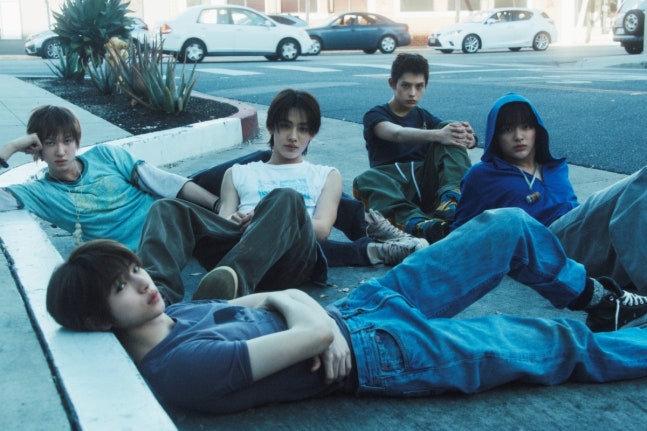
01The Title — A Traffic Light as a Value System
“REDRED” is named for the color it rejects. The song’s entire logic is built around a traffic light metaphor — and every Korean phrase in the song is assigned to one side of that binary. Understanding which behaviors are RED and which are GREEN is understanding the song’s complete philosophical position.
- 팔랑귀Easily swayed by others’ opinions — “flappy ears”
- 눈치나 살피기Constantly reading the room / worrying about social perception
- 도가니 사리기Playing it safe / self-protecting to avoid controversy
- 궁뎅이 가리기Covering your behind / hedging all actions
- 주변을 살피기Constantly checking surroundings for approval
- 쿨한 척 척하기Pretending to be cool without actually being it
- 차갑게 방치된 cityA city left cold and neglected — creative stagnation
- 먼지가 쌓인 그 CDThe CD collecting dust — music no one plays, art abandoned
- 신호등 바뀌었어The light changed — momentum, forward motion
- 넘어가 울타리Clear the fence / go beyond the boundary
- 내 팀과 함께With the team — collective energy, not solo posturing
- 거리로 나가서Going out into the streets — public, visible, unafraid
- studio로 돌아가Back to the studio — creation as the destination
- 홀린 듯이 만들던 tracksMaking tracks as if possessed — instinctive, driven creation
The title “REDRED” does not celebrate red. It names what must be recognized and rejected. The doubling — REDRED, not simply “red” — amplifies the refusal: not just once, but twice, emphatically. Every time the chorus lands on “that’s red-red,” it is a diagnosis, not a celebration. This is the behavior that stops you. Name it. Leave it behind.
The song title is also the first half of a two-part EP concept. “REDRED” (April 20 pre-release) names the obstacles. “GREENGREEN” (the album, May 4) is the state on the other side of clearing them. You cannot understand what green means without first understanding what red is. The pre-release single is the diagnostic; the album is the prescription. Listening in sequence — REDRED first, then the full GREENGREEN album — is the intended experience.
02Key Lyrics — Korean, Romanization & English Translation
The song code-switches fluidly between Korean and English, but unlike many bilingual K-pop tracks, the Korean lines here are not emotional interior — they are the most specific and culturally dense content in the song. The English sections provide the energy and the hooks. The Korean sections provide the precise vocabulary of what the group is rejecting. Below are five passages that most reward close reading.
The Opening — A Night That Belongs to the Team
| Korean | 어젯밤에 만들던 beat 내 폰에다 담아서 거리로 나가서 다섯이 고개를 빙빙 |
| Romanization | Eojetbame mandeuldeon bit nae pone da damaso Georiro nagaseo daseos-i gogaereul bingbing |
| English | The beat I was making last night, saved on my phone — heading out into the streets, all five of us nodding our heads |
The opening establishes the song’s physical world with precise detail: a beat made the night before, stored on a phone, taken out into the streets. The specificity matters — this is not a grand creative statement but a completely ordinary moment: five people leaving somewhere with something they made, heads already nodding to it. 다섯이 (daseos-i — all five of us) is the number that carries weight throughout the song. The team is always exactly five. The number is not incidental.
The Red Behaviors — Korean Idioms Under the Microscope
팔랑귀 팔랑귀
눈치나 살피기
도가니 사리기
쿨한 척 척하기
눈치 is one of the most discussed concepts in Korean social psychology — the ability to read unstated expectations, to sense the emotional atmosphere of a room, and to calibrate behavior accordingly. It is generally considered a social virtue: high 눈치 makes you a thoughtful, considerate person. The song’s choice to call it red — to list 눈치 살피기 alongside flattery and posturing as something to reject — is a culturally specific provocation. CORTIS is not saying social awareness is bad. They are saying that when awareness of others’ reactions starts to govern creative decisions, it becomes a cage. In the context of the K-pop industry — where groups are intensely managed for public perception — naming 눈치 as red is a statement about creative independence.
The Possessed State — Creation Without Self-Consciousness
| Korean | They called me a freak 홀린 듯이, yeah 만들던 tracks, yeah 듣고 모인 friends, yeah 하루가 갈수록 늘어가 pack |
| Romanization | Hollin deusi yeah mandeuldeon tracks yeah deutgo moin friends yeah haru-ga galssurok neureo-ga pack |
| English | They called me a freak / making tracks as if possessed, yeah / friends who gathered after hearing it, yeah / the pack grows bigger every day |
홀린 듯이 (hollin deusi) — “as if possessed” or “as if bewitched.” 홀리다 describes the state of being completely taken over by something, unable to stop, acting beyond normal volition. The creative ideal described here is not discipline or craft — it is compulsion. Making tracks because you cannot not make them. The word “freak” — offered as an insult, accepted as a compliment — is the English equivalent: someone whose drive looks excessive from the outside precisely because it is genuine from the inside.
The Static City — What Happens When Red Wins
| Korean | 차갑게 방치된 city 먼지가 쌓인 그 CD 정숙한 무대는 시시해 |
| Romanization | Chagapge bangchidoen city Meonjiga ssain geu CD Jeongsukan mudaeneun sisihae |
| English | A city left cold and neglected / the CD with dust collecting on it / a quiet stage is boring |
This verse visualizes what a fully red world looks like. 차갑게 방치된 (chagapge bangchidoen — coldly neglected, abandoned) describes a city that has been left to grow cold — not destroyed, not dramatic, just abandoned. 먼지가 쌓인 그 CD — the CD with dust on it — is a specific and devastating image: music that no one plays, art that was made but never heard, creative work that stopped circulating. And 정숙한 무대 (jeongsukan mudae — a quiet, well-behaved stage) is directly called 시시해 (sisihae — boring, dull, pointless). The well-behaved performance — the one that doesn’t challenge or risk — is exactly what the group refuses to give.
03CORTIS — Big Hit’s Third Group and What That Means
Described as a natural vocalist since childhood. Led LA songwriting sessions: “We felt really driven to meet that level of quality.” His performance standard — flawless live vocals through demanding choreography — defined CORTIS’s debut reputation.
Former member of pre-debut group Trainee A. Led the sonic shift for GREENGREEN: “We wanted to explore new textures in terms of sound and bring out more raw feel — instruments and rhythms we haven’t used before.” Made six or seven versions before the final.
Known for vocal color and cover performance praised during training. His tone anchors CORTIS’s mid-range in ensemble passages. At the first music show #1 win, shed tears alongside teammates before delivering an encore with full vocal control.
Praised for performance precision and vocal color throughout training. Part of CORTIS’s choreography-as-statement identity — the group’s kalgun-mu (synchronized precision dance) is described as their visual signature from debut.
Freestyled with teammates as standard training practice. His rap delivery in “REDRED” carries the most culturally loaded Korean idioms — 팔랑귀, 도가니 사리기 — with a specificity that suggests personal familiarity with the behaviors being rejected.
Big Hit’s third group after BTS (2013) and TXT (2019) — each debut exactly 6 years apart. First Big Hit act to debut after the company’s corporate split from HYBE. All members credited on REDRED alongside LA-based external producers.
The Big Hit lineage is not background noise. It is the specific pressure that makes “REDRED” legible as a statement. BTS and TXT both operated under the weight of enormous expectation — the “BTS younger brothers” label followed both groups from announcement to debut. CORTIS is the third group in that line, and “REDRED” is explicitly a song about refusing to let expectation govern creative output.
That all five members are credited on the track is significant in the same way 3RACHA’s KOMCA credits are significant for Stray Kids: it means the group’s stated identity as creators — not just performers — is a verifiable fact, not a marketing position. The song about creative autonomy was written by the people performing it.
BTS debuted in 2013. TXT debuted in 2019 — six years later. CORTIS debuted in August 2025 — six years after TXT, almost to the month. The consistent interval is noted by Korean music industry observers as deliberate: Big Hit takes the time to build properly rather than rushing new acts into a crowded market. CORTIS is also the first group to debut after Big Hit Music’s structural separation from the wider HYBE umbrella — making them, in a very specific sense, the first act shaped entirely by the post-consolidation version of the company. “Color Outside the Lines” (debut EP, 2025) and “GREENGREEN” (second EP, 2026) are both building a creative identity independent of their label lineage. “REDRED” names what independence requires you to leave behind.
04GREENGREEN — What the Album Adds to the Song
Grand Slam — all 5 music shows May 2026
Billboard 200 — debut EP (2nd highest K-pop debut ever)
All members credited on REDRED
TNT
REDRED
Title Track
ACAI
YOUNGCREATORCREW
Wassup
Blue Lips
The EP opens with TNT before landing on REDRED as the title track — meaning the album begins with explosive energy and then immediately explains where that energy comes from. YOUNGCREATORCREW (Track 04) states the group’s identity in its title alone: young, creative, collective. ACAI, Wassup, and Blue Lips fill in the sonic range of what “green” actually sounds and feels like across six tracks — instinctive, unguarded, alive.
The decision to have all five members involved in songwriting, choreography, and visual direction across the EP is described in interviews as the group’s most deliberate creative step since debut. James described the GREENGREEN sessions: “We went to LA, worked with very famous producers — and we felt really driven to meet that level. More than anything, we just really wanted to do well. So we learned a lot, and we tried to stay actively involved.” Staying actively involved, rather than receiving a delivered product, is itself the green behavior the song describes.
Featured Album
CRAVITY — CORTEZ GREENGREEN STREET ver.
CRAVITY · Audio CD · Available on Amazon
05The Songwriting — What Makes “REDRED” Work
“REDRED” is structurally unusual for a K-pop lead single in one specific way: its hook is not a feeling or a desire but a classification system. Most choruses make you feel something. This one teaches you to recognize something. Every time “that’s red-red” lands, it is labeling a behavior — and asking the listener to do the same work of recognition.
The Diagnostic Hook
The song’s main hook is a repeated call-and-response: a behavior is named in Korean, then classified in English — “that’s red-red.” The structure is deliberately pedagogical. By the third repetition of the chorus, the listener has internalized the red list. They are no longer just hearing a song — they are running a checklist. This is a significant structural choice: it asks the listener to participate in the song’s argument rather than simply receive it.
Code-Switching as Precision Tool
Unlike AKMU’s use of Korean for emotional interior and English for outward declaration, or Stray Kids’ use of Korean for introspection and English for kinetic energy, CORTIS’s code-switching in “REDRED” operates on a different axis: Korean carries the specific cultural vocabulary of what must be rejected (the idioms that name precisely the social behaviors being targeted), while English carries the verdict and the energy. The Korean is the diagnosis; the English is the ruling.
The Team as Subject
Most K-pop songs about creative identity are written in the first person singular. “REDRED” is consistently plural: 다섯이 (all five of us), 내 친구들 (my friends), 내 팀 (my team). The creative unit being described is not an individual genius but a collective — five people who go out together, come back together, cook up together. The song’s vision of creativity is inherently social. Green is not a solo destination. You get there as a pack.
| Technique | Example in “REDRED” | Effect |
|---|---|---|
| Diagnostic hook structure | [Korean behavior] → “that’s red-red” | Listener learns to classify behaviors, not just feel an emotion |
| Korean for cultural specificity | 팔랑귀, 눈치 살피기, 도가니 사리기 | Each idiom names a behavior with a precision English can’t replicate |
| English for verdict / energy | “that’s red-red” / “You should come mess with the team” | Bilingual structure separates diagnosis (Korean) from ruling (English) |
| Collective subject throughout | 다섯이, 내 팀, 내 친구들 | Creative identity is team-based, not individualist — green is plural |
| 홀린 듯이 as creative ideal | “making tracks as if possessed” | Compulsion over discipline; creation as instinct, not performance |
06Key Vocabulary — Words Worth Knowing
| Korean | Romanization | Meaning & Notes |
|---|---|---|
| 팔랑귀 | pallanggwi | Flappy ears — idiom for someone easily swayed by whatever they last heard; no fixed convictions |
| 눈치 | nunchi | Social awareness / reading the room — a Korean virtue turned liability when it governs creative decisions |
| 도가니 사리기 | dogani sarigi | Playing it safe / self-protecting — coiling inward to avoid exposure or controversy |
| 쿨한 척하기 | kulhan cheokhagi | Pretending to be cool — performing authenticity rather than having it |
| 넘어가 울타리 | neomeo-ga ultari | Clear the fence / go beyond the boundary — the green action that counters all the red behaviors |
| 홀린 듯이 | hollin deusi | As if possessed / bewitched — the state of creating beyond normal volition; compulsion as creative ideal |
| 방치된 | bangchidoen | Neglected / abandoned — used to describe the cold city that results when red wins; creative stagnation |
| 정숙한 | jeongsukan | Quiet / well-behaved / decorous — the kind of stage CORTIS explicitly calls boring (시시해) |
| 다섯이 | daseos-i | All five of us — the number that recurs throughout; green is always collective, never solo |
팔랑귀 — literally “flappy ears” — is one of those Korean idioms that sounds almost cartoonish in translation but carries real cultural weight. It describes someone whose opinions and decisions flap in the wind of whoever spoke to them most recently: no internal compass, no fixed creative direction, perpetually shaped by outside input. In the context of K-pop — where groups receive intense feedback from companies, producers, fans, critics, and algorithms simultaneously — 팔랑귀 is a specific and recognizable trap. Every creative decision can become a negotiation with external voices. The song opens with this idiom because it names the first and most fundamental failure mode: listening to everyone else so much that your own voice disappears. The traffic light turns red the moment the ears start flapping.
— Why “REDRED” Works as an Argument, Not Just a Song
“REDRED” succeeds because it trusts its metaphor completely. The traffic light system is simple enough to internalize in one listen and specific enough to mean something real. By the time the chorus has repeated four times, the listener is not just enjoying a song — they are running a behavioral checklist. They are asking themselves: am I팔랑귀? Do I 눈치 살피기 at the cost of moving forward? Is my stage 정숙한 when it should be alive?
The song was written by the five people performing it — five members of a group that entered an industry carrying the weight of being called “BTS and TXT’s younger brothers” from the day their existence was announced. “REDRED” is, among other things, a declaration that they know what that pressure sounds like, they can name it precisely in Korean, and they have chosen not to let it govern them.
They go out into the streets with a beat on their phone. All five of them nodding. They turn the signal green and they go. That is what the song is saying. That is what a Grand Slam sounds like when it means something.